








Aaron Industries EVOQ360 fits homes without shaft or pit
MAX Plan at ₹4,999/yr

Find your next multibaggerBe a Pro Investor
Research stocks and track your picks on the go. Download the app.
Key highlights
- Aaron says EVOQ360 needs a 4-foot-by-4-foot area for a three- or four-passenger home lift.
- Aaron supplied 19 EVOQ360 projects in the second quarter, generating about Rs 1.2 crore of revenue.
- Aaron disclosed 60 confirmed EVOQ360 advance orders from 18 parties for phased dispatch through December 2026.
- Aaron is targeting fulfilment of 150 EVOQ360 units in the current financial year.
powered by IRIS
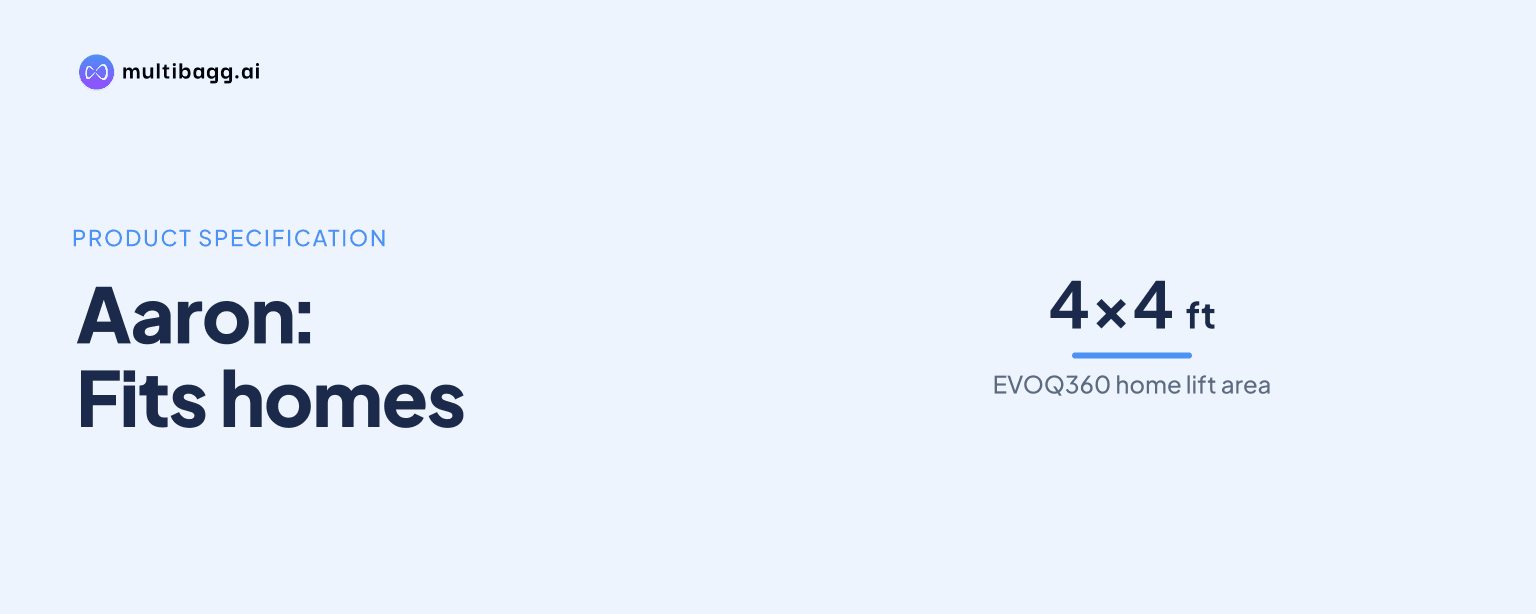
Aaron Industries says its EVOQ360 home-lift system can be added to an existing residence with a 4-foot-by-4-foot blank space, without a reinforced cement concrete, or RCC, shaft, pit, overhead provision or machine room. The company supplied 19 EVOQ360 projects in the second quarter, producing about Rs 1.2 crore of revenue.
Know Aaron Industries inside out
Results, valuation, peers and who's buying, in one view.
Can Aaron EVOQ360 be installed in an existing home?
Yes, Aaron says EVOQ360 can be installed in an existing home if the homeowner has a suitable blank space, even where a lift was not planned during construction. Management said the solution is intended for homes whose civil work has already been completed but where no lift shaft had been planned, although it noted that some completed residential projects may not be suitable for EVOQ360.
The stated requirement is a 4-foot-by-4-foot area for a three-passenger or four-passenger lift. Aaron said the system does not require an RCC shaft, a pit, additional overhead space or a machine room. That configuration is the basis of the product proposition for residences that were built without conventional lift infrastructure.
Management described EVOQ360 as a response to rising home-lift demand in Tier 2 and Tier 3 cities. It said elevators are increasingly being planned in G+1 and G+3 buildings, while standard elevator products face some price constraints and competition. Aaron’s stated approach is to differentiate through value-added solutions rather than rely only on standard products.
What makes EVOQ360 different from a conventional lift installation?
EVOQ360 differs from a conventional installation because Aaron says it can operate without the shaft, pit, overhead and machine-room requirements it identified for its 4-foot-by-4-foot home-lift format. This can allow a homeowner to consider a lift after the construction phase, provided the property has an appropriate unused area.
The company did not say that every existing building qualifies. Management specifically said certain residential projects with completed civil work are not suitable, while projects lacking a planned shaft can “definitely” use EVOQ360. The distinction matters because the product’s addressable market, based on the call, depends on each building’s available space and project conditions rather than simply whether a home is old or new.
Aaron has positioned the product through elevator-company partners rather than direct project execution. It supplies the EVOQ360 material to elevator companies, which carry out installations at project sites. Management said it is developing different partner types for complete installation while Aaron remains focused on manufacturing rather than directly participating in installations or project services.
How much EVOQ360 revenue did Aaron report in the second quarter?
Aaron reported about Rs 1.2 crore of EVOQ360 revenue from 19 projects supplied in the second quarter, and about Rs 2 crore dispatched in the first half. The half-year amount was therefore higher than the second-quarter contribution, reflecting earlier dispatches as well as the 19 projects reported for the quarter.
Management said the previous six months had functioned as a pilot period for elevator companies. It said partners had completed multiple projects and had been able to assess the product’s performance and benefits, which had increased their confidence. Aaron did not disclose a unit-wise revenue figure for the full half year beyond the approximate Rs 2 crore dispatch value.
Aaron said EVOQ360 was delivering the 20% to 25% margin range referenced by a caller at current volumes. Management further said it expected the margin to be sustainable and potentially move towards 25% as volumes increase, but this was management’s expectation rather than a quantified forecast for a specified period.
Got a follow-up? Ask IRIS
What orders and distribution plans does Aaron have for EVOQ360?
Aaron said it had 60 confirmed advance orders from 18 parties, expected to be dispatched in phases by December 2026, subject to potential project delays. Management said delays could affect about 5% to 10% of projects at most, while the remainder were expected to be completed within that timetable.
The company also said it had signed exclusive distributorship arrangements with five distributors, whose partners contributed the 60-unit order book. Orders will not necessarily refill on a standard recurring cycle because EVOQ360 orders are processed project by project. Still, management said all these partners were producing orders and that additional customers were interested in becoming product partners.
A September 2026 partners’ conclave in Rajkot generated interest in the product, according to management. Aaron said Gulf Elevators signed a contract for 30 lifts within the current financial year following the event, and two or three other parties from the conclave were interested in similar contracts. Management plans to hold multiple partner conclaves in other territories to support EVOQ360 distribution.
The company’s target is to fulfil 150 EVOQ360 units in the current financial year. That target is separate from the 60 confirmed advance orders disclosed in the presentation discussion, and it depends on project-level demand and installation partners. Aaron said monthly project supplies would increase, but did not provide a monthly unit target or a projected revenue value for the 150 units.
How does EVOQ360 fit into Aaron’s wider growth plan?
EVOQ360 is one part of Aaron’s plan to grow through higher-value elevator and steel products, alongside embossed, physical vapour deposition, or PVD, and decorative sheets. Management said embossed sheets made a major contribution to visible growth in the steel division and that it was adding customers with recurring demand for the product.
For the wider business, management is targeting revenue above Rs 150 crore by financial year 2028, with current capacity described as supporting Rs 180 crore to Rs 200 crore. It said it was focusing on crossing Rs 150 crore to Rs 160 crore by 2028 and was also exploring new capacity avenues and product lines for a further jump by 2030.
The company said first-half growth was 24%, compared with 18% in the prior year cited by an analyst on the call. Management attributed slower order lead times to several conditions mentioned during the discussion, while saying it hoped for improved figures in the third and fourth quarters. Separately, it said its gross margin had moved to 36% from 37% in the quarter, versus a prior best of 38%, and expected the current level to remain stable this year.
Conclusion
Aaron’s core EVOQ360 proposition is that a homeowner with a 4-foot-by-4-foot blank space may add a three- or four-passenger lift without the RCC shaft, pit, overhead provision or machine room that management said are unnecessary for this design. The reported commercial evidence is still early: 19 second-quarter projects produced about Rs 1.2 crore, while first-half dispatches were about Rs 2 crore.
The next disclosed milestones are the phased dispatch of 60 confirmed units from 18 parties by December 2026, allowing for a possible 5% to 10% project delay, and management’s target to fulfil 150 EVOQ360 units in the current financial year. Investors can also watch whether new partner conclaves produce contracts comparable to Gulf Elevators’ 30-lift agreement and whether increasing volumes support management’s stated 20% to 25% EVOQ360 margin range.

