










Aarti Maintained Energy Spreads Through Second-Quarter Crude Rally
Key highlights
- Aarti said energy spreads were maintained in the second quarter after gasoline-naphtha cracks exceeded $20 per barrel in the prior quarter.
- Aarti typically has Rs 800 crore to Rs 1,000 crore of inventory in transit, with margin recognised upon customer delivery.
- Aarti reported about Rs 500 crore of trading activity in the first half to develop markets for expanded capacity.
- Aarti expects to implement selected energy feedstock initiatives within the next three to four months.
powered by IRIS
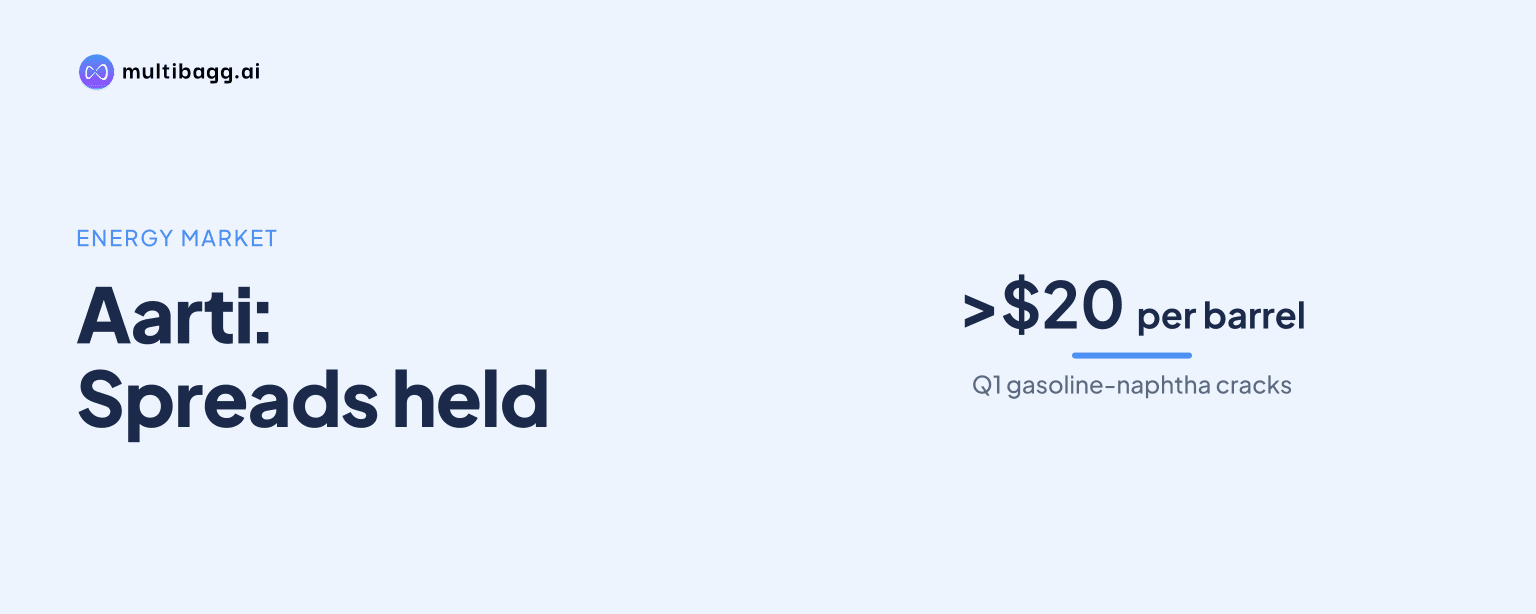
In the second quarter, Aarti Industries Limited maintained energy-portfolio spreads despite crude-linked input inflation; management cited a gasoline-naphtha crack above $20 per barrel in the prior quarter, while warning that imported aniline availability and octane-booster affordability could affect the business.
Know Aarti Industries inside out
Results, valuation, peers and who's buying, in one view.
How did Aarti maintain energy spreads during the crude rally?
Aarti maintained, rather than expanded, its energy-portfolio spreads in the second quarter. Management said the gasoline-naphtha crack had been robust at more than $20 per barrel in the preceding quarter and that demand remained robust, helping the company preserve spreads despite an inflationary raw-material environment.
Aarti assesses the business through volume growth, absolute contribution margin and earnings before interest, tax, depreciation and amortisation, or EBITDA, rather than percentage margins. Management said more than two-thirds of the portfolio operates on pass-through arrangements that protect an absolute rupee contribution, but not necessarily the margin percentage when raw-material prices raise revenue.
The distinction affects reported gross margins because Aarti typically has Rs 800 crore to Rs 1,000 crore of inventory in transit at a given time. Margin on that material reaches the profit and loss account only when goods are delivered to customers, so inventory timing and higher input values can alter quarterly gross-margin percentages without indicating a change in per-unit spread.
The outcome differed across value chains. Aarti said sulfur-price inflation significantly compressed spreads in the acid chain because costs could not be fully passed through, while agricultural-chemical intermediate prices can take three to four months to catch up with input costs. By contrast, management said it had maintained per-kilogram spreads across almost two-thirds of the overall portfolio.
What drove Aarti's energy revenue growth in the second quarter?
Aarti's energy revenue growth came from both higher volumes and higher realizations, with calcium chloride, fuel additives and stronger domestic demand contributing. An analyst described the segment's revenue increase as nearly twofold, and management said two products were now contributing significantly to the energy portfolio.
Calcium chloride contributed higher volume and revenue after the Zone IV commissioning, and management said its price increase had been significant. The calcium chloride plant exceeded design capacity within three months of commissioning, while the PEDA plant reached design capacity and design norms within two months, providing management confidence in the ramp-up of later Zone IV products when demand supports it.
Domestic demand for fuel additives also increased, and some volumes that would otherwise have been exported were sold in India. Reported revenue growth included about Rs 500 crore of trading activity in the first half, undertaken to build markets ahead of expanded capacity; management said this trading activity was partly responsible for the margin outcome.
Got a follow-up? Ask IRIS
Where does Aarti face feedstock risk in energy products?
Aarti's main feedstock constraint is aniline, where management said it had faced difficulty securing enough volume to run its assets at full capacity. India imports both aniline and methanol, leaving Aarti dependent on overseas supply for two inputs relevant to its energy value chain.
Methanol availability has not been a volume challenge, as Aarti said it has generally sourced the quantities it needs. Its price remains volatile because the Middle East is a major supply region. Aniline is more constrained because Aarti depends substantially on China, although supply from Europe has started to arrive and management said it has not always secured the required volumes.
Aarti said it is among India's largest merchant buyers of aniline for non-methylene diphenyl diisocyanate, or non-MDI, use and has begun discussions with multiple global producers. Management expects sourcing to become more streamlined as its volumes stabilise, but did not disclose a supply agreement, minimum volume or pricing arrangement.
The company is also exploring energy-value-chain integration, ranging from strategic partnerships to manufacturing some inputs itself. Management said the initiatives remained exploratory and that it expected to implement selected measures in the next three to four months to strengthen the value chain and its margin profile, without identifying an investment amount, partner or feedstock project.
How sensitive is Aarti's MMA business to end-market cracks?
Aarti said its methyl methacrylate, or MMA, business is significantly sensitive to end-market affordability. Management identified the affordability of octane boosters, which is linked to end-market cracks, as the biggest driver of that business segment, meaning a crack reversal can affect customer demand even if Aarti's own capacity is available.
Competition has not disappeared: management said some competitors have increased capacity, while Aarti has also expanded and placed its additional output despite that competition. It characterised MMA as still being in a business-development phase, with potential demand yet to be developed, and did not disclose how much volume is covered by term contracts compared with spot sales.
Aarti's current plan is to stabilise existing MMA capacity at a higher annual-average utilisation rather than pursue a large new capacity programme. Management said it could use preferential raw-material arrangements, downstream integration and a broader energy-product portfolio to improve earnings stability, while pursuing fuel-additive, DCB and NCB expansions through limited brownfield spending or debottlenecking rather than greenfield projects.
Conclusion
Aarti's second-quarter energy performance was not presented by management as a windfall from wider spreads. It said spreads were maintained through an inflationary environment supported by robust demand and a prior-quarter gasoline-naphtha crack above $20 per barrel, while revenue also reflected calcium chloride ramp-up, domestic fuel-additive demand and about Rs 500 crore of first-half trading activity.
The next indicators are whether Aarti implements selected feedstock initiatives within the stated three to four months, whether aniline sourcing enables fuller utilisation, and how end-market cracks affect octane-booster affordability. Management's disclosed operating plan is to raise annual-average utilisation of existing MMA capacity and improve stability across the wider energy value chain.