










Aarti keeps inventory risk despite 55-60 working-capital days
Key highlights
- Aarti said it optimized working capital to 55-60 days in Q2 FY27.
- Aarti’s net debt exceeded Rs 4,650 crore after two quarters of higher raw-material-driven working-capital needs.
- Aarti’s Q2 FY27 revenue rose 73% year on year to Rs 3,887 crore and EBITDA rose 44% to Rs 418 crore.
- Aarti said inventory and foreign-exchange effects combined were roughly Rs 50 crore to Rs 60 crore in Q1 FY27.
powered by IRIS
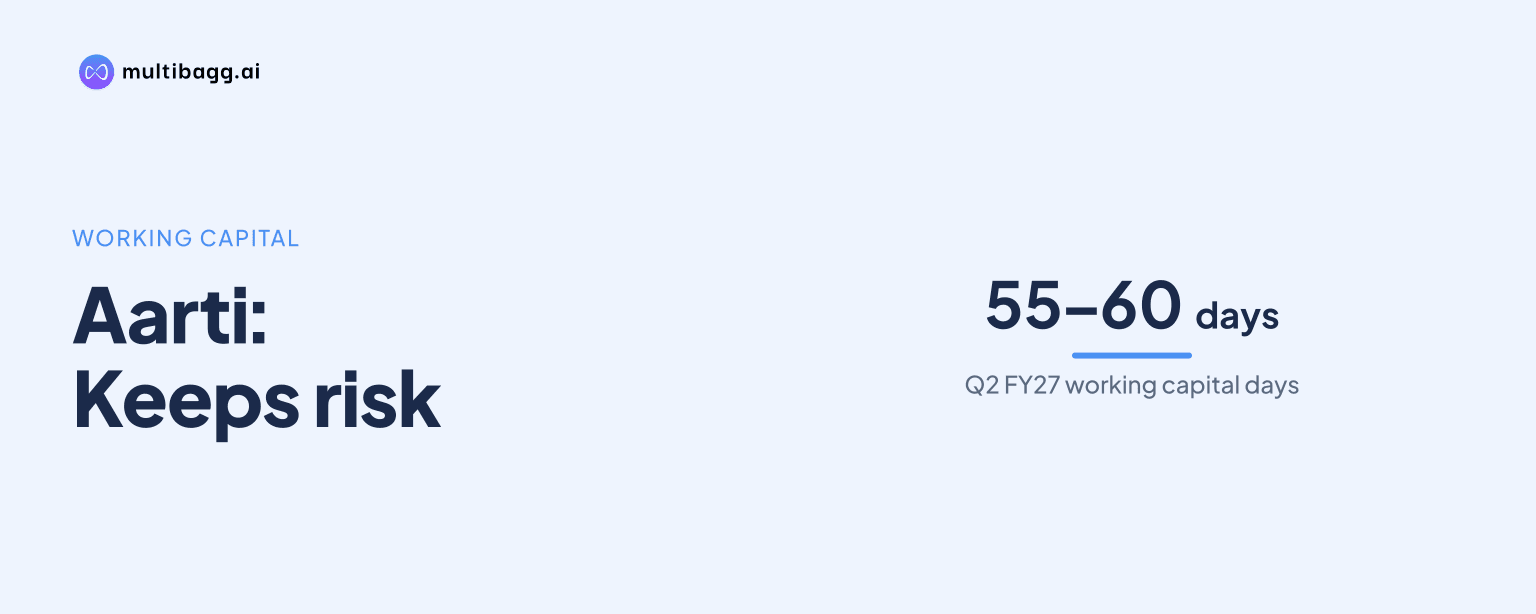
In Q2 FY27, Aarti said it had reduced working-capital days to 55-60, but inventory-loss risk remained because a reversal in global crude prices can affect its import- and export-heavy business. The financial exposure is material: elevated raw-material prices had pushed Aarti’s net debt above Rs 4,650 crore over the preceding two quarters.
Know Aarti Industries inside out
Results, valuation, peers and who's buying, in one view.
How did Aarti bring working capital to 55-60 days?
Aarti said it had practically optimized working capital to 55-60 days by operating with the minimum possible inventory. Management described this as the optimum level at which Aarti could operate. It distinguished between higher rupee values of working capital, caused by inflation in raw-material prices, and physical inventory volumes, which it said were running tight.
The higher value of inventory and receivables still increased funding needs. Aarti said elevated raw-material prices stretched working-capital requirements over the past two quarters, taking net debt above Rs 4,650 crore and increasing finance costs. This occurred as Q2 FY27 revenue rose 73% year on year to Rs 3,887 crore, driven by volume gains and pass-through of elevated input prices.
Profit also rose, but at a slower rate than revenue. Q2 FY27 earnings before interest, tax, depreciation and amortisation, or EBITDA, increased 44% year on year to Rs 418 crore, while H1 FY27 EBITDA rose more than 58% to more than Rs 802 crore from Rs 507 crore in H1 FY26. The comparison indicates that higher prices increased sales values and cash requirements even where input costs could be passed through.
Aarti has approved a potential balance-sheet response. Its board approved an enabling resolution on October 1, 2026, to raise up to Rs 1,000 crore through one or more avenues, and shareholders approved it at the October 31, 2026 extraordinary general meeting. Management said the intended uses were deleveraging, strengthening its financial position and maintaining flexibility for growth initiatives beyond FY28 and FY29.
Why cannot Aarti fully avoid inventory losses?
Aarti said it cannot fully eliminate inventory-loss risk because its significant import and export exposure leaves some exposure when raw-material prices reverse. Management specifically identified a major correction in global crude-oil prices as a factor to watch in H2 FY27. Material procured at elevated prices can lose value before the related selling price is realised.
Aarti’s main mitigation is forward booking of product contracts. Management said it aims, wherever possible, to book product sales after it has booked raw materials, so that input-price changes are passed on to customers. This links purchased material to a customer commitment, but management said the approach cannot remove all exposure across an import- and export-heavy operation.
The call did not provide a standalone inventory gain or loss for H1 FY27. For Q1 FY27, management had indicated inventory and foreign-exchange effects of roughly Rs 50 crore to Rs 60 crore combined, and the finance team said there was no significant improvement in Q2. That disclosure combines two factors, so it does not establish the separate profit-and-loss effect of inventory movements.
Got a follow-up? Ask IRIS
Which pricing mechanisms affect Aarti’s exposure?
Aarti said more than two-thirds of its portfolio operates on an absolute-rupee pass-through basis. Under this mechanism, the contribution per product is generally protected even when raw-material inflation reduces percentage margins. In Q2 FY27, management said it maintained energy-segment spreads despite the inflationary input environment, rather than expanding them.
Pass-through timing differs by value chain. Aarti said many agrochemical contracts are quarterly, creating about a one-quarter lag before raw-material inflation is reflected in selling prices. Management said this can pressure spreads in agrochemical intermediates for around three to four months, even though prices generally catch up after that lag.
Some value chains have had less complete pass-through. Aarti cited the acid value chain, where higher sulphur prices could not be fully passed on and spreads compressed significantly. By comparison, management said the non-carbon black, or NCB, chain had performed above its original spread assumptions, partly offsetting delayed Zone IV progress in its planning.
Material in transit adds another timing issue. Aarti said it typically has Rs 800 crore to Rs 1,000 crore of inventory on the water at a given time, with margins reaching the profit and loss account only when material is delivered to customers. This can make reported gross-margin percentages sensitive to price changes even when absolute contribution is protected through contracts.
What could change Aarti’s risk in H2 FY27?
Aarti said Q2 FY27 received a substantial lift from the energy portfolio, linked to strong refining margins and gasoline-naphtha cracks. Management said the gasoline-naphtha crack exceeded US$20 per barrel in the quarter, while an analyst noted that energy revenue had approximately doubled sequentially from about Rs 1,000 crore to about Rs 1,900 crore. Management said both volumes and pricing contributed, but noted that some cracks typically soften during winter.
Raw-material availability is another issue. Aarti said domestic raw-material availability in Q3 FY27 should remain good, while imported raw materials could face supply-chain gaps that require mitigation. This creates a practical constraint on keeping inventories low: Aarti must balance the risk of holding higher-priced imported inputs against the need to protect production continuity.
Zone IV is the second issue management identified for H2 FY27. Phase I at Jhagadia, Gujarat, was commissioned on September 7, 2026, and includes the Calcium Chloride unit, the PEDA plant and part of a multipurpose plant. Management said Zone IV fixed costs could enter the profit and loss account around Q4 FY27, while it plans to introduce five to 10 products in FY27.
How does Zone IV affect Aarti’s funding plans?
Aarti said it expects to capitalise roughly Rs 1,800 crore to Rs 1,900 crore of capital work in progress, mostly related to Zone IV, by March 31, 2027. Management did not provide a revenue target because crude-price movements can alter reported sales values, but said its first-18-month aspiration was Rs 250 crore to Rs 350 crore of bottom-line contribution from Zone IV.
For FY28, management’s plan is for Zone IV to be additive to EBITDA. It said the Calcium Chloride plant exceeded design capacity within its first three months, while the PEDA plant achieved design capacity and norms within its first two months. The outcome still depends on commercial batch qualification, customer approvals and demand traction as products are ramped up.
Conclusion
Aarti has lowered its physical working-capital intensity to 55-60 days, but this does not remove the financial effects of higher raw-material prices, in-transit inventory and delayed pass-through in selected value chains. Net debt above Rs 4,650 crore shows why the company is pairing tighter inventory management with an approved option to raise up to Rs 1,000 crore.
The next disclosures to watch are Q3 FY27 imported raw-material availability, any movement in crude prices and gasoline-naphtha cracks, and whether Zone IV fixed costs begin affecting results around Q4 FY27. Management plans to provide guidance for the next financial year closer to the end of FY27, while targeting Zone IV to be additive to EBITDA in FY28.