










Aarti Industries Limited Q2 EBITDA reaches Rs 418 crore as debt rises
Key highlights
- Aarti Industries reported record Q2 FY27 EBITDA of Rs 418 crore, up 44% year on year.
- Aarti Industries' Q2 FY27 revenue rose 73% year on year to Rs 3,887 crore.
- Aarti Industries' net debt exceeded Rs 4,650 crore after higher raw-material prices increased working-capital needs.
- Aarti Industries' shareholders approved an enabling resolution for up to Rs 1,000 crore of fundraising on October 31, 2026.
powered by IRIS
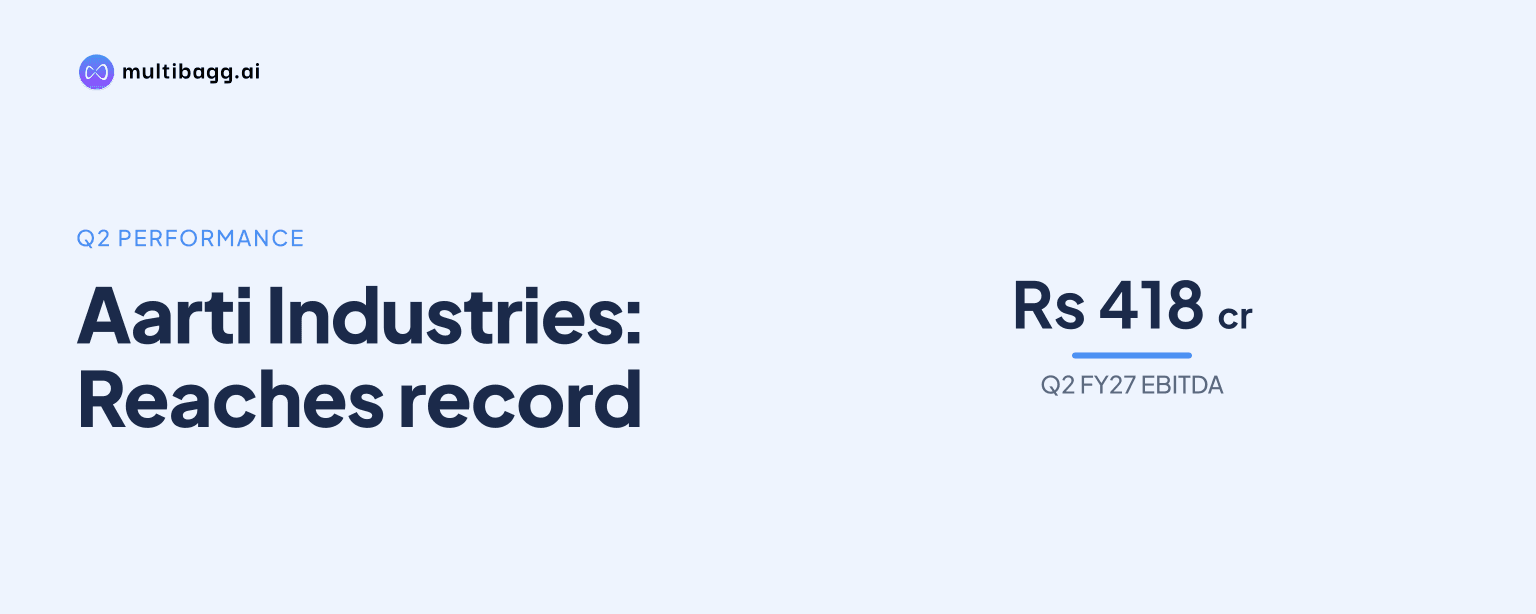
Aarti Industries Limited reported record earnings before interest, tax, depreciation and amortisation of Rs 418 crore in the second quarter of financial year 2027, up 44% year on year, while net debt exceeded Rs 4,650 crore as raw-material inflation increased working-capital needs. Shareholders had approved an enabling resolution for up to Rs 1,000 crore of fundraising by October 31, 2026.
Know Aarti Industries inside out
Results, valuation, peers and who's buying, in one view.
What drove Aarti Industries' record Q2 FY27 EBITDA?
Aarti Industries' record second-quarter EBITDA was driven by volume growth, resilient export demand and pass-through of elevated input costs. Revenue for Q2 FY27, the quarter ended September 30, 2026, rose 73% year on year to Rs 3,887 crore. Management said higher raw-material prices were reflected in revenue alongside volume gains across its chemical value chains.
The increase in EBITDA was lower than revenue growth because the company also absorbed higher input costs. EBITDA rose 44% year on year to Rs 418 crore, while profit after tax, or PAT, increased about 60% to Rs 169 crore. In the first half of FY27, or H1 FY27, EBITDA increased by more than 58% to over Rs 802 crore and PAT rose 117% to Rs 324 crore.
The Energy-Linked Portfolio contributed to the quarter through elevated crude oil prices and favourable gasoline-naphtha cracks, which supported blending economics. Management also cited price increases to offset raw-material costs. Fuel Additives capacity utilisation remained strong after capacity increased to 360 thousand tonnes per annum from 290 thousand tonnes per annum in the first quarter of 2026.
Why did Aarti Industries' net debt exceed Rs 4,650 crore?
Aarti Industries' net debt exceeded Rs 4,650 crore because higher raw-material prices stretched working-capital requirements over the past two quarters. Management said nearly all key inputs became more expensive amid Middle East geopolitical tensions and crude-oil volatility. Sulphur prices rose by more than five to six times, while sharply higher freight costs added to the cash needed to maintain supplies and meet demand.
The higher debt also increased finance costs, despite Q2 FY27 EBITDA of Rs 418 crore and PAT of Rs 169 crore. For Q3 FY27, management said domestic raw-material availability and visibility appeared adequate, but imported materials could face supply-chain gaps requiring mitigation. This leaves inventory funding and imported-input availability as unresolved variables after the September 2026 quarter.
The board approved an enabling resolution on October 1, 2026, to raise up to Rs 1,000 crore through various avenues or a combination of them. Shareholders approved the resolution at an extraordinary general meeting on October 31, 2026. Management said the primary objectives are to deleverage, strengthen the financial position and retain flexibility for strategic growth initiatives beyond FY28 and FY29.
Got a follow-up? Ask IRIS
Which Aarti Industries businesses performed differently in Q2 FY27?
Aarti Industries reported uneven conditions across end markets in Q2 FY27. Dyes and Pigments recorded steady growth, supported by domestic demand despite sulphur inflation. Agrochemicals achieved volume growth in selected categories, but pricing remained mixed; management said a weaker domestic monsoon could affect the business in the second half of FY27.
Pharma and Fluoro Products delivered pricing and volume gains in the PNCB chain, while paracetamol building blocks saw robust demand following capacity rationalisation in China. Fluoro-product margins, however, remained under pressure. These differences show that the 73% rise in total Q2 FY27 revenue did not reflect uniform pricing or margin conditions across the portfolio.
Polymers and Additives faced short-term softness in the PDA chain during Q2 FY27, which management identified as a drag on the quarter. It nevertheless expects demand traction in Q3 FY27 as downstream demand improves. Management separately said demand remained robust in high-end engineering, electric-vehicle and defence markets, while it is debottlenecking its DCB capacity to 140 thousand tonnes per annum.
What operating and capital plans has Aarti Industries disclosed?
Aarti Industries plans capital expenditure of Rs 700 crore to Rs 800 crore in FY27 across energy, agrochemical intermediates, advanced polymer formulations and pharma building blocks. Management is evaluating additional capacity in the NCB chain because current asset utilisation is elevated. The planned spending comes as the company seeks to complete its major capital-expenditure cycle while addressing net debt above Rs 4,650 crore.
In the Energy-Linked Portfolio, management said it is shifting towards a solutions-based approach and anticipates launching several new solutions over the next 12 to 24 months. It cited bulk-shipment capabilities and its research-and-development pipeline as supporting mechanisms. The company also reported more than 50 generative artificial intelligence use cases across its workspace in the preceding quarter to improve plant yields, reliability and energy efficiency.
Management said its priority after the FY27 spending programme is to maximise asset utilisation, expand value-added chemistries and build portfolio resilience through partnerships. That plan is linked to the proposed up-to-Rs 1,000 crore fundraising, which management described as a means to support deleveraging and long-term flexibility rather than as a completed capital raise.
Conclusion
Aarti Industries combined record Q2 FY27 EBITDA of Rs 418 crore, revenue of Rs 3,887 crore and PAT of Rs 169 crore with a balance-sheet cost from raw-material inflation. Higher input and freight prices helped lift reported revenue through pass-through arrangements, but also expanded working-capital needs, raising net debt above Rs 4,650 crore and increasing finance costs.
The next developments to watch are the timing and structure of the shareholder-approved up-to-Rs 1,000 crore fundraising, imported raw-material availability in Q3 FY27 and the outcome of the Rs 700 crore to Rs 800 crore FY27 capital-expenditure plan. Management also flagged potential second-half effects from a weaker monsoon in Agrochemicals and its planned 12-to-24-month rollout of new energy solutions.