










Aarti targets Rs 250-350 crore from Zone IV in 18 months
Key highlights
- Aarti targets Rs 250-350 crore of Zone IV bottom-line contribution in its first 18 months.
- Aarti expects Rs 1,800-1,900 crore of mostly Zone IV CWIP to be capitalised by 31 March 2027.
- Aarti’s Zone IV calcium chloride plant exceeded design capacity within three months of operation.
- Aarti said Zone IV is planned to be additive to EBITDA in FY28.
powered by IRIS
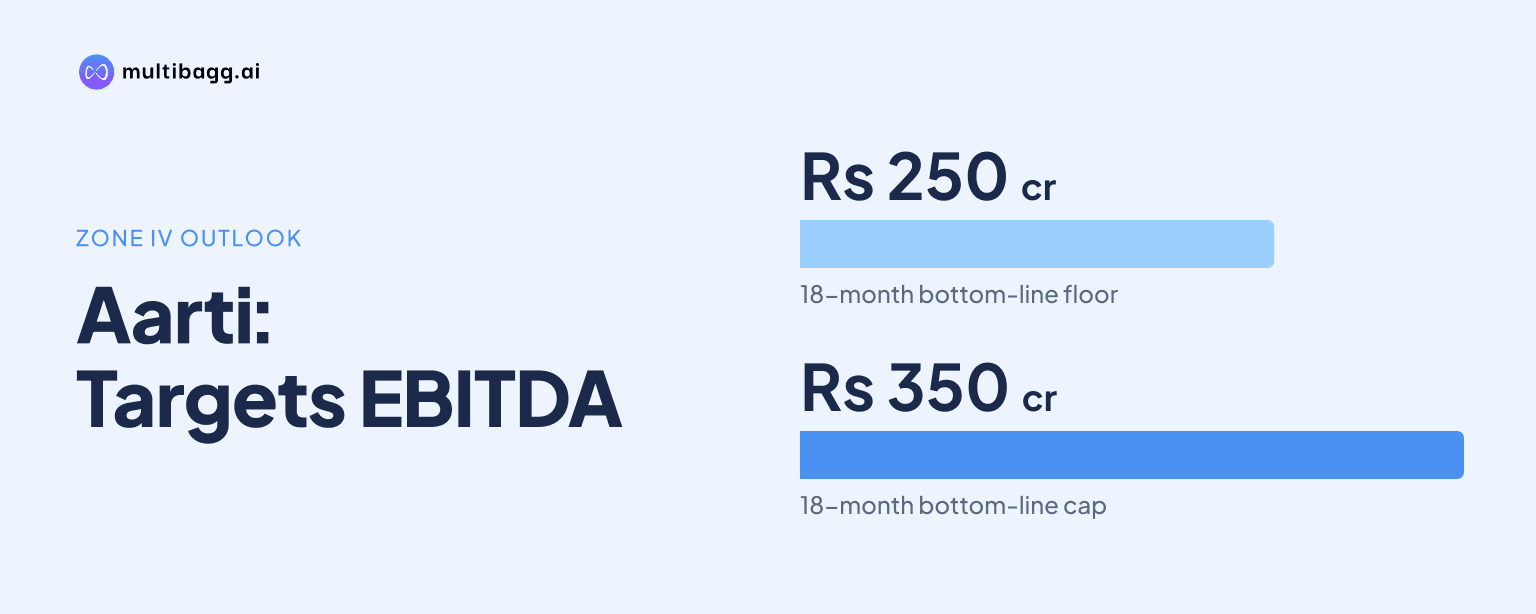
Aarti is targeting Rs 250-350 crore of Zone IV bottom-line contribution in the complex’s first 18 months and expects it to add to earnings before interest, tax, depreciation and amortisation (EBITDA) in FY28. Management cited the calcium chloride plant exceeding design capacity within three months and PEDA reaching design norms within two months.
Know Aarti Industries inside out
Results, valuation, peers and who's buying, in one view.
What is Aarti targeting from Zone IV?
Aarti is targeting Rs 250-350 crore of bottom-line contribution from Zone IV during its first 18 months of operation. Management gave this range in response to a request for Zone IV’s peak revenue potential, but framed the target in margin terms rather than sales because crude-price movements can materially change reported revenue.
Aarti expects to capitalise a significant part of its construction work in progress (CWIP), largely related to Zone IV, by 31 March 2027. Management put the amount expected to be capitalised by the end of that financial year at about Rs 1,800-1,900 crore, compared with total CWIP of Rs 2,200 crore at September.
The Rs 250-350 crore objective is an aspiration stated by management, not a reported result or a revenue forecast. Aarti said it continues to pursue that goal as commissioning progresses, while the planned capitalisation provides its timetable for moving most of the Zone IV investment onto the operating asset base.
Why is Aarti not providing a Zone IV revenue target?
Aarti is not providing a Zone IV revenue target because management said crude-price conditions can make sales figures change sharply. The company therefore chose to discuss the first-18-month opportunity as Rs 250-350 crore of bottom-line contribution, which management considered more informative than revenue when raw-material and product prices move materially.
Aarti said more than two-thirds of its portfolio operates on pass-through arrangements where absolute rupee contribution is broadly protected, although percentage margins can vary when raw-material prices rise. In the energy value chain alone, it typically has Rs 800-1,000 crore of inventory on the water, with margin recognised in profit and loss only when material is delivered to the customer.
This distinction affects how the Zone IV target should be read. A higher crude price can increase sales without lifting contribution at the same rate, while an inflationary input environment can reduce percentage margins despite an unchanged absolute spread. Management said it focuses on volume growth, absolute contribution and EBITDA, as well as balance-sheet health, rather than percentage margin alone.
How quickly have Aarti’s Zone IV plants reached design performance?
Aarti said the calcium chloride plant commissioned in Zone IV exceeded design capacity within its first three months of operation. The PEDA plant reached its design capacity and design norms within its first two months, giving management confidence in the commissioning and ramp-up process for products launched from the complex.
Management described these outcomes as achieving first-time-right execution across many newly commissioned capacities. Its expectation of faster ramp-up for future Zone IV products remains conditional on demand traction, rather than an assurance that every product will immediately match the calcium chloride and PEDA performance.
The early plant performance is also contributing to the energy portfolio’s domestic business, according to management. Calcium chloride volume and revenue increased after the Zone IV commissioning, its price increased, domestic fuel-additive demand improved, and some volume previously exported was sold in the domestic market.
Got a follow-up? Ask IRIS
When will Zone IV add to Aarti’s EBITDA?
Aarti’s current plan is for Zone IV to be additive to EBITDA in FY28. Management called this an aspiration rather than saying the complex would merely be EBITDA-neutral, linking its confidence to the rapid ramp-up at the calcium chloride and PEDA plants.
The FY28 objective follows a period in which management acknowledged a delay in Zone IV commissioning. It said the delay and fixed costs associated with commissioning could enter profit and loss around the fourth quarter, offsetting at that stage an upside in the NCB value chain’s spreads.
Aarti’s wider energy plan is to stabilise existing capacity at higher average utilisation before pursuing further capacity-led growth. For the MMA business, management said actions could include preferential raw-material arrangements, downstream integration and a broader product portfolio to improve stability in the energy value chain’s earnings profile.
What could affect Aarti’s Zone IV ramp-up?
Aarti said good demand traction is the key condition for faster Zone IV product ramp-up, while the previously cited commissioning delay remains relevant to timing. Management also flagged a major correction in global crude-oil prices as a risk because it could affect inventory values while Zone IV fixed costs begin entering the accounts.
Aarti is seeking to reduce that exposure through forward booking of product contracts where raw materials have already been booked, enabling price pass-through to customers. Management said working capital has been optimised to 55-60 days, but inventory-loss risk cannot be fully eliminated in a business with significant import and export activity.
The pricing backdrop differs by value chain. Aarti said it maintained energy spreads in the second quarter despite inflationary raw-material costs, whereas sulfur-price inflation compressed spreads in the acid chain and agrochemical intermediates can face a three- to four-month lag before price pass-through occurs.
Conclusion
Aarti has set a measurable Zone IV objective of Rs 250-350 crore in bottom-line contribution during the first 18 months, alongside its plan for the complex to add to FY28 EBITDA. The calcium chloride and PEDA ramp-up milestones support management’s confidence, but the target remains an aspiration rather than a reported outcome.
The next points to watch are the capitalisation of about Rs 1,800-1,900 crore of mostly Zone IV CWIP by 31 March 2027, commissioning-related fixed costs around the fourth quarter, and demand for further Zone IV products. Crude-linked inventory exposure, despite 55-60 days of working capital, remains relevant to the path toward FY28 EBITDA accretion.