










Aarti signs Rs 1,500 crore supply deal, targets FY29 start
Key highlights
- Aarti signed the 10-plus-year specialty-chemicals agreement on October 13, 2026.
- The FY29 dedicated facility carries about Rs 1,500 crore of revenue potential.
- Aarti reported Q2 FY27 revenue of Rs 3,887 crore, up 73% year on year.
- Aarti said net debt exceeded Rs 4,650 crore and shareholders approved a potential raise of up to Rs 1,000 crore.
powered by IRIS
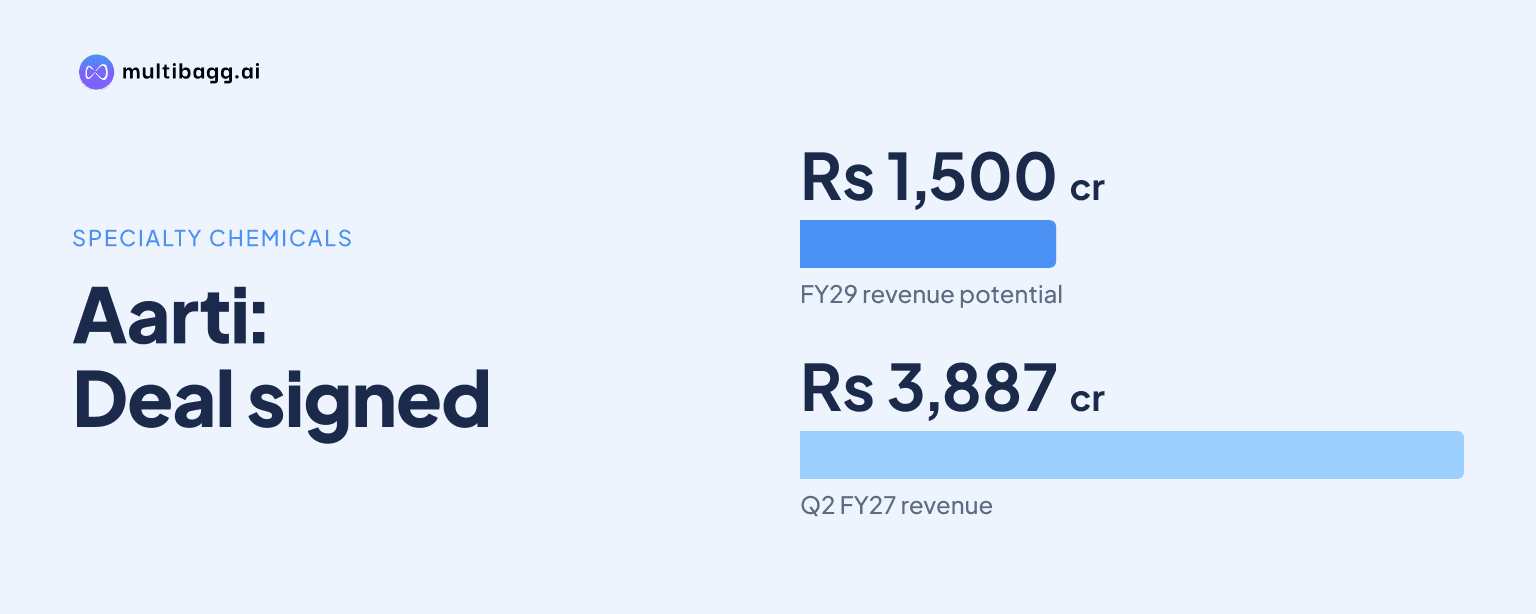
In Q2 FY27, Aarti Industries Limited disclosed a 10-plus-year specialty-chemicals supply agreement with about Rs 1,500 crore of revenue potential and commercial operations targeted for FY29. The October 13, 2026 agreement requires Aarti to build and operate a dedicated proprietary-technology facility for an unnamed global specialty chemical major.
Know Aarti Industries inside out
Results, valuation, peers and who's buying, in one view.
What does Aarti's new supply agreement cover?
Aarti will manufacture and supply specialty chemicals from a dedicated facility under the agreement signed on October 13, 2026. Management said the counterparty is a global specialty chemical major, but did not identify the customer, product, annual supply volume or annual revenue contribution.
The stated Rs 1,500 crore is potential revenue over the arrangement, rather than booked sales or a disclosed order-book value. With commercial operations planned for FY29, the project had not contributed to Aarti's Q2 FY27 revenue of Rs 3,887 crore, which was 73% above Q2 FY26.
Aarti said it will build and operate the plant using proprietary technology, with structured capital-expenditure financing. Management did not disclose the project’s annual capex schedule, the source of the proprietary technology, customer qualification steps or whether the revenue potential is contingent on minimum purchase volumes.
How does Aarti's new deal compare with existing contracts?
Aarti said the new agreement adds to three existing long-term contracts that were performing in line with management expectations as of the November 2, 2026 earnings call. The existing set comprises two specialty-chemicals contracts and one agrochemical contract with a global major, although management did not disclose their current revenue or profit contribution.
The two existing specialty-chemicals contracts have terms of more than 15 years, with residual lives extending into the late 2030s and, in some cases, to 2040, according to management. Aarti said volumes have increased in the advanced-polymer applications serving electric vehicles and electronics, but added that these contracts are commercially structured around margins rather than revenue.
The agrochemical contract has a shorter disclosed remaining duration, running to around 2029 or 2030, compared with the late-2030s-to-2040 horizon for the specialty-chemicals agreements. Management said it expects the partnerships to continue beyond their contractual terms, but that was management’s expectation rather than a disclosed renewal agreement.
The FY29 project also has a later operating timeline than Zone IV at Jhagadia, Gujarat. Zone IV Phase I was commissioned on September 7, 2026, and includes a calcium chloride unit, a PEDA, or 2-Phenyl Ethyl Diethyl Aniline, plant, and part of a multipurpose plant undergoing batch qualification, customer approvals and volume ramp-up.
Got a follow-up? Ask IRIS
What does the deal mean for Aarti's capital plans?
Aarti’s broader FY27 capital-expenditure plan is Rs 700 crore to Rs 800 crore, while management described the new facility’s financing as structured. The call did not say whether the FY29 supply project is included within the FY27 range or provide a year-by-year investment plan for the dedicated facility.
The agreement was disclosed while working-capital needs had increased with raw-material prices over the preceding two quarters. Aarti said net debt had risen above Rs 4,650 crore, and its board approved an enabling resolution on October 1, 2026 to raise up to Rs 1,000 crore through various avenues; shareholders approved that resolution on October 31, 2026.
Management said the potential Rs 1,000 crore fund raise is intended to deleverage the balance sheet, strengthen the financial position and support strategic flexibility beyond FY28 and FY29. It did not state that any part of the proposed raise was earmarked for the new supply facility.
Zone IV remains Aarti’s nearer-term capitalisation event. Management said that around Rs 1,800 crore to Rs 1,900 crore of construction work in progress, mostly related to Zone IV, was expected to be capitalised by March 31, 2027, and it targets Rs 250 crore to Rs 350 crore of bottom-line contribution from the zone in its first 18 months.
What could affect Aarti's FY29 project execution?
Aarti’s FY29 target will be pursued amid raw-material and supply-chain volatility reported in Q2 FY27. Management said Middle East tensions had increased crude-oil volatility, sulphur prices had risen by more than five to six times, and imported raw materials could face supply-chain gaps in Q3 FY27 despite domestic-material availability.
Aarti said it seeks to forward-book product contracts where possible so raw-material costs can be passed to customers. It reported working capital of 55 to 60 days after optimisation, while also cautioning that an import- and export-heavy business cannot fully eliminate inventory-loss risk if prices reverse.
Price pass-through can be delayed in some value chains. Management said agrochemical contracts are generally quarterly, creating about a one-quarter lag before higher input prices affect revenue; it did not disclose whether the new specialty-chemicals agreement has a similar pricing mechanism.
The company’s current portfolio showed differing conditions across segments in Q2 FY27. Pharma and fluoro products recorded both pricing and volume gains in PNCB, or para-nitrochlorobenzene, while fluoro-product margins remained under pressure; polymers and additives faced PDA-chain softness, although management expected DCB demand to support Q3 FY27 traction.
Conclusion
The October 13, 2026 agreement gives Aarti a customer-backed FY29 specialty-chemicals project with more than 10 years of duration and about Rs 1,500 crore of revenue potential. It extends a contract-based model in which two existing specialty-chemicals contracts run into the late 2030s or 2040, while the agrochemical contract is expected to run until around 2029 or 2030.
The next disclosed milestones are the FY29 commercial-operations target and further execution detail for the dedicated facility. Before then, management plans to introduce five to 10 Zone IV products in FY27, bring the remaining four chemistry blocks online during FY27, and expand Zone IV to 20 to 25 products across five chemistry blocks by FY28.