










Aarti Industries Ltd Q2 FY27 revenue rises 73% to ₹3,887 crore
Key highlights
- Aarti Industries reported Q2 FY27 revenue of ₹3,887 crore, up 73% year on year.
- Q2 FY27 EBITDA reached a record ₹418 crore, 44% higher year on year.
- Q2 FY27 profit after tax was ₹169 crore, about 60% above the previous year.
- H1 FY27 EBITDA exceeded ₹802 crore, compared with ₹507 crore in H1 FY26.
powered by IRIS
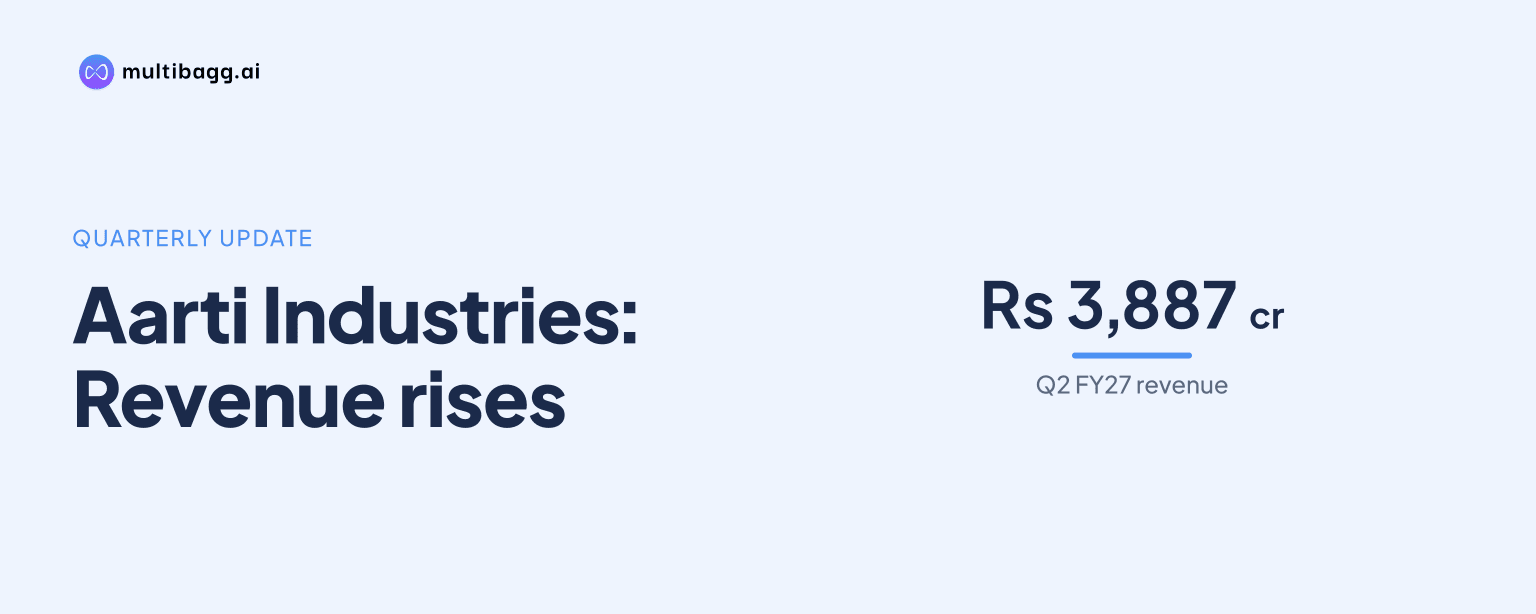
Aarti Industries Ltd reported Q2 FY27 revenue of ₹3,887 crore, up 73% year on year, for the quarter ended September 30, 2026. The specialty chemicals company also recorded EBITDA of ₹418 crore, its highest quarterly level, as volume growth and pass-through of higher input costs supported sales despite raw-material inflation.
Know Aarti Industries inside out
Results, valuation, peers and who's buying, in one view.
What did Aarti Industries report for Q2 FY27?
Aarti Industries reported its highest-ever quarterly revenue and EBITDA in Q2 FY27, according to management's November 2 earnings call. Revenue rose 73% year on year to ₹3,887 crore, while EBITDA increased 44% to a record ₹418 crore. Profit after tax rose about 60% from the corresponding quarter of the previous year to ₹169 crore.
Management said the performance reflected strong volume gains, resilient export demand and its ability to pass through higher raw-material costs. The company also cited robust demand from the energy segment and benefits from capacity expansion as contributors to the quarter's performance. Revenue increased both sequentially and year on year, management said, although it did not provide a sequential revenue figure in the call transcript.
The company reported H1 FY27 EBITDA of more than ₹802 crore, compared with ₹507 crore in H1 FY26. Crossing ₹400 crore of quarterly EBITDA is significant because management described it as a record and as evidence of improved operating momentum across its portfolio.
What drove Aarti Industries' record revenue and EBITDA?
Aarti Industries said volume growth and the pass-through of elevated input costs were the principal drivers of its Q2 FY27 revenue increase. Management linked the demand improvement to resilient exports and energy applications, while higher selling prices also reflected cost inflation in chemical supply chains.
The company said escalating geopolitical tensions in the Middle East contributed to crude-oil volatility and higher raw-material costs. These costs affected key chemical value chains during the quarter. Aarti Industries stated that raw-material prices continued to rise, increasing input costs even as it maintained revenue growth.
Management also referred to a solutions-based strategy and plans to introduce several new solutions during the next 12 to 24 months. A new chemistry block in Zone IV is supported by a long-term agreement that management said has potential revenue of ₹1,500 crore. The company has not specified in the provided material when that potential revenue would be recognised.
Why do higher raw-material costs remain important for margins?
Higher raw-material costs remain important because revenue growth partly came from passing those costs through to customers, while EBITDA grew more slowly than revenue. Revenue rose 73% year on year, compared with a 44% increase in EBITDA, indicating that input-cost inflation remained relevant to operating profitability during the quarter.
The call did not disclose a quarterly EBITDA-margin figure, sulfur price level or a quantified impact from softer PDA demand. It did, however, confirm that higher input prices were a material operating issue. This makes the company's ability to sustain pass-through arrangements and manage product mix relevant for assessing future margins.
For investors, the quarter shows a clear improvement in absolute earnings but also highlights the distinction between growth in sales and growth in operating profit. The reported results should therefore be read alongside the cost environment, which management said was influenced by crude volatility and broader geopolitical conditions.
Got a follow-up? Ask IRIS
How does the Q2 result affect investors and industry operations?
Aarti Industries' result provides evidence of higher utilisation and demand across parts of its portfolio, particularly energy-related applications, while the record EBITDA gives a stronger earnings base for its expansion plans. The company said it intends to maximise asset utilisation and build a more diversified portfolio to reduce dependence on specific fuels or products.
The broader specialty chemicals industry remains exposed to changes in feedstock and crude-linked raw-material prices. Aarti Industries' reported ability to pass through part of the increase supported quarterly revenue, but continued cost pressure can affect customers, product pricing and profitability across the value chain if market conditions change.
The supplied material contains different revenue and profit figures from separate summaries. Management's earnings-call remarks cite Q2 FY27 revenue of ₹3,887 crore and profit after tax of ₹169 crore, which are the figures used in this report. Another results summary cited revenue of ₹3,942 crore and net profit of ₹186 crore, without an explanation for the difference.
What is Aarti Industries' stated outlook after the quarter?
Aarti Industries expects to launch several new solutions over the next 12 to 24 months, with Zone IV ramp-up and new capacities central to its growth plans. A separate filing summary in the supplied material cited FY28 EBITDA guidance of ₹1,800 crore to ₹2,200 crore.
That outlook places execution at new facilities, asset utilisation and the conversion of long-term customer arrangements at the centre of the company’s next phase. It also means that investors will monitor whether the company can grow earnings while managing raw-material price movements and demand conditions in its key end markets.
Conclusion
Aarti Industries delivered record Q2 FY27 revenue of ₹3,887 crore and EBITDA of ₹418 crore, supported by volume growth, export demand, energy applications and price pass-through. The results also show that raw-material inflation remained a significant factor, with EBITDA growth lagging the pace of revenue growth.
The next disclosures to watch are the rollout of new solutions over the next 12 to 24 months, progress in Zone IV and capacity ramp-up, and performance against the stated FY28 EBITDA guidance of ₹1,800 crore to ₹2,200 crore. Updates on input costs and demand conditions will remain relevant to the company’s margin trajectory.