










ABB agrees to buy Ziehl-Abegg, targets Motion margin in 3 years
Key highlights
- ABB agreed to acquire Ziehl-Abegg at a US$2.65 billion enterprise value and a US$2.22 billion equity value.
- Ziehl-Abegg is expected to generate approximately US$1.4 billion of revenue in 2026.
- ABB targets Ziehl-Abegg Operational EBITA margin alignment with the Motion average within three years after closing.
- Closing is expected in the second half of 2027, subject to regulatory approvals and customary conditions.
powered by IRIS
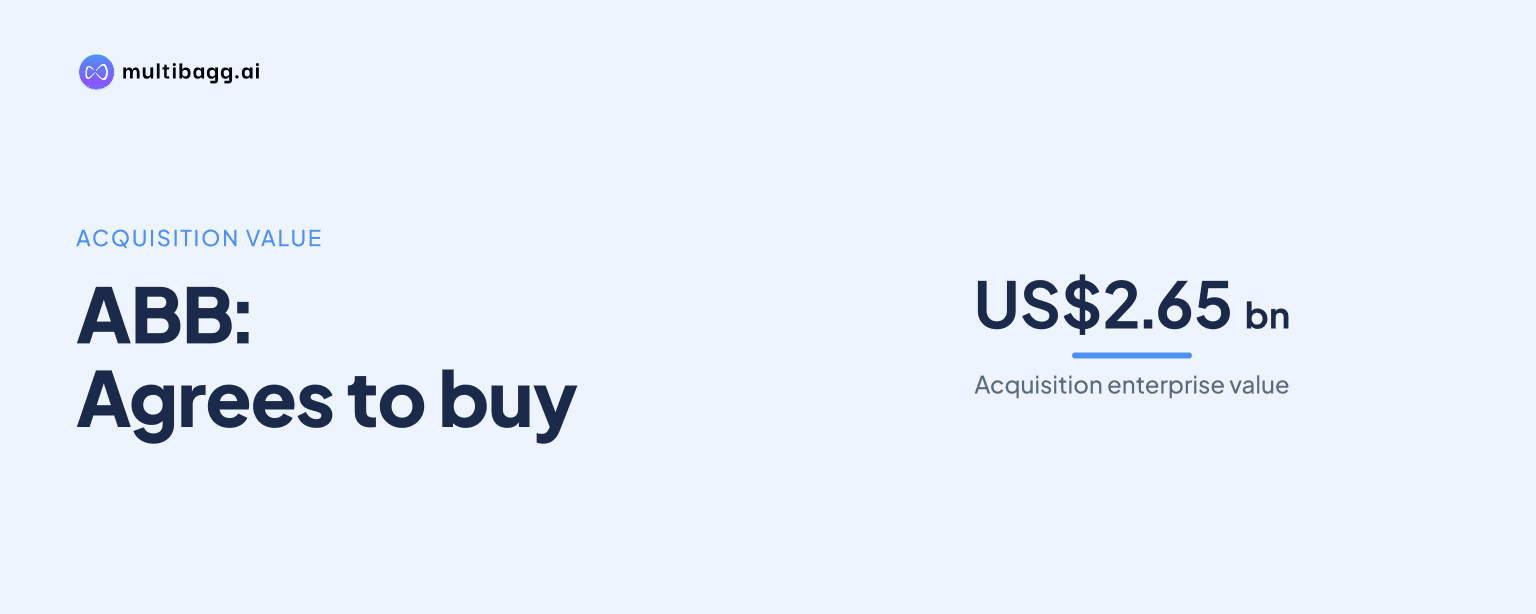
ABB Limited agreed on November 23, 2026, to acquire Ziehl-Abegg for a US$2.65 billion enterprise value, aiming for the target’s Operational EBITA margin to become broadly in line with ABB Motion’s average within three years after closing. Ziehl-Abegg is expected to generate about US$1.4 billion of revenue in 2026.
Know ABB India inside out
Results, valuation, peers and who's buying, in one view.
What are the financial terms of ABB's Ziehl-Abegg acquisition?
ABB has signed an agreement to acquire Ziehl-Abegg at a US$2.65 billion enterprise value and a US$2.22 billion equity value. The transaction values the operating business separately from the value attributable to its owners, and remains conditional on regulatory approvals and other customary closing conditions.
The valuation equals 1.9 times enterprise value to sales and 18.6 times enterprise value to earnings before interest, taxes, depreciation and amortisation, or EBITDA, based on the year ending 2026. ABB said the EBITDA multiple is expected to decrease materially towards the low double-digits when estimated mid-term synergies and improved operational performance are included.
ABB expects the transaction to generate a return on invested capital well above its weighted average cost of capital. This is ABB’s expectation rather than a post-acquisition result, because closing is expected only in the second half of 2027.
What does Ziehl-Abegg add to ABB Motion?
Ziehl-Abegg adds electronically commutated, or EC, fans, integrated electric motors, ventilation systems and integrated control technology to ABB Motion’s motors and drives portfolio. Its products include axial, centrifugal and process fans, plus internal and external rotor motors for heating, ventilation and air conditioning, or HVAC, industrial cooling and thermal-management applications.
The product range also serves data centres, clean rooms, medical technology, industrial processes, agriculture and elevator drives. ABB said a fan typically represents around 5% of a cooling system’s capital cost but accounts for around 80% of its lifetime energy consumption, making fan efficiency a key operating-cost mechanism for customers.
ABB said the combined offering is intended to help equipment manufacturers improve system performance and energy efficiency while reducing integration complexity, development costs and time to market. The deal therefore extends ABB Motion’s component range into air movement and ventilation equipment used alongside motors and drives in cooling systems.
How large is Ziehl-Abegg's operating footprint?
Ziehl-Abegg employs around 6,300 people across Europe, the Americas and Asia, based on September 2026 data. Its 2025 company profile lists 18 production plants, 30 companies and 114 sales locations, with approximately 30,000 products sold in more than 100 countries.
The company employs 3,000 personnel in production plants in southern Germany, according to its 2025 profile. Its 2025 turnover exceeded €1 billion, while ABB’s acquisition announcement uses expected 2026 revenue of about US$1.4 billion as the basis for the transaction valuation.
Ziehl-Abegg opened a €100 million manufacturing, logistics and research-and-development hub in the United States in 2024. In 2026, it separately launched a €90 million global investment programme to expand capacity across Europe, North America and Asia, making the programme €10 million smaller than the US hub but spread across three regions.
Got a follow-up? Ask IRIS
How does ABB expect the deal to change Ziehl-Abegg's margin?
Ziehl-Abegg is expected to produce an Operational EBITA margin in the mid-single-digit range during 2026. Operational EBITA is operational earnings before interest, taxes and amortisation, and ABB expects this margin to become broadly in line with the average for its Motion business area within three years after closing.
The disclosed comparison is between Ziehl-Abegg’s mid-single-digit 2026 margin and ABB Motion’s undisclosed average margin. ABB attributes the planned movement to estimated mid-term synergies and operational performance improvements as it combines complementary motors, drives, fans and ventilation capabilities.
ABB did not disclose a quantified synergy amount, restructuring cost or post-closing revenue target. It said Ziehl-Abegg will benefit from ABB’s global scale, distribution reach, service presence and customer relationships across Europe, the Americas, Asia and other growth markets.
When could the transaction close and what will stay in Germany?
ABB expects the acquisition to close in the second half of 2027, subject to regulatory approvals and other customary closing conditions. The three-year margin-alignment period disclosed by ABB would begin after that closing rather than from the November 23, 2026 agreement date.
ABB intends to retain Ziehl-Abegg’s headquarters in Künzelsau, Germany, and to support leadership continuity with its management team after completion. Germany is ABB’s third-largest market by revenue, where it has around 8,300 employees across 35 sites, compared with Ziehl-Abegg’s 3,000 production personnel in southern Germany.
Ziehl-Abegg was founded in Berlin in 1910, relocated its headquarters to southern Germany after the Second World War, and remains family-owned rather than listed. ABB’s stated plan is to preserve Künzelsau as headquarters while using its international distribution and service network to support expansion in Europe, the Americas and Asia.
Conclusion
The proposed acquisition gives ABB a business expected to generate about US$1.4 billion of 2026 revenue, adding EC fans, ventilation technology and integrated motors to the Motion portfolio. Its strategic rationale rests on cooling-system economics disclosed by ABB: fans account for around 5% of capital cost but about 80% of lifetime energy consumption.
The next disclosed milestone is the expected second-half 2027 closing, which remains subject to approvals and customary conditions. After closing, ABB’s stated benchmark will be whether Ziehl-Abegg’s mid-single-digit Operational EBITA margin becomes broadly aligned with ABB Motion’s average within three years, alongside the expected reduction of the 18.6x EBITDA multiple towards the low double-digits including estimated synergies.