










ABFRL says TCNS remains negative as recovery stays off track
Key highlights
- ABFRL said TCNS was negative overall in H1 and cannot yet resume portfolio growth.
- TCNS festive same-store growth was marginal to low single digit, 500 to 600 basis points below Pantaloons.
- ABFRL said old-inventory correction is largely complete, but residual clearance still affects TCNS gross margins.
- Management said it needs third-quarter festive trading data before judging TCNS’s annual outcome.
powered by IRIS
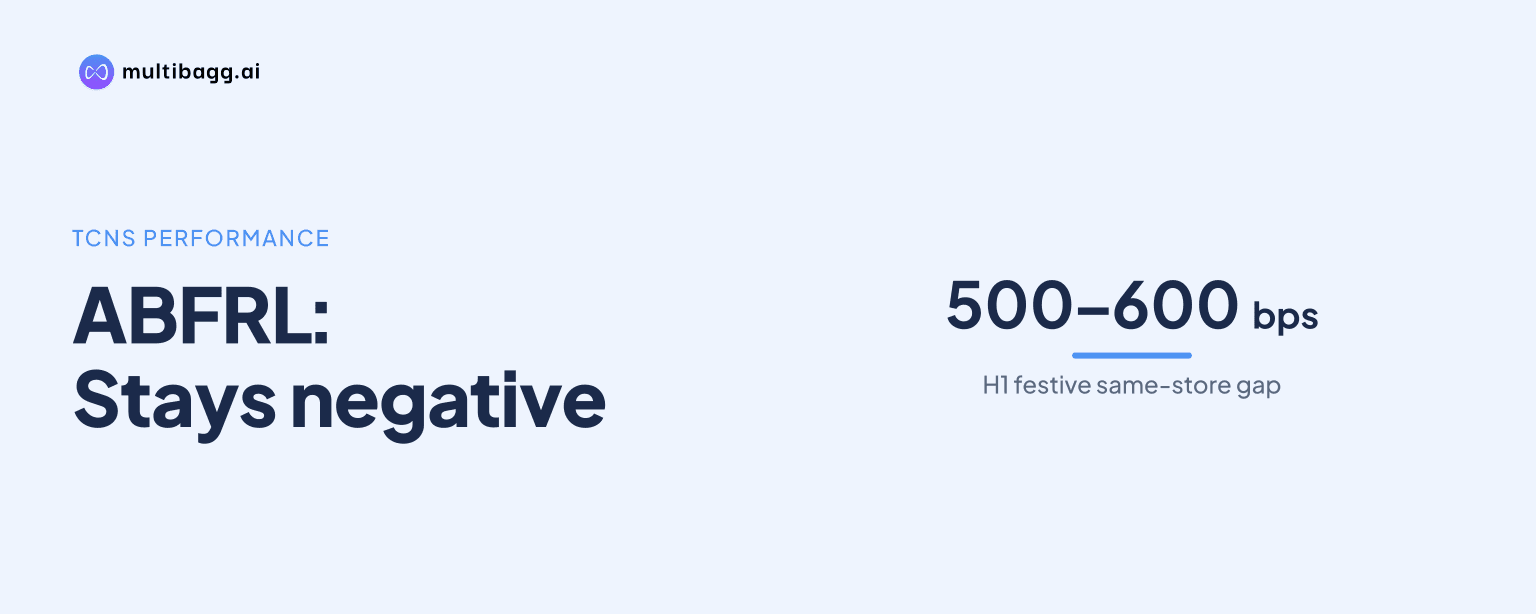
Aditya Birla Fashion and Retail Limited said TCNS was negative overall in H1, while festive same-store growth was marginal to low single digit and trailed Pantaloons by 500 to 600 basis points. Management said the portfolio cannot yet resume growth, describing the shortfall chiefly as a performance problem rather than seasonality.
Know Aditya Birla Fashion & Retail inside out
Results, valuation, peers and who's buying, in one view.
Why does ABFRL call TCNS weakness a performance problem?
ABFRL said TCNS’s current weakness is more an issue of business performance than seasonality. Management made that assessment when comparing TCNS with its designer-led ethnic portfolio, where festive and wedding demand is much more concentrated in the second half of the year.
The sales mix differs between the two ethnic businesses. ABFRL said less than one-third, or sometimes about one-third, of designer-led business occurs in the first half, with about two-thirds generated in the second half. TCNS has a more even sales pattern across the year, although it also has a festive peak, making weak current trading less attributable to the timing of festivals.
ABFRL acknowledged that ethnic wear has faced market headwinds and that festival shifts can affect demand. But management said TCNS had been more subdued than it wanted and explicitly characterised the problem as underperformance rather than seasonality. That distinction matters because the business was negative overall in H1, following a marginally low outcome in the previous year, according to management.
How far did TCNS trail Pantaloons during festive trading?
ABFRL said TCNS festive same-store growth was marginal to low single digit, about 500 to 600 basis points below Pantaloons. A basis point is one-hundredth of a percentage point, so the comparison indicates a gap of five to six percentage points in like-to-like trading performance.
Pantaloons reported solid double-digit like-to-like growth during Onam in Kerala and double-digit like-to-like growth during Pujo. Management also said Pantaloons recorded double-digit growth in customer entries during Pujo, which it attributed to changes in merchandise and the store experience.
The gap with TCNS was based on same-store performance, rather than total sales, so it does not simply reflect a different pace of store additions. ABFRL said Pantaloons had used radio-frequency identification, or RFID, to shorten replenishment timelines for products selling in stores. It also cited renovated stores in Malad and Kurla with a larger proportion of self-checkouts as part of the format changes.
Management separately said Pantaloons’ festive like-to-like growth through the period just before Diwali was in the mid- to high-single digits. It cautioned that this was an early festive reading rather than guidance for the quarter or full year. Still, TCNS’s marginal to low-single-digit growth remained below the department-store business despite the broader effect of festival timing on ethnic demand.
Got a follow-up? Ask IRIS
Is old inventory still affecting TCNS gross margins?
ABFRL said the main correction of old TCNS inventory is more or less complete, but residual clearance is still affecting gross margins. Management said this continuing impact is less significant than it was last year, when inventory liquidation was a more prominent factor in the comparison base.
The remaining issue is that fresh merchandise has not yet become sufficiently representative of the whole business to show its full intended gross-margin profile. ABFRL said some portion of old stock still has to be absorbed through gross margin, meaning current performance does not yet reflect a fully refreshed assortment.
Management did not disclose the value of residual old inventory, the precise gross-margin effect or a target date for completing the reset. It said only that the base correction was largely done and the residual impact continued. This leaves the pace at which fresh merchandise will fully shape TCNS margins unresolved.
The inventory comments also qualify the reading of current sales growth. Festive same-store growth was marginal to low single digit, but ABFRL said overall TCNS performance for the quarter was negative. Until the remaining stock correction recedes, gross margins may continue to include the effect of clearance activity rather than solely the outcome from fresh collections.
When can ABFRL restart TCNS store expansion?
ABFRL said it has not reached a stage where it can start growing the TCNS portfolio. Management said it needs to assess the rest of the festive period through the third quarter before determining what the annual picture looks like for the business.
The approach contrasts with Pantaloons, where ABFRL expects the expansion trajectory to shift from FY 2028 onwards. Management said Pantaloons could begin adding 30 to 40 new stores in FY 2028, compared with 15 to 20 additions in each of the last couple of years, when rationalisation and openings often left net additions limited or negative.
No equivalent store-addition plan was disclosed for TCNS. ABFRL said it had spent two years revisiting strategy and consolidating the Pantaloons network before considering faster expansion, whereas TCNS remains under pressure and has not yet met the operating threshold needed for portfolio growth.
The wider capital-allocation discussion also points to a more selective approach. ABFRL said it would pursue growth more aggressively in businesses where the turnaround was more visible, citing Pantaloons, while being more watchful where recovery was less visible or slower. Management said it would take a fresh look at the wider portfolio strategy at the end of FY 2028.
Conclusion
ABFRL’s H1 assessment indicates that TCNS has not yet achieved the recovery required to support store-network growth. The business was negative overall in H1, its festive same-store growth was marginal to low single digit, and it lagged Pantaloons by 500 to 600 basis points. While ethnic-wear market conditions and residual inventory clearance remain relevant, management identified performance as the primary issue.
The immediate test is trading through the rest of the festive period and the third quarter, which management said it needs to assess before reaching an annual view. Investors will also watch whether fresh merchandise becomes more representative of TCNS gross margins and whether the FY 2028 portfolio review changes ABFRL’s approach to businesses with slower turnarounds.