










Pantaloons to Add 30-40 Stores From FY28 After Network Cleanup
Key highlights
- Pantaloons plans to add 30 to 40 new stores from FY28.
- Pantaloons expects about 20 closures and 20 to 22 openings in the current full year.
- Pantaloons added 15 to 20 stores over the past two years, but rationalisation kept net additions marginal or negative.
- Pantaloons reported post-Ind AS EBITDA margins of close to 18% and aspires to move past 20% over the next couple of years.
powered by IRIS
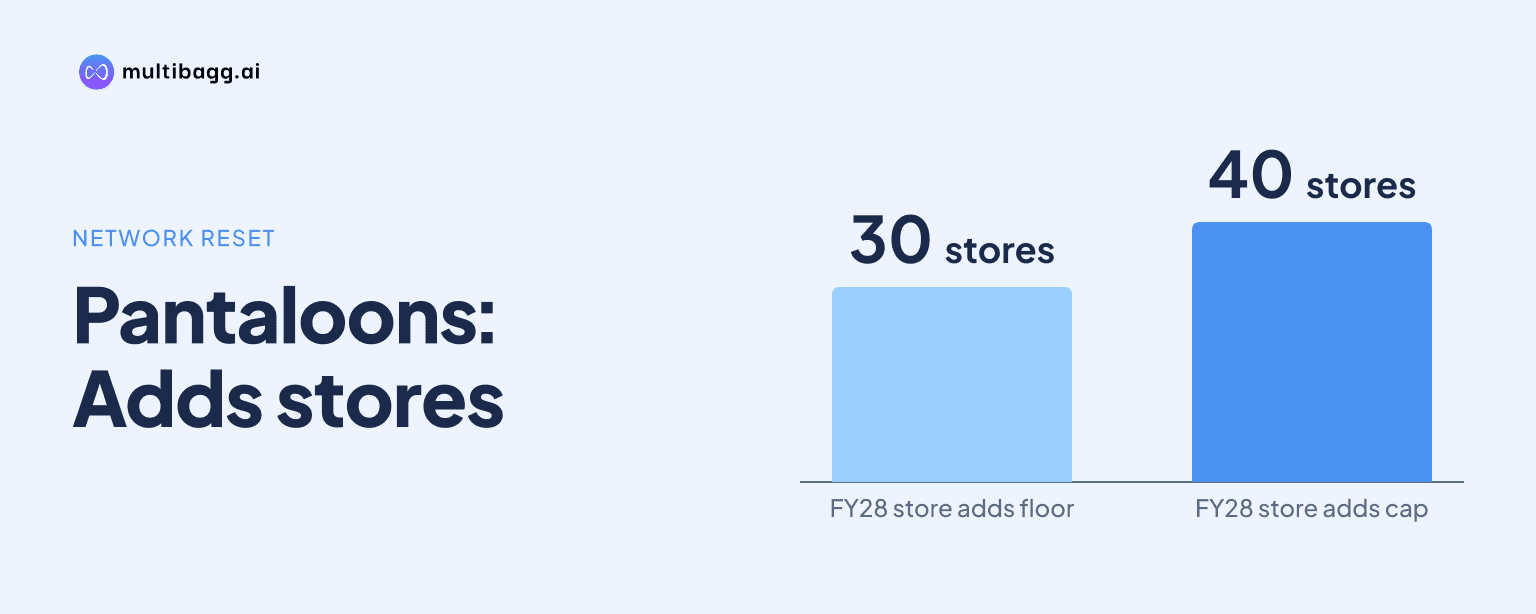
Pantaloons plans to add 30 to 40 new stores from FY28 after network rationalisation left net additions marginal or negative in the past two years. Management said the expansion will follow the rollout of its revised strategy and improved organic performance; in the current full year, about 20 to 22 openings are set against roughly 20 closures.
Know Aditya Birla Fashion & Retail inside out
Results, valuation, peers and who's buying, in one view.
When will Pantaloons begin adding 30 to 40 stores?
Pantaloons expects to begin adding 30 to 40 new stores from FY28. Management said it is waiting for the revised strategy to play out and for organic performance to improve before accelerating distribution, rather than expanding the network before the operating changes are established.
The FY28 plan differs from the past two years, when Pantaloons added 15 to 20 stores but saw much of that activity offset by rationalisation. Management said effective net additions were limited and may have been negative during that period. It did not commit to high double-digit growth, but said the first objective would be to achieve early double-digit growth as the store-addition trajectory changes.
Management also said the big parts of network cleanup are complete. A small number of closures or relocations may continue where a store tenure ends, a new mall opens, or a more attractive site becomes available, but it expects more additions and only marginal closures from next year onwards.
How are Pantaloons openings and closures balancing this year?
Pantaloons expects little change in its net store count in the current full year because planned openings of about 20 to 22 stores broadly match expected closures of about 20 stores. Management said it had already closed close to 16 or 17 stores in the first half, leaving only a marginal net increase for the year.
The current openings are not intended to be like-for-like replacements in size or format. Management said new stores have a higher-quality retail identity and are, in most cases, slightly larger, while it also said the stores being added are significantly bigger than those being closed. That means the network can change in sales capacity and customer experience even while the store count is broadly flat.
Why is Pantaloons prioritising organic growth before expansion?
Pantaloons said its overall growth has been lower than its like-to-like growth because it has not added much distribution. Like-to-like growth measures performance at comparable stores, and management said Pantaloons delivered mid- to high-single-digit like-to-like growth during the festive period, while faster-expanding competitors recorded higher overall growth through additional stores.
Management described Pantaloons' comparable-store performance as at par with, or among, the better results in the industry during the festive period. The comparison with peers is therefore between organic performance and total reported growth: peers that expanded their networks more rapidly had a larger distribution contribution, while Pantaloons' closures and limited additions constrained its overall growth.
The decision to defer a larger rollout is tied to management's assessment of the format's strategy. Pantaloons said it was satisfied with current organic growth, but acknowledged that it would need to accelerate expansion at some stage. The 30-to-40-store FY28 plan is management's stated point for moving from cleanup-led network management to greater net additions.
Got a follow-up? Ask IRIS
What operational changes are supporting Pantaloons stores?
Pantaloons is using radio-frequency identification, or RFID, to reduce the time required to replenish merchandise that has sold in stores. Management said RFID is working strongly and linked faster replenishment to shifts in like-to-like growth during the recent Onam and Pujo trading periods, because products can be returned to stores more quickly after sales.
The format is also changing the customer experience at renovated stores in Malad and Kurla, where management cited a larger proportion of self-checkout facilities. These initiatives accompany the current programme of about 20 to 22 openings, which management said will feature a newer retail identity and generally larger stores than the locations being closed.
Pantaloons is adjusting merchandise to current consumer demand for women's western wear and fusion wear. Management said its core customer remains young adults, rather than a separate aggressive pursuit of Generation Z, and that its social-media communication has evolved for young-adult sensibilities. It did not set a numerical long-term category-mix target, saying the assortment would follow changes in consumer preferences.
What margin pressures and targets does Pantaloons face?
Pantaloons has delivered post-Ind AS EBITDA margins of close to 18%, according to management. Ind AS means Indian Accounting Standards, and EBITDA means earnings before interest, tax, depreciation and amortisation. Management said better store throughput and productivity could sustain that level or produce a slight short-term improvement, while its aspiration over the next couple of years is to move past 20%.
That target is being pursued amid about 4% to 5% cost inflation. Management said Pantaloons has passed on part, but not all, of that increase, and expects a 100-basis-point gross-margin impact when the full cost increase has flowed through. One basis point equals one-hundredth of a percentage point.
Some inflation pressure was already visible in the second quarter and was expected to continue through the third and fourth quarters because products are purchased over different periods. Management said stronger same-store performance could offset part of the impact over the next quarter or two, and expects margins to start increasing from next year if costs normalise. The margin path is relevant because the FY28 store plan follows management's effort to establish improved organic performance.
Conclusion
Pantaloons is moving from a period in which 15 to 20 store additions were largely offset by closures to a planned FY28 phase of 30 to 40 new stores. The strategy combines network cleanup with larger replacement locations, RFID-enabled replenishment, self-checkout at renovated stores, and a merchandise shift toward women's western and fusion wear.
The next developments to watch are management's expectation of more additions and marginal closures from next year, progress toward the 30-to-40-store FY28 plan, and the remaining effect of 4% to 5% cost inflation through the third and fourth quarters. Management's stated operating target is to move beyond close to 18% post-Ind AS EBITDA margin over the next couple of years, subject to costs normalising.