










ABFRL plans TMRW funding near Rs 1,000 crore in 12 months
Key highlights
- ABFRL expects TMRW to raise capital within 12 months, with management indicating a requirement close to Rs 1,000 crore.
- TMRW revenue rose 10% year on year in Q2 FY27, or 19% including WROGN.
- ABFRL reported Rs 1,143 crore of consolidated gross cash at the end of Q2 FY27.
- Management expects standalone year-end FY27 cash of around Rs 400 crore to Rs 500 crore.
powered by IRIS
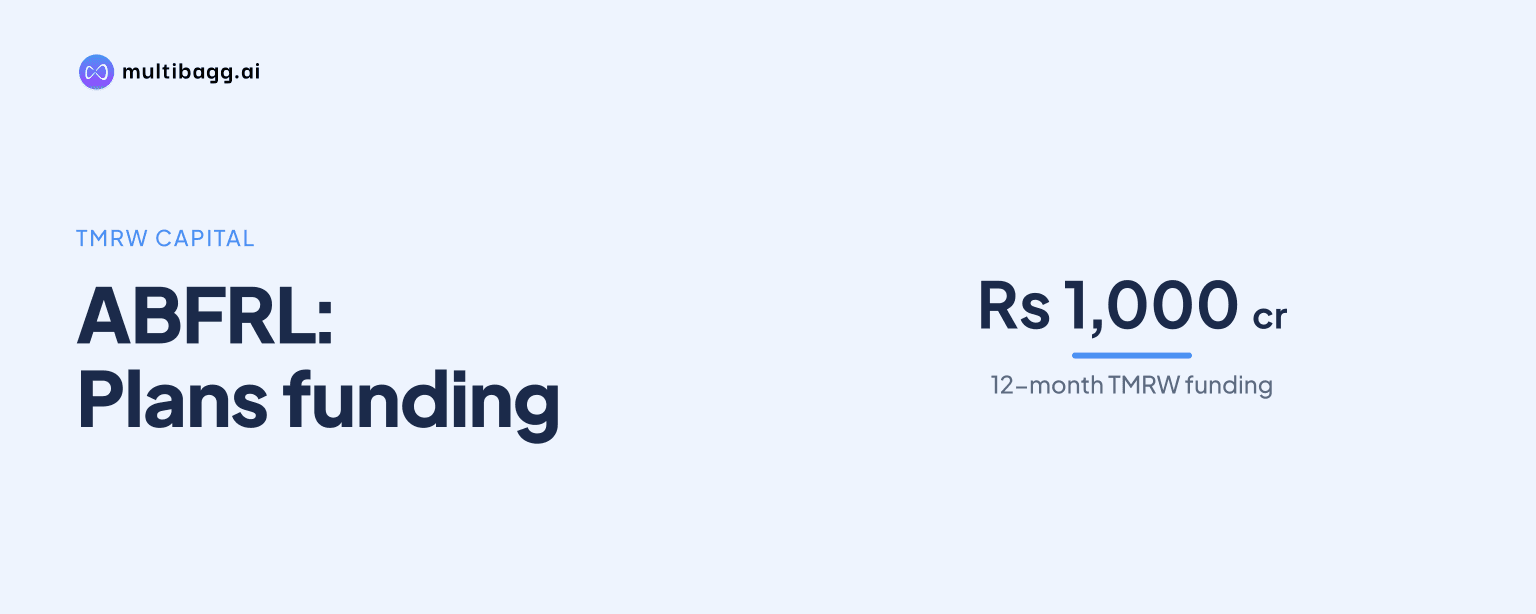
Aditya Birla Fashion and Retail Limited expects TMRW to raise capital within 12 months, with management indicating a requirement close to Rs 1,000 crore. ABFRL identified TMRW as its largest current cash requirement and said a fundraise by the end of FY27 or early FY28 would ease pressure on consolidated liquidity while funding the platform itself.
Know Aditya Birla Fashion & Retail inside out
Results, valuation, peers and who's buying, in one view.
Why is ABFRL raising capital for TMRW?
ABFRL is planning a TMRW capital raise because management said TMRW has accounted for a substantial part of the group’s cash outflow in recent years. During the Q2 FY27 earnings call, Managing Director Ashish Dikshit said TMRW could raise capital by the end of FY27 or early FY28, which management described as the next 12 months.
Management later put the likely funding need at close to Rs 1,000 crore, while saying the final amount could be somewhat higher or lower. ABFRL said the capital would fund TMRW itself, rather than the ABFRL standalone entity. The company did not disclose the proposed mix of equity, debt or other funding instruments.
TMRW reported 10% year-on-year revenue growth in Q2 FY27, rising to 19% when WROGN is included. Management said profitability improved year on year for a fourth consecutive quarter, as the business pursued sharper products, category expansion and a growing omnichannel presence. ABFRL did not disclose TMRW’s revenue in rupees, operating profit or loss, or a break-even target.
The proposed funding also reflects ABFRL’s entity-by-entity financing approach. Management said designer-led ethnic subsidiaries could fund growth through their own cash flows or debt raised on their own balance sheets. It said another entity-level fundraise could be considered about two years later if needed, but did not announce a transaction or identify a specific business.
What does the TMRW raise mean for ABFRL’s liquidity?
The TMRW raise is intended to ease consolidated liquidity pressure, while ABFRL targets adequate standalone cash for FY28. ABFRL ended Q2 FY27 with consolidated gross cash of Rs 1,143 crore and standalone gross cash of Rs 628 crore. During the call, management also referred to a standalone cash balance of about Rs 350 crore at that point in the year.
Management maintained its expectation of ending FY27 with standalone cash of around Rs 400 crore to Rs 500 crore. It said the second half has historically been stronger for revenue, profitability and cash generation, while the sale of festive inventory should release working capital. These are management expectations rather than reported second-half results.
Chief Financial Officer Jagdish Bajaj said ABFRL had guided in Q4 for FY27 investment of roughly Rs 600 crore while retaining around Rs 500 crore of cash at year-end. He said cash consumption in H1 FY27 was around Rs 700 crore, but management still expected adequate cash for FY28. In a downside case, management said the standalone entity could be short by Rs 100 crore to Rs 150 crore.
Got a follow-up? Ask IRIS
How is TMRW performing before the planned fundraise?
TMRW is reporting revenue growth and consecutive profitability improvement, although ABFRL remains in an investment phase for the platform. TMRW’s Q2 FY27 revenue rose 10% year on year on a standalone basis, or 19% including WROGN. Management linked the performance to product changes, category expansion and omnichannel development.
Management said Q2 FY27 was TMRW’s fourth consecutive quarter of year-on-year profitability improvement. However, ABFRL did not provide TMRW’s absolute profitability figure, cash burn, gross margin, or planned capital allocation. The prospective funding size therefore remains an indicated requirement, with the final structure still under evaluation.
Including WROGN, TMRW had more than 150 exclusive brand outlets, or EBOs, at the end of Q2 FY27. That compares with ABFRL’s total network of 1,268 stores across approximately 7.8 million square feet. The wider group added 35 stores in Q2 FY27 and more than 80 stores in H1 FY27, showing that capital commitments extend beyond TMRW.
ABFRL reported Q2 FY27 revenue of Rs 2,030 crore, up 2% year on year, while earnings before interest, tax, depreciation and amortisation, or EBITDA, were Rs 67 crore. Management attributed the slower group growth and lower operating leverage partly to the festive calendar shift, which moved Pujo into Q3, and to continued investment in newer businesses including TMRW.
What other businesses will shape ABFRL’s cash needs?
ABFRL plans to pursue growth more actively where turnarounds are progressing, particularly at Pantaloons, while being more watchful in slower-recovering businesses. Management said it would manage the portfolio using available capital through FY28 and take a fresh strategic look at the end of that year, after assessing progress across the businesses.
Pantaloons is expected to move into a more expansionary phase from FY28. Management said it expects to add 30 to 40 new Pantaloons stores annually from FY28 onward, compared with 15 to 20 additions in recent years. It said this would follow a period of network rationalisation and an effort to establish improved organic performance.
In FY27, Pantaloons is expected to have limited net store growth because closures and openings are broadly offsetting. Management expects about 20 closures and 20 to 22 openings, with the new stores generally larger and aligned with the revised retail identity. Pantaloons had 387 stores at the end of Q2 FY27, while OWND had 90 stores.
The ethnic portfolio generated Q2 FY27 revenue of Rs 517 crore, up 2% year on year, but grew 12% excluding TCNS. Management said TCNS remained under pressure after approximately 60 underperforming store closures over the preceding 12 months, which reduced reported revenue. It also said Jaypore reduced losses further during the quarter.
Conclusion
ABFRL’s indicated TMRW funding requirement of close to Rs 1,000 crore is central to management’s plan to finance growth while limiting strain on the consolidated balance sheet. TMRW delivered 10% Q2 FY27 revenue growth, or 19% including WROGN, and a fourth straight quarter of year-on-year profitability improvement, but management still identified it as the portfolio’s largest cash requirement.
The next developments to watch are whether TMRW completes a capital raise by the end of FY27 or early FY28, the final size and structure of the transaction, and whether ABFRL achieves its targeted Rs 400 crore to Rs 500 crore of standalone year-end cash. Management also plans a wider portfolio review at the end of FY28, while Pantaloons targets 30 to 40 annual store additions from FY28 onward.