










Pantaloons targets post-Ind AS EBITDA margin above 20%
Key highlights
- Pantaloons aims for post-Ind AS EBITDA margin above 20%, versus a consistently delivered level close to 18%.
- Management described the margin ambition as a 200-300 basis-point increase over the current level.
- Pantaloons faces about 4%-5% cost inflation and estimated a potential 100-basis-point gross-margin impact.
- Pantaloons plans to add 30-40 stores annually from FY 2028 onwards.
powered by IRIS
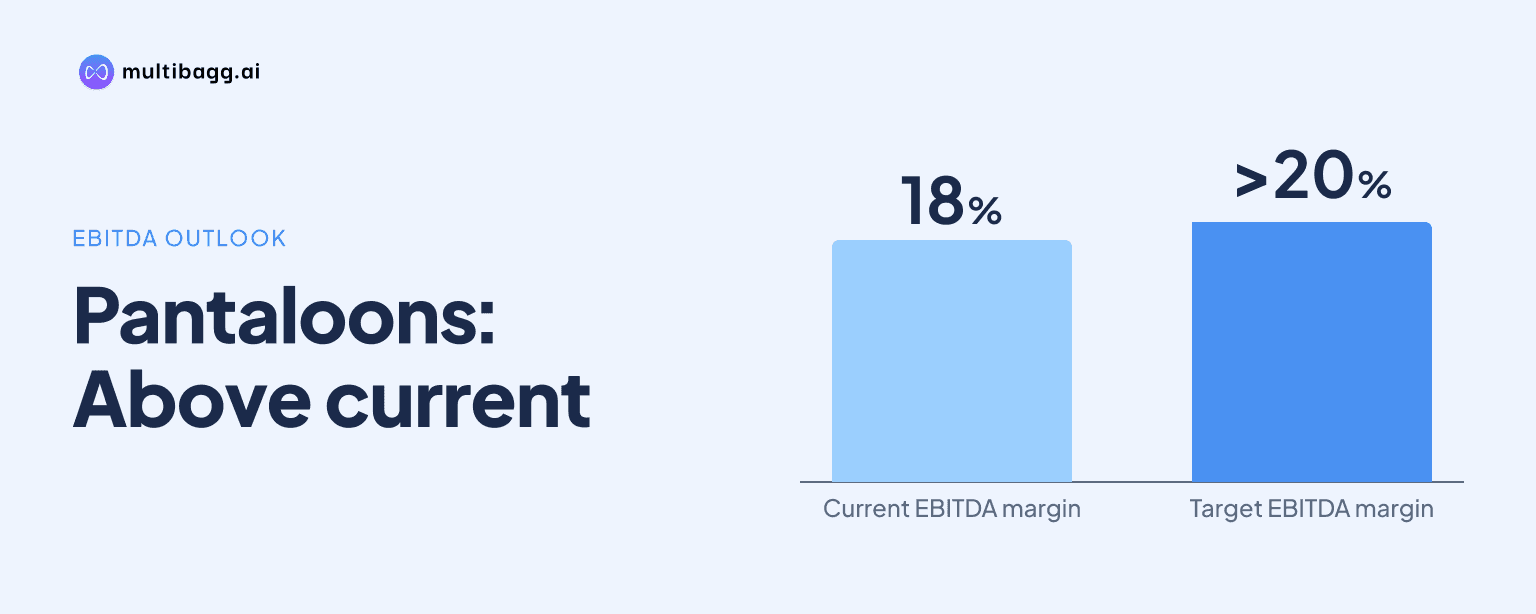
Pantaloons aims to take post-Ind AS EBITDA margin above 20% over the next couple of years, from a consistently delivered level close to 18%, management said. The ambition implies a 200-300 basis-point increase, while management expects store productivity and same-store growth to help offset a potential 100-basis-point gross-margin effect from cost inflation.
Know Aditya Birla Fashion & Retail inside out
Results, valuation, peers and who's buying, in one view.
What post-Ind AS EBITDA margin is Pantaloons targeting?
Pantaloons is targeting post-Ind AS EBITDA margin above 20% over the next couple of years. Management said the business has delivered close to 18% margins consistently despite material-cost increases, and that the stated aspiration is 200-300 basis points above the current level. Ind AS means Indian Accounting Standards, while EBITDA means earnings before interest, tax, depreciation and amortisation.
Management did not provide a year-by-year margin forecast or specify a formal end-date within the next couple of years. It said store-throughput productivity had created room to maintain the close-to-18% level or do slightly better in the short term, before margin expansion starts from next year as costs normalise.
What is pressuring Pantaloons' margin in the near term?
Pantaloons is facing about 4%-5% cost inflation, and management said it has passed on only part of that increase through pricing. In a full-cost scenario, the unpassed portion could create about a 100-basis-point gross-margin impact. Gross margin is not the same measure as post-Ind AS EBITDA margin, so the estimated impact does not directly define the above-20% EBITDA aspiration.
Management said part of the cost effect was already visible in Q2 and would continue to flow through Q3 and Q4. Products are bought across different periods rather than at one time, meaning higher costs reach the business gradually as merchandise purchased after inflation is sold.
Management said strong organic growth, referring to same-store performance, could potentially offset part of the cost increase over the next quarter or two. It expects margins to begin increasing from next year once the cost side normalises, rather than saying that all of the 4%-5% inflation will be recovered through additional price increases.
How does Pantaloons plan to lift margin above 20%?
Pantaloons plans to improve margin through store throughput and productivity, which management said have enabled the business to sustain close-to-18% post-Ind AS EBITDA margin despite higher material costs. Management did not quantify the productivity gain or allocate the expected 200-300 basis-point improvement among individual initiatives.
One mechanism is radio-frequency identification, or RFID, which management said has materially shortened replenishment timelines for products selling in stores. Pantaloons also cited a greater proportion of self-checkouts at newer stores and recently renovated stores in Malad and Kurla as part of its effort to improve consumer experience.
Pantaloons is also changing merchandise toward women's western wear and fusion wear, where management said consumer preference is currently shifting. The business identified young adults as its core customer and said its social-media communication had evolved for that audience, while clarifying that it was not aggressively targeting Gen Z consumers.
Got a follow-up? Ask IRIS
When will Pantaloons expand its store network?
Pantaloons expects more net store additions from next year, while its larger expansion phase is planned from FY 2028 onwards. Management said it expects to add 30-40 new stores annually from FY 2028, compared with 15-20 stores added in each of the past couple of years.
Effective net additions were limited or somewhat negative in the earlier period because new openings were offset by rationalisation and closures. Management said the main rationalisation phase is now largely complete, although a small number of relocations or closures will continue when store tenures end or more attractive mall locations emerge.
Management said it had delayed faster expansion until its strategy played out and organic performance improved. It expects more additions and only marginal closures from next year, and said the initial objective is early double-digit growth rather than a commitment to high-double-digit growth.
How does Pantaloons compare with TCNS on current growth?
Pantaloons reported mid- to high-single-digit same-store growth during the festive period, while TCNS recorded marginal to low-single-digit same-store growth. Management said TCNS was operating about 500-600 basis points below Pantaloons, supporting its view that Pantaloons' organic performance can partly absorb near-term cost pressure.
TCNS was negative at the overall level in H1, according to management, which said the business remained under pressure from both internal factors and ethnic-wear market headwinds. Management also said TCNS's current outcome was more an underperformance issue than a seasonal issue, despite ethnic wear having a festive peak.
Pantaloons' overall growth was lower than that of some competitors because it had not expanded distribution as quickly, management said. It nevertheless described Pantaloons' like-for-like growth as at par with, or among, the better industry outcomes, distinguishing existing-store performance from growth generated by a larger store network.
Conclusion
Pantaloons' above-20% post-Ind AS EBITDA margin ambition rests on a 200-300 basis-point improvement from close to 18%, supported by store throughput, RFID-enabled replenishment, self-checkouts and same-store growth. The goal is specific to Pantaloons and should not be read as a margin target for TCNS, whose H1 overall performance was negative.
The next disclosed issue to watch is the cost effect through Q3 and Q4, after part of the estimated 4%-5% inflation was visible in Q2 and management flagged a potential 100-basis-point gross-margin impact. Management expects margins to start rising from next year as costs normalise, with a planned acceleration to 30-40 new stores a year from FY 2028 onwards.