










Airfloa targets FY28 cash-positive operations as debtors age
Key highlights
- Airfloa said 21.8% of receivables were aged beyond 180 days, while 78.2% were within 180 days.
- Management targets positive operating cash flow in FY28 and expects debtor days to reduce within about six months.
- H1 FY27 revenue rose 143% year on year to Rs 220.3 crore, while inventory days declined by 19 days from March 2026.
- Airfloa said Rs 140 crore of borrowings should support its Rs 750 crore FY28 revenue target without big new borrowing for at least one year.
powered by IRIS
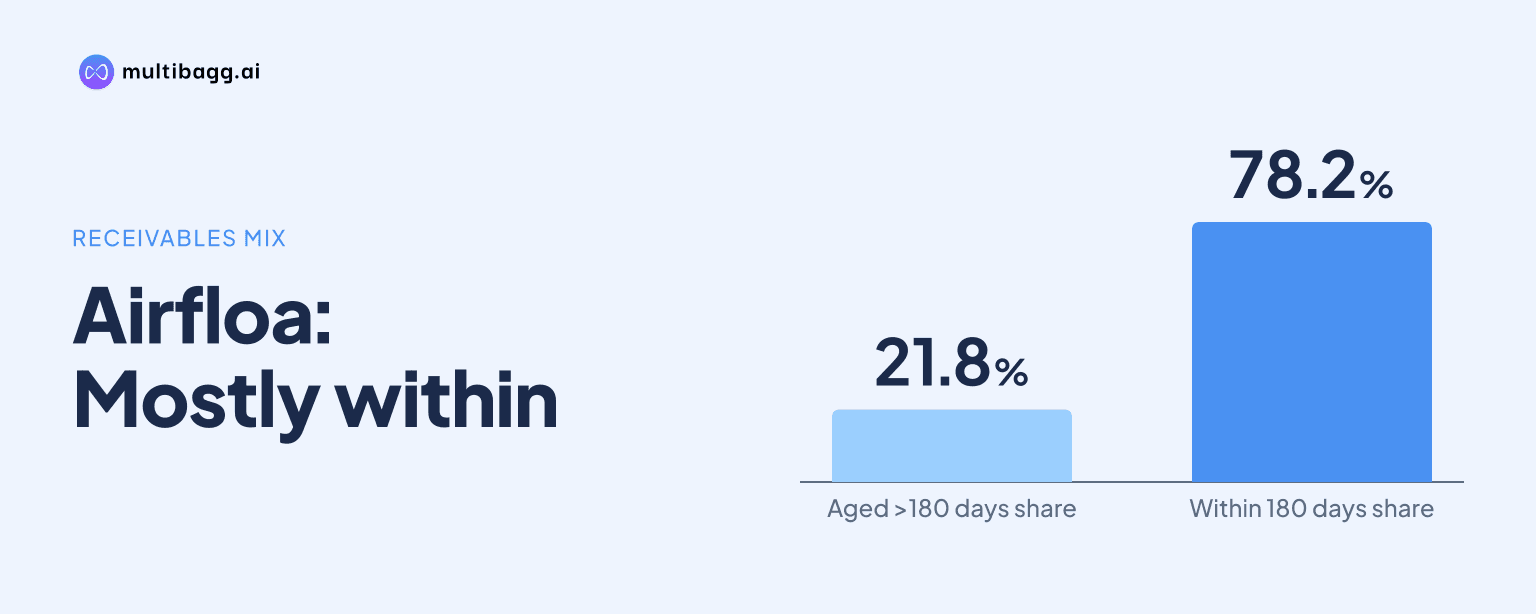
Airfloa Rail Technology Limited is targeting positive operating cash flow in FY28 after management said 21.8% of receivables were aged beyond 180 days and acknowledged collections as a current challenge. An analyst put debtors at about Rs 263 crore, while management said it expects debtor days to reduce within roughly six months.
Know Airfloa Rail Technology inside out
Results, valuation, peers and who's buying, in one view.
Why are Airfloa receivables under scrutiny?
Airfloa receivables are under scrutiny because an analyst cited debtors of about Rs 263 crore and management agreed that collections require improvement. Airfloa said debtor days remained broadly stable despite rapid growth, but management accepted that the metric was at the higher end. Revenue from operations rose 143% year on year to Rs 220.3 crore in the first half, or H1, of FY27.
Airfloa said approximately 78.2% of receivables were within 180 days, leaving 21.8% aged beyond 180 days. Management initially described the ageing mix as near 80:20 before specifying the 78.2% figure. The split means stable aggregate debtor days do not by themselves show the extent of balances that have taken more than six months to collect.
Airfloa linked the timing of collections to new, end-to-end turnkey projects, including Amrit Bharat contracts, electric multiple-unit trains and mainline electric multiple-unit trains. Management said these projects require more time for conversion and receipt of payments than a contract that can be executed within two or three months. It did not identify a customer-specific dispute or disclose a receivables provision.
What is Airfloa doing to reduce debtor days?
Airfloa said it is meticulously monitoring collections through various methods and expects debtor days to reduce within about six months. Management did not disclose a numerical debtor-days target for the next two quarters, a receivables target below the Rs 263 crore cited by the analyst, or the individual measures it will use to accelerate cash conversion.
Inventory movement offers a different working-capital trend. Airfloa said inventory days declined by 19 days from March 2026, while debtor days were broadly stable through H1 FY27. The comparison shows that inventory conversion improved even as management continued to focus on cash collection from turnkey railway projects.
Airfloa reported cash and bank balances of Rs 17.3 crore as of September 30, 2026, and net debt to equity of 0.5 times. It also reported return on capital employed of 32.1%, although the call did not provide a comparative prior-period figure for that ratio. Management said working-capital management would remain part of its capital-allocation and execution approach.
When does Airfloa expect positive operating cash flow?
Airfloa’s stated objective is positive operating cash flow in FY28, not specifically in H2 FY27. Asked whether cash flow could turn positive in the second half of FY27, management said its goal was to achieve it in 2027-28. It did not provide an expected operating cash-flow amount, quarterly trajectory or a target date within FY28.
The target coincides with management’s FY28 revenue guidance of Rs 750 crore and its profit-after-tax, or PAT, margin baseline of 10% to 12%. In H1 FY27, earnings before interest, tax, depreciation and amortisation, or EBITDA, rose 120% to Rs 48.4 crore, producing a 21.9% margin. PAT increased 108% to Rs 25.1 crore, and the PAT margin was 11.4%.
Airfloa plans to execute Rs 280 crore of orders in the balance of FY27 and has maintained revenue guidance of Rs 500 crore or more for the year. That planned execution raises the importance of converting project milestones into collections, but management did not disclose the payment terms, billing milestones or customer mix that would support its FY28 cash-flow objective.
Got a follow-up? Ask IRIS
Will Airfloa need more funding for FY28 growth?
Airfloa said it expects to manage its Rs 750 crore FY28 revenue target with current borrowings and does not anticipate big additional borrowings for at least one year. Management said borrowings had risen to Rs 140 crore, with approximately Rs 100 crore representing regular working-capital borrowing. It said the larger rise in borrowings during the year was mainly for the KIN acquisition.
That view is based on a forecast led by railways. As of November 16, 2026, management said more than 90% of its Rs 750 crore to Rs 800 crore FY28 outlook was attributable to railway business, with the remainder from aerospace and defence. Airfloa also said revenue from KIN would help it manage the Rs 750 crore target without large new borrowings.
Airfloa nevertheless left open the prospect of new capital if sizeable defence or aerospace orders become tangible. Management said it did not envisage an equity raise over the next six or seven months for the railway-led plan. It said extra funding could be needed if demand exceeds current expectations following the conversion of large defence or aerospace opportunities into orders.
How does the order book shape Airfloa’s cash plan?
Airfloa said its combined order book, including KIN, was Rs 610 crore as of November 15, 2026. It plans Rs 450 crore of fresh order inflows over coming months and expects to close FY27 with an unexecuted order book of approximately Rs 750 crore to Rs 800 crore. Management said this position would provide revenue visibility for FY28.
Management later clarified that the projected Rs 750 crore to Rs 800 crore order book would be executed in the next financial year. It has remained selective in bidding to preserve profitability, management said, despite being able to pursue orders worth Rs 1,000 crore to Rs 2,000 crore. The call did not disclose whether the future orders would carry shorter payment cycles than existing turnkey contracts.
Airfloa said KIN brought an Rs 180 crore order book and operates in metro contracts, which management expects to have better margins than its regular railway business. Management also said KIN is approved on global platforms of Alstom, Hitachi and Siemens. No export order, collection schedule or FY28 cash-flow contribution from those approvals was disclosed.
Conclusion
Airfloa’s FY28 cash-flow target depends on improving collection timing while executing a larger railway-led revenue plan. H1 FY27 revenue increased 143% to Rs 220.3 crore and PAT increased 108% to Rs 25.1 crore, while inventory days declined by 19 days from March 2026. However, management acknowledged the collection challenge after disclosing that 21.8% of receivables were aged beyond 180 days.
The next disclosed milestones are management’s roughly six-month timetable to reduce debtor days, execution of Rs 280 crore in the balance of FY27, and progress toward FY28 revenue guidance of Rs 750 crore. Investors will also watch whether current borrowing remains sufficient, as management said additional funding could be considered if larger defence or aerospace orders become tangible.