










Airfloa says FY28 plan remains more than 90% railway-led
Key highlights
- Airfloa said more than 90% of its Rs 750 crore to Rs 800 crore FY27-28 revenue plan is railway-led.
- Management indicated aerospace and defence account for about 10% of the current FY27-28 revenue plan.
- Airfloa reported receivables of about Rs 263 crore, with 78.2% within 180 days.
- Management said working-capital borrowing was about Rs 100 crore and interest rates were approximately 8.25% to 8.5%.
powered by IRIS
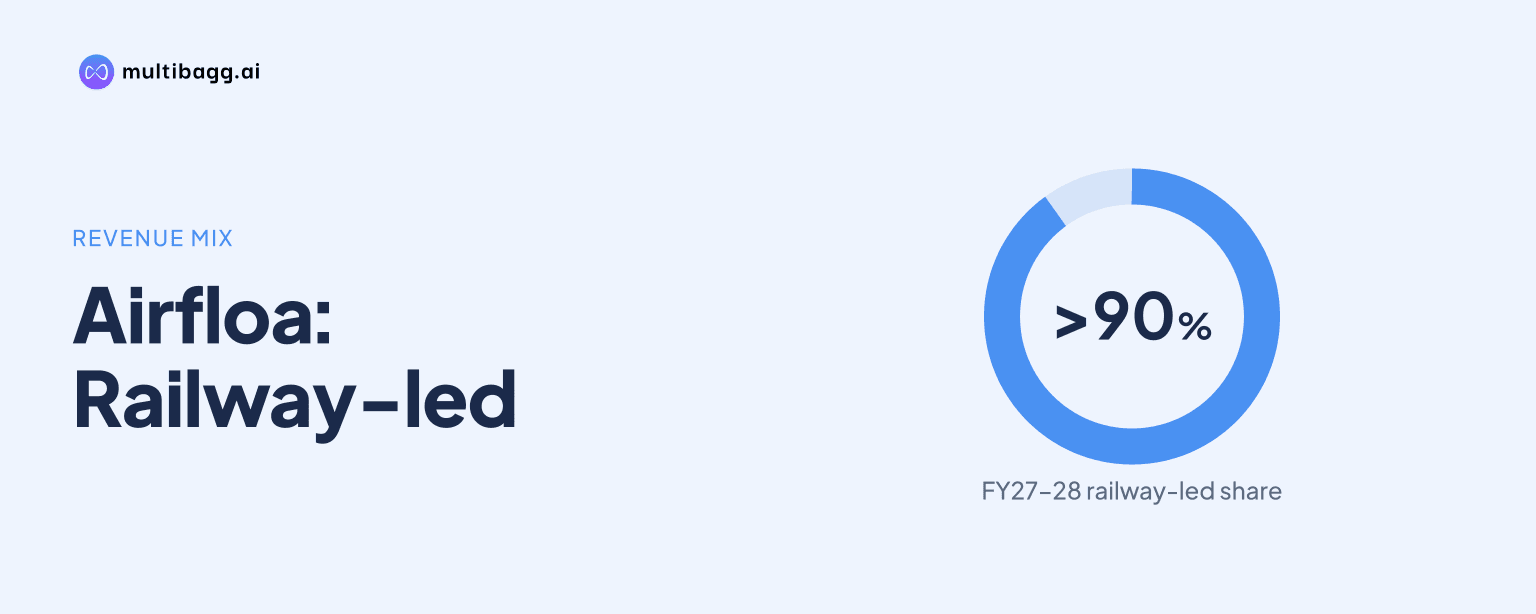
Airfloa Rail Technology Limited said on November 16, 2026 that more than 90% of its Rs 750 crore to Rs 800 crore FY27-28 revenue plan was expected to come from railways, with aerospace and defence contributing about 10% unless projects under pursuit convert into tangible orders. Management said its committed revenue numbers were based predominantly on railway contracts.
Know Airfloa Rail Technology inside out
Results, valuation, peers and who's buying, in one view.
What share of Airfloa’s FY28 revenue plan is railway-led?
Airfloa said more than 90% of its Rs 750 crore to Rs 800 crore FY27-28 revenue guidance was railway-led, while aerospace and defence accounted for the remaining roughly 10%. Management gave that assessment in response to a request for revenue and margin guidance by segment, and said it reflected its view as of November 16, 2026.
Management also clarified that the Rs 750 crore to Rs 800 crore figure was its projection for the following year, rather than a closing order book expected to be executed over several years. It said the company expected to build the relevant order book in the current year for execution during the next year, making the target a one-year revenue plan.
The railway weighting matters because management separately told an analyst that the numbers it was committing to were based on railway contracts. It said sizeable defence orders, if converted, could alter both the revenue mix and its capital requirements, but such awards were not the basis of the stated Rs 750 crore to Rs 800 crore plan.
Why are defence and aerospace not a larger part of the plan?
Defence and aerospace are not a larger part of Airfloa’s current plan because management said their contribution can rise only when projects being pursued become tangible orders. The company is pursuing tender-based defence work and the government’s Make-1 programme, but management distinguished the potential timing and scale of those routes.
For tender-based work, management said it was anticipating possible orders in the Rs 50 crore, Rs 100 crore and Rs 150 crore range. For Make-1, it described the opportunity as a larger government programme, potentially involving thousands of crores of business, but said product development itself would take at least one year even if agreements were completed in the near future.
Airfloa said it was working on shock and vibration testing of Indian Space Research Organisation, or ISRO, satellites, satellite testing and simulation, and rocket-launching programmes. Management also identified specialised drones, anti-drones, autonomous systems and precision-guided ammunition as defence focus areas, without disclosing an awarded order value or revenue contribution for these activities.
Management said aerospace and defence could record a significant percentage increase in FY27-28, but this was its outlook rather than contracted revenue guidance. A percentage increase from the current roughly 10% share would not change the railway-led plan unless the company secures orders beyond those currently reflected in its guidance.
Got a follow-up? Ask IRIS
What railway activities support Airfloa’s revenue target?
Airfloa’s FY27-28 target is supported by turnkey railway contracts, including work related to Amrit Bharat trains, new electric multiple unit, or EMU, trains and mainline electric multiple unit, or MEMU, trains. Management said these are predominantly new end-to-end contracts, which lengthen both conversion and receivable cycles.
The company also expects a greater metro contribution after its KIN acquisition. Management said metro contracts normally have better margins than regular railway contracts and said KIN had been approved on the global platforms of Alstom, Hitachi and Siemens, an element of the acquisition strategy that could support future international opportunities.
Metro previously represented less than 10% of Airfloa’s overall railway business, management said. Following the KIN acquisition and an association with KTK, management said the company expected to become a major participant in metro interiors, changing the composition of its railway activities even while railways remain the principal revenue source.
Airfloa is also expanding into railway infrastructure through platform screen doors. Management estimated the Indian platform screen-door market at about Rs 2,000 crore a year and said annual business growth was Rs 1,500 crore to Rs 2,000 crore, with KTK intended to support participation in tenders from metro systems including Delhi, Chennai and Bangalore.
Management described Airfloa as a supplier of railway-coach interiors and exteriors and a frontline system integrator, rather than a conventional coach builder. It cited automatic sliding-door systems and vacuum-toilet systems as technology products that could supplement its core coach-related activity.
How will Airfloa fund its railway-based plan?
Airfloa said it could manage the Rs 750 crore revenue target with borrowings already in place, including about Rs 100 crore of working-capital borrowing. Management said major borrowing during the current year had been undertaken for the KIN acquisition and said it did not foresee a need for large additional borrowing to achieve the railway-based target over at least the next year.
Analysts on the call cited total borrowings of about Rs 140 crore and about Rs 150 crore in separate questions, and management did not reconcile the difference. It did state that its interest rate was approximately 8.25% to 8.5%, and said it could take another Rs 100 crore of borrowing after one year over the following two years.
Management said fresh equity was not envisaged for the next six or seven months under the current railway-focused plan. It said additional funds could be required if large defence or aerospace orders materialised, particularly if demand exceeded the company’s current expectations in those segments.
Receivables remain a disclosed operating consideration. Management acknowledged receivables of about Rs 263 crore and said 78.2% were within 180 days, attributing slower collection partly to the longer cycle of new turnkey Amrit Bharat, EMU and MEMU contracts.
Airfloa said it was working to reduce debtor days through closer monitoring and expected an improvement within about six months. Management also set a goal of achieving positive cash flow in FY27-28, linking receivable collection and cash flows to its ability to manage funding during the next year.
Conclusion
Airfloa’s FY27-28 revenue outlook remains primarily a railway execution plan, with more than 90% of the Rs 750 crore to Rs 800 crore target tied to that segment. The mix is supported by turnkey train contracts, a larger metro presence following KIN, and an expansion into platform screen doors, while defence and aerospace remain a smaller current component.
The next disclosures to watch are management’s planned reduction in debtor days within about six months and its FY27-28 positive cash-flow goal. Investors should also monitor whether tender-based defence projects or Make-1 agreements become tangible orders, because management said such conversion could change the revenue mix and require additional capital.