










Airfloa Rail Technology H1 FY27 Revenue Rises 143% to ₹220.3 Crore
Key highlights
- Airfloa reported H1 FY27 revenue of ₹220.3 crore, up 143% year on year.
- H1 FY27 EBITDA rose 120% to ₹48.4 crore, with an EBITDA margin of 21.9%.
- H1 FY27 profit after tax increased 108% to ₹25.1 crore, with an 11.4% PAT margin.
- Airfloa's combined order book was ₹610 crore as of 15 November 2026, and FY27 revenue guidance of ₹500 crore or more was retained.
powered by IRIS
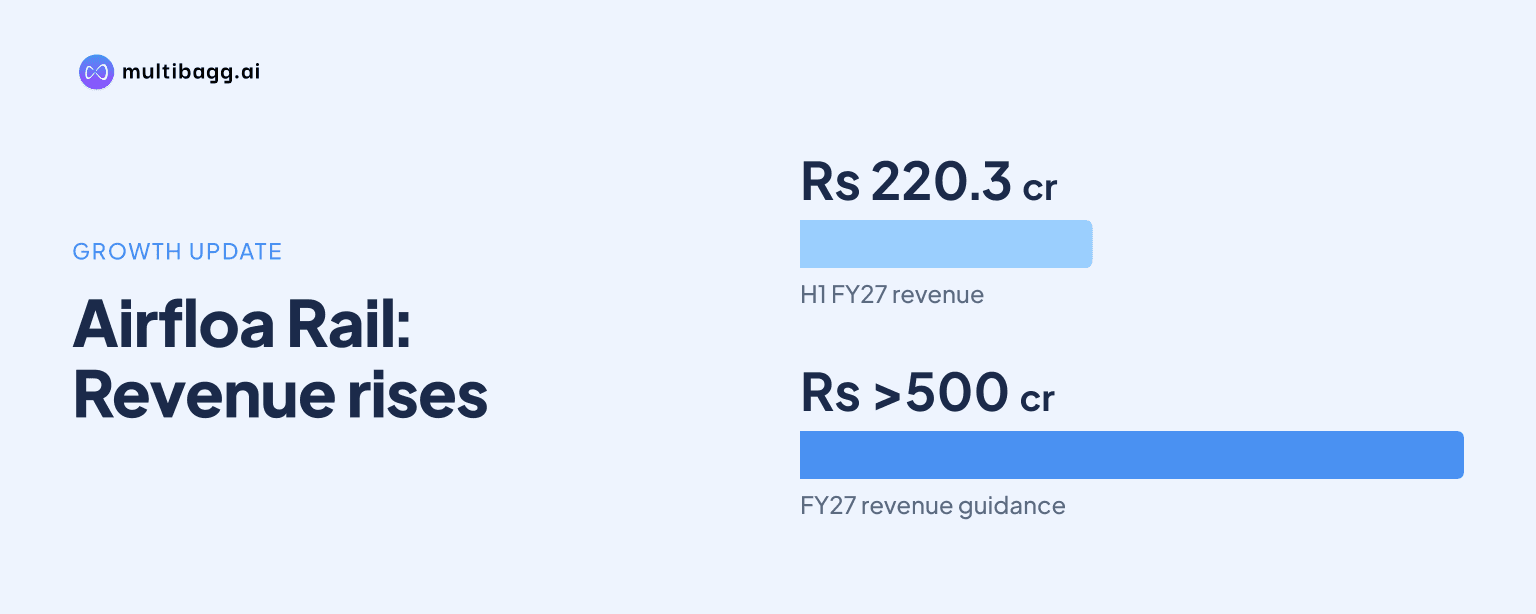
Airfloa Rail Technology Limited reported H1 FY27 revenue from operations of ₹220.3 crore, a 143% year-on-year increase, while profit after tax rose 108% to ₹25.1 crore. The railway-focused manufacturer retained its FY27 revenue guidance of ₹500 crore or more, supported by its existing order book, the KIN Railway Equipments acquisition and planned execution in the second half.
Know Airfloa Rail Technology inside out
Results, valuation, peers and who's buying, in one view.
What drove Airfloa's H1 FY27 financial performance?
Airfloa delivered higher revenue and profit in the half year ended 30 September 2026, led by its core railway business. Revenue from operations increased 143% year on year to ₹220.3 crore, EBITDA grew 120% to ₹48.4 crore, and PAT increased 108% to ₹25.1 crore.
The EBITDA margin was 21.9%, compared with 24.3% in H1 FY26. PAT margin stood at 11.4%, against 13.3% a year earlier. Management said the PAT margin remained within its communicated 10% to 12% range despite the movement in operating margins.
The H1 results were discussed during the investor earnings call held on 16 November 2026. The company subsequently submitted the call recording link and said the discussion covered unaudited financial and operational results for the half year, with no unpublished price-sensitive information shared during the meeting.
What does Airfloa's order book indicate for FY27 execution?
Airfloa's combined order book stood at ₹610 crore as of 15 November 2026, including about ₹180 crore acquired with KIN Railway Equipments. The company said it planned to execute around ₹280 crore during the balance of FY27 while maintaining its revenue guidance of ₹500 crore or more.
Railways represented 94% of the order book and non-railway activities accounted for 6%. Management attributed the lower H1 order inflow of ₹49 crore, compared with ₹380 crore in FY26, to its approach of selecting projects based on profitability rather than pursuing growth at any cost.
The company has targeted fresh order inflow of ₹450 crore in the coming months, mainly from railways and, to a lesser extent, defence and aerospace. It expects its FY27 closing unexecuted order book to be ₹750 crore to ₹800 crore, based on this planned inflow and execution schedule.
Got a follow-up? Ask IRIS
How are KIN and new projects expanding Airfloa's operations?
Airfloa acquired KIN Railway Equipments' business for ₹41 crore in cash plus GST. The acquired Coimbatore facility has more than 2 lakh square feet of space and capabilities spanning metro rail, rolling stock, coach interiors and railway equipment. The company plans to position it as an International Business Facility for exports and metro-related work.
KIN brought an order book of about ₹180 crore and approvals with global platforms including Alstom, Hitachi and Siemens. Management said these approvals were an important reason for the acquisition, with export orders targeted from FY28 and beyond. It also indicated that metro work could carry better margins than regular railway business.
Airfloa also received a ₹34.85 crore contract, including GST, from ICF Chennai in October 2026 for Vande Bharat sleeper trainset interior design and associated development. It is leading a consortium with Italy-based Blue Engineering SRL, with completion scheduled within 12 months of the letter of acceptance.
In defence, Airfloa has a 51:49 joint venture with Big Bang Boom Solutions, where it is the manufacturing partner and intellectual property resides with the venture. Three projects involving electronic warfare, AI-driven autonomous platforms and high-precision defence components are under way, with commercial timelines communicated for FY28.
What are the margin, working-capital and balance-sheet considerations?
Airfloa said increases in aluminium and other input prices affected the economics of certain ongoing and prospective projects. The company has engaged customers on price revisions, while retendering has started and new bids are being submitted at revised prices. Its stated EBITDA margin target range is 20% to 30%, while its PAT margin baseline remains 10% to 12%.
Working-capital intensity remains material because of turnkey railway contracts, including Amrit Bharat, EMU and MEMU projects. Debtor days were 197, compared with 195 in FY26, and the cash conversion cycle was 234 days, against 203 days. Inventory days had reduced by 19 days from March 2026, and management said it expects debtor days to decline within about six months.
As of 30 September 2026, cash and bank balances were ₹17.3 crore and net debt to equity was 0.5 times, compared with 0.2 times in FY26. Borrowings rose to support business scale and the KIN acquisition, with regular working-capital borrowings of about ₹100 crore. Management said positive operating cash flow is targeted in FY28.
Capacity utilisation was around 90% across six manufacturing units, including KIN's facility. Airfloa plans a new facility on a 14-acre site to consolidate units and add automation, funded through IPO proceeds. The company also said it did not expect to require fresh equity over the next six to seven months unless large defence and aerospace orders materialise.
Conclusion
Airfloa's H1 FY27 results show rapid growth in revenue, EBITDA and profit, backed primarily by railway execution. The ₹610 crore combined order book, KIN acquisition and Vande Bharat sleeper interiors contract provide identifiable operating activity, while the margin decline and longer cash conversion cycle remain relevant financial considerations.
Investors will watch execution of the planned ₹280 crore in second-half FY27 revenue, the company's ability to secure the targeted ₹450 crore of new orders, and progress on reducing debtor days. Management has retained FY27 revenue guidance of ₹500 crore or more and has set FY28 revenue guidance at ₹750 crore with a 10% to 12% PAT margin range.