










Airfloa sees EBITDA margin nearing 30% within a year
Key highlights
- Airfloa reported a 21.9% EBITDA margin in H1 FY27 and envisages moving toward 30% within six months to one year.
- Airfloa's H1 FY27 revenue was Rs 220.3 crore, up 143% year on year, while EBITDA was Rs 48.4 crore, up 120%.
- Airfloa's combined order book stood at Rs 610 crore on November 15, 2026, including KIN's order book.
- Airfloa targets Rs 450 crore of fresh orders and Rs 750 crore to Rs 800 crore of unexecuted orders at FY27-end.
powered by IRIS
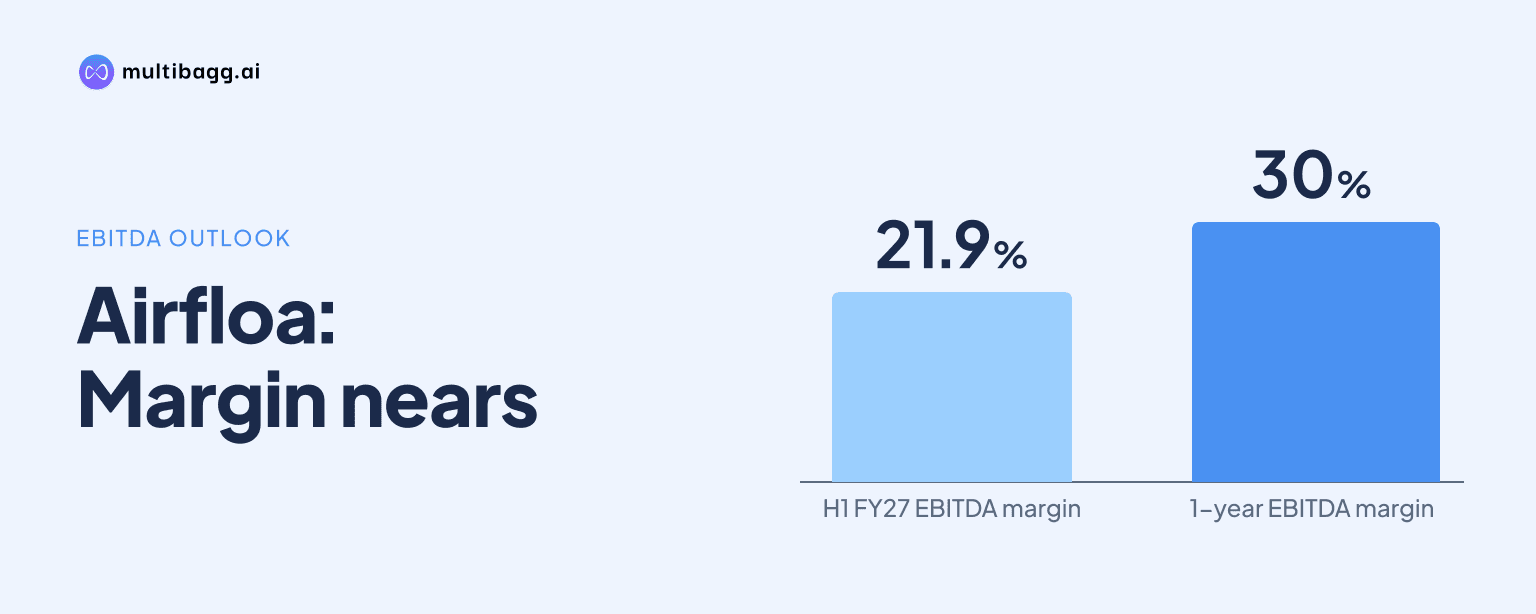
Airfloa Rail Technology Limited said it envisages lifting EBITDA margin toward 30% within six months to one year, from 21.9% in H1 FY27, as it expands into technology-led railway, metro, aerospace and defence projects. Management maintained a profit-after-tax margin baseline of 10% to 12%, despite not committing to a higher PAT outcome.
Know Airfloa Rail Technology inside out
Results, valuation, peers and who's buying, in one view.
Can Airfloa reach a 30% EBITDA margin within a year?
Yes, Airfloa management said it envisages increasing EBITDA margin from about 22% to 30% within six months to one year. Airfloa reported a 21.9% EBITDA margin for H1 FY27, when revenue from operations reached Rs 220.3 crore and EBITDA, or earnings before interest, tax, depreciation and amortisation, was Rs 48.4 crore. Management confirmed, when asked whether the timeframe extended to FY28, that it did.
The H1 FY27 figures show revenue growing faster than EBITDA. Revenue rose 143% year on year to Rs 220.3 crore, while EBITDA rose 120% to Rs 48.4 crore. Profit after tax, or PAT, increased 108% to Rs 25.1 crore, and the PAT margin was 11.4%. That reported PAT margin remained within Airfloa's stated 10% to 12% baseline range.
Airfloa has not issued a formal commitment to a 30% EBITDA margin or to a corresponding PAT margin. When an analyst suggested that a 30% EBITDA margin in FY28 could lead to a 15% to 18% PAT margin, management declined to commit to those numbers. It said its committed PAT margin range remains 10% to 12%, while its objective is to raise the margin beyond that baseline.
Which projects could lift Airfloa's EBITDA margin?
Airfloa expects higher-technology railway work, metro contracts, and eventual aerospace and defence activity to lift margins. Management said technology-led businesses offer better margins and said its anticipated EBITDA margin range is 20% to 30% as it concentrates on aerospace, defence and high-technology railway projects. It also linked a higher margin outcome to larger businesses where technology is involved.
In October, Airfloa secured a Rs 34.85 crore contract, including goods and services tax, from ICF Chennai as lead member of a consortium with Italy-based BLUE Engineering S.r.l. The assignment covers the interior design of the Vande Bharat sleeper trainset and associated development work. It is scheduled for completion within 12 months from issuance of the letter of acceptance and extends Airfloa's participation from manufacturing and furnishing into design and engineering work.
Airfloa has also signed a memorandum of understanding with KTK Group Company Limited to jointly pursue eligible platform screen-door projects in India. KTK is expected to provide system design, engineering expertise, proprietary technology and technical oversight. Airfloa's expected role covers selected mechanical and electrical components, local project management, installation, testing and commissioning, although the company disclosed no contract value, awarded order or execution date under the arrangement.
Management said the acquired KIN business has an Rs 180 crore order book and operates in metro projects. It said metro contracts normally carry better margins than regular railway contracts and that it expects better margins from KIN than from its regular business. Airfloa did not disclose KIN's EBITDA margin, PAT margin or its expected contribution to the consolidated margin in FY27 or FY28.
Got a follow-up? Ask IRIS
What order book supports Airfloa's FY27 and FY28 plan?
Airfloa reported a combined order book of Rs 610 crore as of November 15, 2026, including the order book acquired through KIN. Management plans to execute Rs 280 crore of orders during the balance of FY27 and is targeting Rs 450 crore of fresh orders in the coming months. It expects to end FY27 with an unexecuted order book of about Rs 750 crore to Rs 800 crore.
Airfloa retained revenue guidance of Rs 500 crore and above for FY27 and introduced revenue guidance of Rs 750 crore for FY28. Management said the expected Rs 750 crore to Rs 800 crore unexecuted order book at the end of FY27 would give revenue visibility entering FY28. In a later clarification, it said that this projected order book was intended for execution in the following financial year.
Order inflow during H1 FY27 was Rs 49 crore, according to an analyst's question, compared with management's Rs 450 crore target for the second half. Management said order inflow had been slower because Airfloa was selecting projects based on profitability. It expects the targeted fresh orders to come mainly from railways, with some contribution from defence and aerospace.
Management said Airfloa could obtain Rs 1,000 crore to Rs 2,000 crore of orders in the current market, but is choosing bids based on profitability requirements. This selective approach is part of the margin plan because revenue guidance of Rs 500 crore and above for FY27 is not based solely on pursuing higher order volumes. The transcript does not disclose a minimum EBITDA margin threshold for individual contracts.
What could delay Airfloa's margin expansion?
Aerospace and defence may take longer to affect Airfloa's earnings mix because management described them as long-gestation businesses. It said projects require product development and qualification against local and international criteria, unlike some railway contracts that can be executed in two or three months. Airfloa's association with Big Bang Boom covers three projects, with management citing a 2027-2028 timeline.
Receivables and operating cash flow are also execution matters management identified. An analyst cited receivables of about Rs 263 crore, and management said approximately 78.2% of receivables were within 180 days. It attributed longer collection timing partly to turnkey contracts for Amrit Bharat, new electric multiple-unit, or EMU, trains and new mainline electric multiple-unit, or MEMU, trains.
Management said debtor days had remained broadly stable despite revenue growth, while inventory days had fallen by 19 days compared with March 2026. It said it was implementing methods to reduce debtor days within about six months. Airfloa's cash and bank balances stood at Rs 17.3 crore on September 30, 2026, while its net debt-to-equity ratio was 0.5 times.
Airfloa's management goal is to generate positive operating cash flow in FY27-28. It said approximately Rs 100 crore of borrowings had been used for regular working capital, with other borrowing mainly related to the KIN acquisition. Management said it did not expect major additional borrowings to achieve the Rs 750 crore FY28 revenue target over the next year, but said a large tangible defence order could require capital raising.
Conclusion
Airfloa's plan to move EBITDA margin toward 30% within six months to one year depends on changing its project mix rather than only expanding railway volume. The company reported a 21.9% EBITDA margin in H1 FY27, while management pointed to high-technology railway design, platform screen-door opportunities, KIN's metro work and longer-term aerospace and defence activity as potential sources of improvement. Its stated PAT margin baseline remains 10% to 12%.
The next disclosed markers are Rs 450 crore of targeted fresh orders, Rs 280 crore of planned execution in the balance of FY27, and an expected Rs 750 crore to Rs 800 crore unexecuted order book at FY27-end. Management also plans to reduce debtor days within about six months and targets positive operating cash flow in FY27-28, while the three Big Bang Boom projects retain a stated 2027-2028 timeline.