










Airtel shifts incremental capex toward data centres and cloud
Key highlights
- Airtel installed roughly 500 to 600 new tower sites in the quarter ended September 30, 2026.
- Airtel says its acquired data-centre land could support at least 400 to 500 megawatts over time.
- The Visakhapatnam data-centre build-out is expected to require lumpy capex over the next 12 to 18 months.
- Airtel reported more than 200 million 5G users in the September 2026 quarter.
powered by IRIS
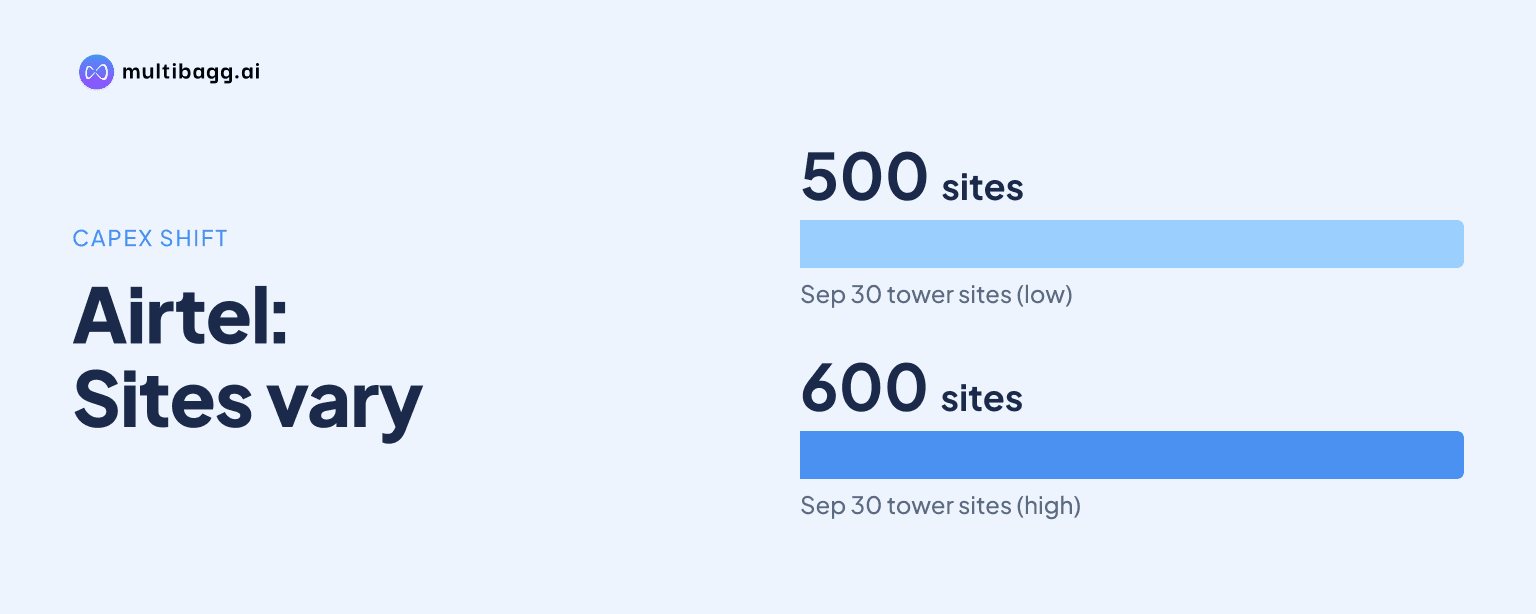
Bharti Airtel Limited says incremental capital expenditure will increasingly fund data centres and cloud after radio-network spending moderated, with only about 500 to 600 new tower sites installed in the quarter ended September 30, 2026. Airtel said much of the mobile-network build-out has already occurred, while data-centre projects will require lumpy investment.
Know Bharti Airtel inside out
Results, valuation, peers and who's buying, in one view.
Why has Airtel's radio-network capex moderated?
Airtel says radio-network capital expenditure has moderated because much of the required build-out is complete. Executive Vice Chairman Gopal Vittal said new tower installations were now very limited, at less than 1,000 and in the range of 500 to 600 sites in the quarter ended September 30, 2026. This marks a different spending profile from the network expansion phase, although management did not disclose a historical tower-addition figure.
Airtel will still spend on fifth-generation, or 5G, network expansion, but management described this as part of a consistent core-business investment profile rather than a source of spending spikes. Core capex will depend on data-volume growth and data consumption, while the radio component is expected to remain relatively small. Airtel reported more than 200 million 5G users during the September 2026 quarter.
Transport infrastructure remains a material part of the network budget because Airtel is carrying out fibre deployment across the company. Vittal distinguished this from radio spending, calling transport capex large because of fibreisation, while saying the core business does not face expected capex spikes. The shift therefore changes the destination of incremental spending rather than ending investment in the mobile network.
Where will Airtel put its incremental capex?
Airtel says much of its incremental capex will go to growth bets in data centres and cloud. Vittal made that allocation explicit in response to a question on company-wide capital deployment, while Chief Financial Officer Soumen Ray said data-centre spending can be lumpy because it includes land purchases and construction projects. By comparison, management described cloud investment as more graded.
Airtel has acquired land that could support at least 400 to 500 megawatts of data-centre capacity over time, according to Vittal. Management said the sites are in locations where demand appears high and that Airtel will assess further land options. This represents capacity optionality, not a disclosed construction timetable or a commitment to build the full 400 to 500 megawatts immediately.
Airtel identified Visakhapatnam as a project that will bring lumpy spending over the next 12 to 18 months as the facility is built out. Management is seeking to shorten construction cycles through strategic partnerships covering construction and equipment such as chillers, alongside modular units that can be added over time. Airtel is also consolidating 56 edge data centres from more than 100 mobile switching centre locations into state-of-the-art facilities.
Got a follow-up? Ask IRIS
What does the capex shift mean for Airtel's spending profile?
Airtel's spending profile is likely to become less tied to tower additions and more exposed to the timing of individual infrastructure projects. Ray said the difference between cash-flow capex and capital work in progress would continue for large projects as Airtel develops more data centres. He added that there is no divergence in the core business, where business-as-usual spending, work in progress and capitalisation follow the same trend.
Management cautioned against drawing conclusions from a single quarter's wireless capex because weather can delay field work during the September quarter. Ray asked investors to use a trailing 12-month measure rather than quarterly figures, noting that poor weather typically affects second-quarter deployment. Airtel did not provide a per-megawatt data-centre capex estimate because location, design and intended use create too many variables for a standard figure.
The home-broadband business is a separate investment call within the wider portfolio. Managing Director and Chief Executive Officer Shashwat Sharma said the business is in an acquisition and growth phase, with fibre and customer-premises equipment, or CPE, as the two major capex components. Its earnings before interest and tax, or EBIT, has been softer as Airtel invests and corrects low-average-revenue-per-user customer acquisition and sales practices identified over the past couple of quarters.
How will Airtel balance data-centre investment with other uses of cash?
Airtel says it will use debt for part of data-centre funding, reflecting the long-term infrastructure nature of the projects. Ray said Airtel had completed an equity raise and had cash on the balance sheet, but said any decision on additional equity one or two years later would depend on cash available to the three owners of Nxtra and debt pricing at that time. Management gave no commitment to another equity raise.
The capital-allocation plan also includes investments outside data centres. Vittal said Airtel had announced a potential continuing buyback in Airtel Africa and had also undertaken one in Indus, while dividend payouts would keep increasing over time. Ray separately said gross debt should trend down directionally and opportunistically by country and operating conditions, after large dividend payouts in Q2 by Indus, Airtel and Airtel Africa.
Cloud and artificial-intelligence spending remain less defined than data-centre construction. Airtel already buys graphics processing unit chips for internal workloads, but management said it is still studying bare-metal leasing, graphics-processing-unit-as-a-service and a full artificial-intelligence stack for enterprise customers. Vittal called the area early-stage and flagged counterparty risk in bare-metal demand, particularly among smaller players.
Conclusion
Airtel's September 2026 commentary indicates a capital-allocation transition rather than a reduction in investment. Radio build-out has moderated to roughly 500 to 600 new sites in the quarter, while fibre remains material and incremental funding is directed toward data centres and cloud. Capex timing may therefore be shaped increasingly by land acquisition, facility construction and project completion rather than tower deployment alone.
The next items to watch are the Visakhapatnam build-out over the stated 12 to 18 months, progress toward using land capable of supporting at least 400 to 500 megawatts, and management's financing choices between project debt and potential future equity. Airtel's trailing 12-month capex trend will also be more informative than a single second-quarter period, according to the chief financial officer.