










Bharti Airtel’s New Land Can Support 500 MW Data Centres
Key highlights
- Airtel aims to build 1,000 MW of data-centre capacity over the next few years.
- Airtel’s new strategic land can support at least 400-500 MW of data-centre capacity over time.
- Airtel is consolidating 56 edge data centres from more than 100 mobile switching centres.
- A Visakhapatnam data-centre build-out is expected to involve lumpy capital expenditure over the next 12-18 months.
powered by IRIS
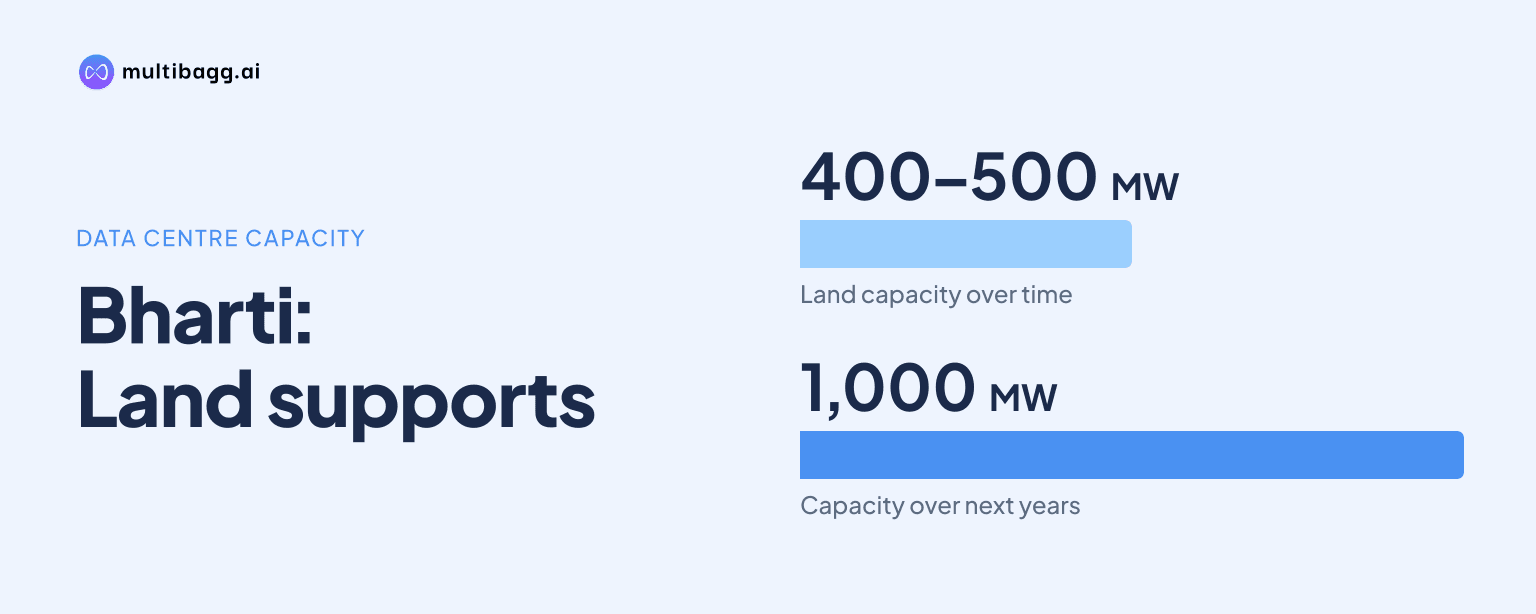
Bharti Airtel Limited said during its Q2 ended September 30, 2026 earnings webinar that newly acquired strategic land can support at least 400-500 megawatts of data-centre capacity over time, equal to as much as half of Airtel’s stated ambition to build 1 gigawatt of capacity over the next few years.
Know Bharti Airtel inside out
Results, valuation, peers and who's buying, in one view.
How much data-centre capacity is Airtel planning?
Airtel is pursuing 1 gigawatt, or 1,000 megawatts, of data-centre capacity over the next few years. Management said Nxtra, its data-centre business, is growing revenue through capacity expansion and new contract wins, while Group Chief Financial Officer Soumen Ray described the planned build-out as moving from a 200-250 MW reference point to 1 GW.
The 1 GW ambition is a multi-year plan rather than a disclosed completion schedule. During the Q2 ended September 30, 2026 webinar, management did not provide annual construction targets, an operational-capacity figure, expected utilisation levels or a date by which Airtel expects to reach 1,000 MW.
The land parcel could account for 40%-50% of the 1,000 MW ambition, based on the stated 400-500 MW range. That comparison shows the site’s importance to Airtel’s expansion options, although management said it would continue to evaluate other land parcels and build-out opportunities.
What can Airtel build on its new data-centre land?
Airtel said the newly acquired land provides optionality to build at least a 400-500 MW data-centre plant over time. Executive Vice Chairman Gopal Vittal described it as a large tract in a strategic data-centre hub where demand appears high, but management did not identify the location, land size, acquisition cost, power availability or timing of an initial construction phase.
The company linked the land acquisition to its broader data-centre expansion rather than to a named customer contract. In prepared remarks for Q2 ended September 30, 2026, Airtel said its investment in the strategic parcel strengthened its footing for ongoing expansion and called data centres the start of a multi-year growth journey.
Management also pointed to a potential overseas demand opportunity. Vittal said capacity additions in the United States may become more challenging and that some demand could therefore be directed to India, but this was an assessment of market conditions rather than a customer commitment, revenue forecast or disclosed order pipeline.
How is Airtel speeding up data-centre construction?
Airtel is working to reduce construction time through modular designs, strategic partnerships and a faster-build toolkit. Management cited partnerships covering both construction and equipment such as chillers, saying modular units could be created repeatedly to compress the development cycle as new capacity is required.
Airtel also disclosed a data-centre build-out in Visakhapatnam that will involve lumpy capital expenditure over the next 12-18 months. Management contrasted that spending pattern with cloud investment, which it expects to be more graded, while not disclosing the Visakhapatnam facility’s capacity, total cost or commissioning date.
The programme includes network-edge infrastructure as well as central data-centre hubs. Airtel is consolidating 56 edge data centres from more than 100 mobile switching centres, or MSCs, into state-of-the-art facilities, and is considering larger land parcels at the edge that could support further data-centre construction closer to its network.
In Q2 ended September 30, 2026, Airtel also said it was strengthening the transport layer beneath its 5G network and building edge data centres to improve network resilience. The transcript does not state how many of the 56 facilities will be rebuilt, their aggregate capacity, or the amount of capital assigned to the edge programme.
Got a follow-up? Ask IRIS
Is Airtel expanding into GPU-as-a-Service?
Airtel is studying graphics processing unit, or GPU, as a service and a broader enterprise artificial-intelligence, or AI, stack, but has not announced a commercial launch. Management said Airtel has already added GPU capacity in its data centres for internal AI workloads and is assessing external opportunities as customer requirements develop.
Management outlined three possible models. The first is bare-metal GPU leasing, which it described as a commoditised capital-expenditure-to-operating-expenditure model with counterparty risk among smaller participants. The second is GPU-as-a-Service, which requires more software and orchestration, while the third is a full AI stack offered through cloud services.
For now, Airtel’s disclosed chip purchases support internal use. Its homegrown Agent Bridge platform and added GPU capacity are helping the company activate AI use cases across customer-facing and internal processes, while its AI-enabled radio access network, or RAN, orchestrated more than 14 million sleep hours each day during Q2.
The external AI opportunity remains under evaluation because enterprise customers have asked Airtel for a cloud-based full AI stack. Management said it has built a platform to optimise model costs for its own AI activity, but did not disclose a third-party GPU capacity target, an AI infrastructure revenue target, or planned external chip procurement.
How will Airtel fund the data-centre expansion?
Airtel expects debt to finance part of its data-centre build-out, while retaining flexibility on any future equity funding. Management said the group had received about US$800 million in equity funding in June and July, and that its three Nxtra owners would weigh available cash against debt pricing if further funding is needed.
Management did not provide a debt-to-equity funding mix, capital-expenditure budget, borrowing cost or timetable for another equity raise. Ray said large, long-term infrastructure projects would use some debt and that Airtel would not fund the entire data-centre programme through equity.
Capital allocation is shifting towards newer growth businesses as radio-network spending moderates. Management said incremental capital expenditure would mainly support data centres and cloud, while core radio spending had moderated after much of the network build-out was completed and fewer than 1,000 new towers were being installed in the referenced quarter.
Airtel also warned that cash spending and reported capitalisation can differ on large projects. Management said capital work in progress, or CWIP, and capital expenditure converge in the core business, but land purchases and facility construction can create timing differences for data-centre projects before assets are commissioned.
Conclusion
Airtel has defined a measurable framework for its data-centre expansion: a 1,000 MW ambition, strategic land with at least 400-500 MW potential, and an effort to shorten build cycles through modular construction and partnerships. The strategy spans colocation capacity, cloud, edge-facility consolidation and an early-stage assessment of enterprise AI infrastructure.
The next disclosed item to watch is the Visakhapatnam build-out over the next 12-18 months, alongside decisions on additional land, modular delivery and any commercial GPU-as-a-Service offering. Funding structure also remains unresolved because management expects to use debt but has not announced a project budget, financing mix or further equity plan.