










Airtel Says Industry Needs Direct Charges for Mobile Data Consumption
Key highlights
- Airtel reported mobile ARPU of Rs 271 in Q2 FY2027, up from Rs 264 in the preceding quarter.
- Airtel said its Rs 299 prepaid intervention had already played out in Q2 FY2027.
- Airtel added 1.2 million postpaid customers in Q2 FY2027, its highest-ever quarterly net additions.
- Airtel added 2.9 million smartphone data customers in Q2 FY2027.
powered by IRIS
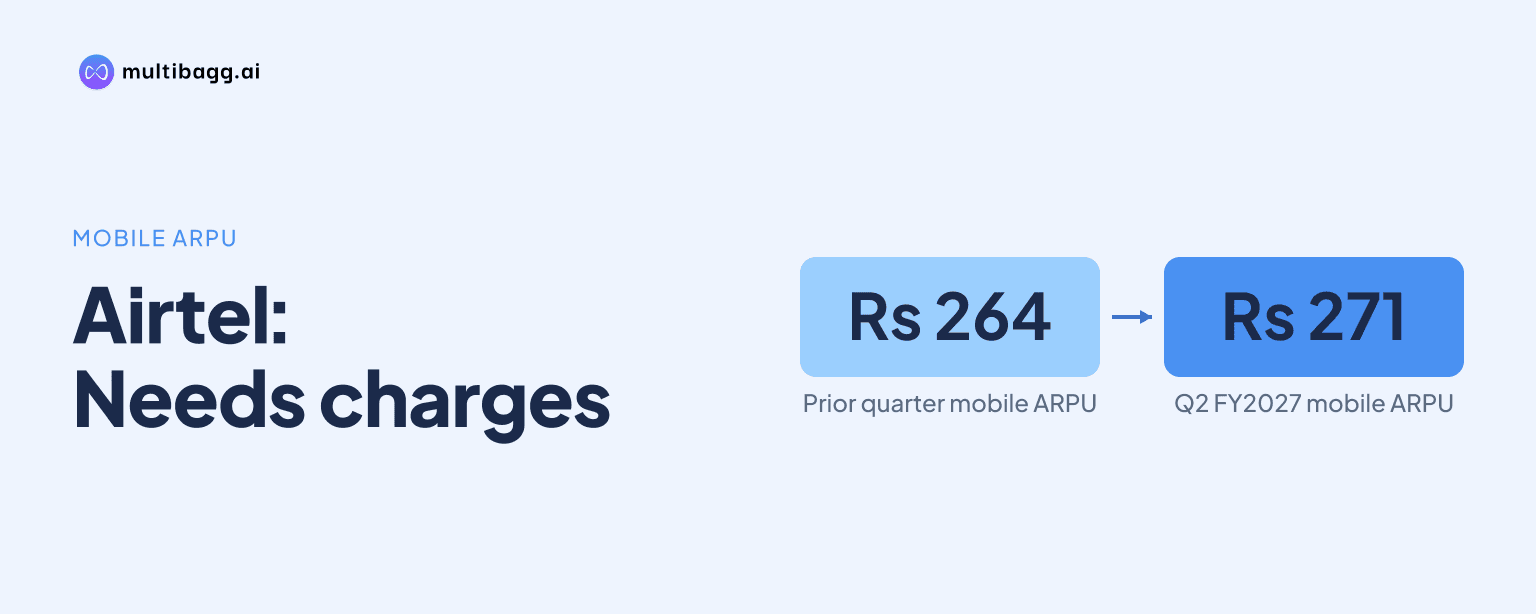
Bharti Airtel Limited said in the second quarter of financial year 2027 (Q2 FY2027) that the mobile industry needs to charge more directly for data consumption, as low average revenue per user (ARPU) plans provide unlimited usage without monetizing consumption; Airtel’s ARPU was Rs 271, up from Rs 264 in the preceding quarter.
Know Bharti Airtel inside out
Results, valuation, peers and who's buying, in one view.
Why does Airtel want mobile data pricing to change?
Airtel’s answer is that the current industry structure gives customers unlimited usage and data at very low ARPUs without monetizing the consumption itself. Shashwat Sharma, managing director and chief executive officer of Airtel India, described the architecture as “very flat” during the earnings webinar for the quarter ended September 30, 2026. He said a structural change would require the industry to move more decisively, rather than being an action Airtel could complete alone.
The distinction matters because Airtel is not merely seeking higher plan prices. Management framed the issue as a mechanism for charging for data in more ways as consumption rises. The transcript does not specify a proposed tariff design, a usage threshold or a timetable for an industry move. It therefore remains a management view about the sector’s pricing framework, rather than a disclosed plan to introduce a particular data-charge model.
Airtel’s mobile ARPU reached Rs 271 in Q2 FY2027, compared with Rs 264 in the preceding quarter. Management said the quarter had one extra day, which also benefited ARPU. The company nonetheless said it sees significant room to increase ARPU through plan upgrades, postpaid migration, international roaming and top-ups while the larger industry architecture remains unchanged.
Was Airtel’s Rs 299 prepaid change an industry pricing correction?
No. Airtel said the Rs 299 pack intervention was an experiment on its own base intended to keep lifting ARPU, not the broader correction in data-pricing architecture that management says the industry needs. An analyst characterized the action as an August intervention, and Sharma said its Q2 effect had already played out. He did not quantify how much of the sequential ARPU increase came from that pack change.
Management said it is now looking to other levers to keep ARPU growing steadily in coming quarters. Those levers include upgrades to higher plans, postpaid, international roaming and top-ups. This separates a company-specific prepaid portfolio action from the sector-wide issue: the former can influence Airtel’s mix and customer revenues, while the latter would change how mobile data usage is monetized across the industry.
The Rs 7 sequential increase occurred alongside customer additions in Q2 FY2027. Airtel added 0.7 million revenue-earning customers and 2.9 million smartphone data customers during the quarter, according to management’s prepared remarks. Those additions show that the ARPU discussion covers both pricing and customer mix, but the call does not allocate the Rs 7 movement among the Rs 299 pack action, plan migrations, customer additions or the extra day.
How is Airtel pursuing ARPU growth before any industry action?
Airtel is pursuing ARPU growth through portfolio premiumization, with personalized offers, plan upgrades, postpaid adoption, international roaming and top-ups as its disclosed levers. Management said it will use deeper customer insights and personalization to improve monetization while maintaining customer acquisition. That approach is distinct from the call for an industry-led move to charge more directly for growing data use.
Postpaid is central to that premiumization strategy. Airtel added 1.2 million postpaid customers in Q2 FY2027, its highest-ever quarterly net additions, and postpaid customers represented 8.3% of its total customer base. Over the past four quarters, postpaid accounted for nearly 30% of all customer net additions, giving Airtel a higher-value segment through which it can grow ARPU without altering prepaid data pricing across the industry.
Management said Airtel has about 30 million to 31 million postpaid customers and sees a large pool of potential customers who resemble existing postpaid users. The proposition includes exclusive experiences, premium content, international roaming and Fast Lane, a service built on fifth-generation network slicing for differentiated connectivity in busy networks. Sharma did not separate Fast Lane’s contribution from other features, but said the overall differentiated proposition has helped accelerate postpaid additions.
Got a follow-up? Ask IRIS
Does Airtel think postpaid pricing needs the same reset?
No. Airtel said it is comfortable with postpaid as a separate, premium and differentiated offering, rather than identifying it as the area requiring a meaningful pricing-architecture correction. Management’s concern about unlimited data at low ARPUs was directed to the industry’s broader mobile pricing structure, whereas it said it has consistently strengthened the postpaid proposition to encourage more customers to choose that service.
The contrast is visible in the company’s customer metrics. Q2 FY2027 postpaid net additions of 1.2 million were higher than the 0.7 million increase in revenue-earning mobile customers reported for the quarter, reflecting movement within the base as well as acquisition. Airtel’s stated aim is to accelerate postpaid upgrades further, supported by its go-to-market execution and differentiated service features, rather than to disclose a specific postpaid tariff intervention.
Airtel also said artificial intelligence (AI) traffic on its network is currently “very, very small,” though it expects it to grow and require higher uplink capacity. The company said it is building the capabilities and investment needed as demand develops, but did not disclose a capital-expenditure figure for AI-related uplink expansion. This is relevant to pricing because management’s longer-term concern is that rising data consumption should be monetized more effectively, even though AI traffic is not yet substantial.
What evidence will show whether Airtel’s ARPU plan is working?
The clearest near-term evidence will be Airtel’s reported ARPU, the pace of postpaid upgrades and the mix of smartphone data customers in quarters after Q2 FY2027. Management said the effects of the prepaid pricing intervention had already played out in Q2, so subsequent ARPU movement should reflect the other levers it identified, including plan upgrades, roaming, top-ups and postpaid migration. The call did not provide an ARPU target.
Investors can also track the customer base supporting that strategy. Airtel added 2.9 million smartphone data customers in Q2 FY2027, while management said 92% to 93% of new smartphone shipments in India are fifth-generation devices. It acknowledged some softness in entry-level smartphone upgrades after handset prices rose, but said a growing refurbished-phone market was supporting upgrades at the entry level.
The company’s prepaid changes and its postpaid strategy have different indicators. A plan-level intervention such as the Rs 299 action can affect ARPU after implementation, while postpaid growth can be measured through the 1.2 million Q2 FY2027 additions and the segment’s 8.3% share of Airtel’s customer base. Neither metric, however, would establish whether other operators adopt the industry-wide data monetization framework management advocates.
Conclusion
Airtel’s position is plain: its Rs 299 prepaid action was a company-level ARPU measure, while the change it wants is an industry-wide shift away from unlimited data at low ARPUs toward direct monetization of consumption. Q2 FY2027 mobile ARPU of Rs 271, up from Rs 264, and record postpaid additions of 1.2 million show the company is using premiumization and customer mix to advance revenue per user under the current structure.
What to watch next is whether Airtel can sustain ARPU growth after the Q2 effect of its prepaid intervention, using the upgrades, postpaid, international-roaming and top-up levers management identified. The unresolved issue is whether the broader industry will move toward the pricing architecture Airtel advocates; management disclosed neither a common framework nor a date for such a change.