










Airtel says refurbs cushion entry-level upgrade softness
Key highlights
- Airtel said higher entry-level smartphone prices caused some softness in customer upgrades in the quarter ended September 30, 2026.
- Airtel said refurbished phones are supporting entry-level upgrades as India’s refurbished market expands.
- Management said 92-93% of all new smartphone shipments were 5G models.
- Airtel said it had 30-31 million postpaid customers and aims to accelerate postpaid upgrades.
powered by IRIS
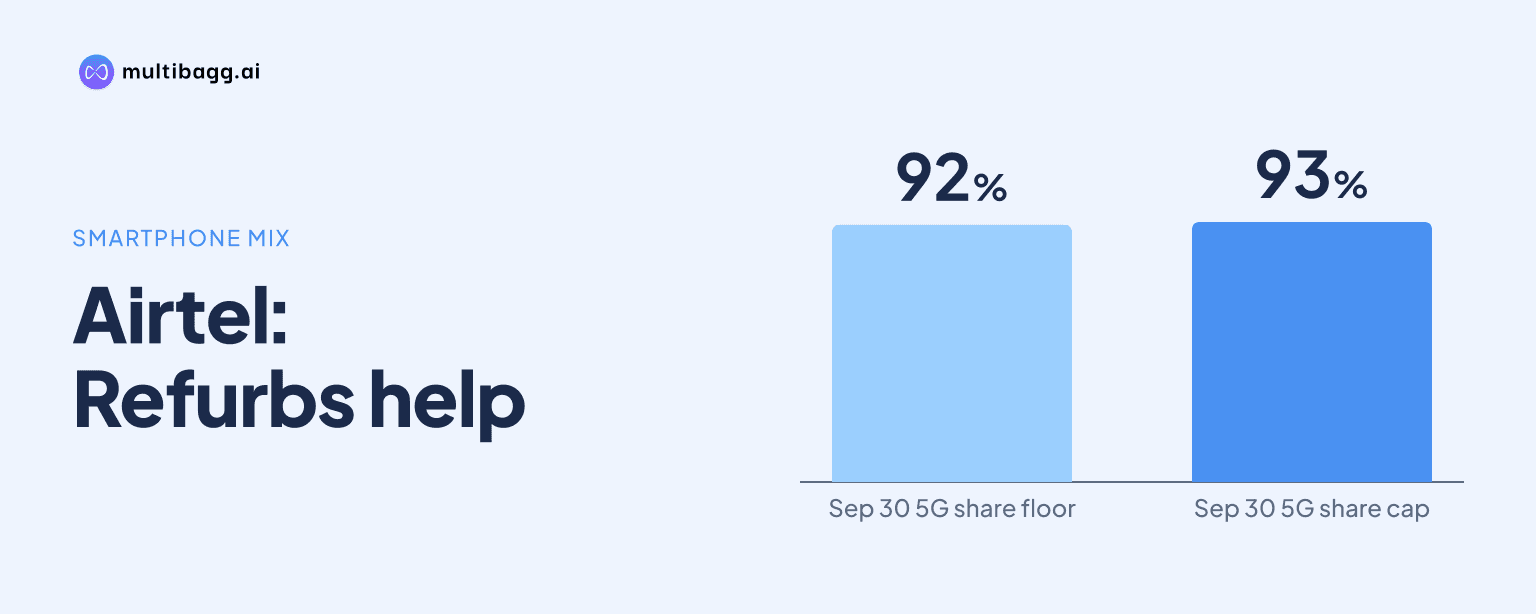
Bharti Airtel Limited said in the quarter ended September 30, 2026 that higher entry-level smartphone prices had caused some softness in customer upgrades, but the expanding refurbished-phone market was supporting entry-level adoption. Airtel said 92-93% of new smartphone shipments were 5G models, so it was not seeing similar softness in the 4G-to-5G transition.
Know Bharti Airtel inside out
Results, valuation, peers and who's buying, in one view.
How have higher smartphone prices affected Airtel upgrades?
Airtel said higher entry-level smartphone prices have caused some softness in customer upgrades in the quarter ended September 30, 2026. Shashwat Sharma, managing director and chief executive officer of Airtel India, said entry-level prices had risen substantially and smartphone shipments had slowed when responding to a question on the 2G-to-4G and 4G-to-5G upgrade cycles.
Airtel did not disclose the size of the price increase, the number of upgrades affected or the extent of the shipment slowdown. Management described the effect as “some softness,” rather than a halt in upgrades. The comment applied particularly to the entry-level smartphone segment, where the upfront handset cost can affect whether a customer moves to a data-capable device.
The handset issue sits alongside Airtel’s mobile strategy of portfolio premiumization and growth in average revenue per user, or ARPU. In the same Q2 webinar, management said plan upgrades, postpaid migration, international roaming and top-ups remained ARPU levers. However, the company’s comments show that device affordability is a separate factor influencing the pace of lower-end customer upgrades.
Are refurbished phones offsetting higher handset prices?
Yes, Airtel said India’s expanding refurbished-phone market is supporting entry-level smartphone upgrades and cushioning the effect of higher new-device prices. Sharma said the refurbished market was strong and growing, and that it was bolstering upgrades despite the softness Airtel had observed in the entry-level segment.
The mechanism is that a refurbished handset can offer a lower-cost route to smartphone ownership when prices of new entry-level devices rise. Airtel did not disclose refurbished-phone sales, device prices, market share or the proportion of upgrades completed using refurbished devices in Q2 ended September 30, 2026. Its statement was therefore qualitative rather than a measure of volume recovery.
Management did not say refurbished devices had fully removed the affordability pressure. Instead, Airtel reported two developments together: higher entry-level prices and slower new-phone shipments had softened customer upgrades, while refurbished phones were supporting those upgrades. The conclusion supported by the call is that refurbished devices provide a partial cushion, not a quantified replacement for new-device demand.
The distinction matters because the analyst’s question covered both the 2G-to-4G and 4G-to-5G cycles. Airtel linked refurbished phones specifically to support “at the entry level,” which is relevant to customers acquiring a smartphone. It gave a separate explanation for the continuing shift to 5G devices.
Got a follow-up? Ask IRIS
Has Airtel’s 4G-to-5G smartphone transition slowed?
No, Airtel said it was not seeing softness in the 4G-to-5G smartphone transition in the quarter ended September 30, 2026. Sharma said almost 92-93% of all new smartphone shipments were 5G models, and that the shift in the original equipment manufacturer, or OEM, device mix was helping the transition.
This differs from the entry-level upgrade trend. Airtel reported that higher entry-level prices and slower smartphone shipments had softened some customer upgrades, but it did not identify comparable softness in migration from 4G to 5G. Management’s explanation was the prevalence of 5G models in new shipments, rather than an Airtel handset programme or price intervention.
The 92-93% figure refers to all new smartphone shipments cited by management. It does not represent Airtel’s 5G subscriber base, handset sales or the share of its customers using 5G devices. Airtel also did not disclose whether the remaining 7-8% of new smartphone shipments were concentrated in a particular price band.
Airtel’s comments therefore separate two stages of device adoption. The first is entry into smartphone use, where affordability has created some softness but refurbished phones are helping. The second is the transition from 4G to 5G, where the high 5G share of new OEM shipments has so far prevented management from seeing a slowdown.
What does handset affordability mean for Airtel’s mobile strategy?
For Airtel, handset affordability is a near-term constraint on certain upgrades, while premiumization remains its stated mobile strategy. In the Q2 webinar, management said it aimed to grow ARPU through plan upgrades, postpaid, international roaming and top-ups, even as entry-level smartphone prices affected the ease of moving some customers to smartphones.
Airtel did not announce a handset subsidy, financing scheme or device partnership in response to the entry-level price issue. Its disclosed mitigating factor was the refurbished-phone market. Management said that market was expanding in India and supporting entry-level upgrades, but it gave no target for refurbished-device penetration or upgrade volumes.
The company also discussed a Q2 intervention on its prepaid plan ladder, including discontinuation of the Rs 299 plan cited by an analyst. Sharma said that intervention had played out and that Airtel would focus on other ARPU levers over coming quarters. He said broader changes to the industry’s pricing architecture would require the industry to move more decisively to monetize data consumption.
Postpaid is a separate part of Airtel’s premiumization plan. Management said Airtel had 30-31 million postpaid customers and was seeking to accelerate upgrades into postpaid through a differentiated offer that includes Fast Lane, premium content and international-roaming features. Airtel did not assign a numerical share of postpaid additions to any one product feature.
Conclusion
Airtel’s Q2 comments present a split device-demand picture. Higher entry-level smartphone prices and slower new-device shipments have softened some customer upgrades, particularly at the point of smartphone entry. Refurbished phones are cushioning that pressure, while the 92-93% share of 5G models in new smartphone shipments has supported the 4G-to-5G transition.
The next issue to watch is whether the refurbished market continues to support entry-level upgrades while new-device affordability remains unresolved. Management plans to pursue ARPU growth through plan upgrades, postpaid, international roaming and top-ups over coming quarters, following the Q2 prepaid-ladder intervention that included the Rs 299 plan.