










Anlon acquisitions add capacity across pharma value chain
Key highlights
- Anlon’s three acquired businesses add 1,500-1,800 MTPA of installed capacity across chemicals, APIs and finished formulations.
- Consolidated H1 FY27 revenue increased 125.9% year on year to Rs 193.172 crore.
- Apiqo and Bizotic contributed a combined 55.4% of group revenue in H1 FY27, while Anlon Healthcare Limited contributed 44.6%.
- Anlon targets eight new clean lines adding about 1,200 MTPA in Q1 FY28, alongside seven new APIs and three to five additional Drug Master File filings in FY27.
powered by IRIS
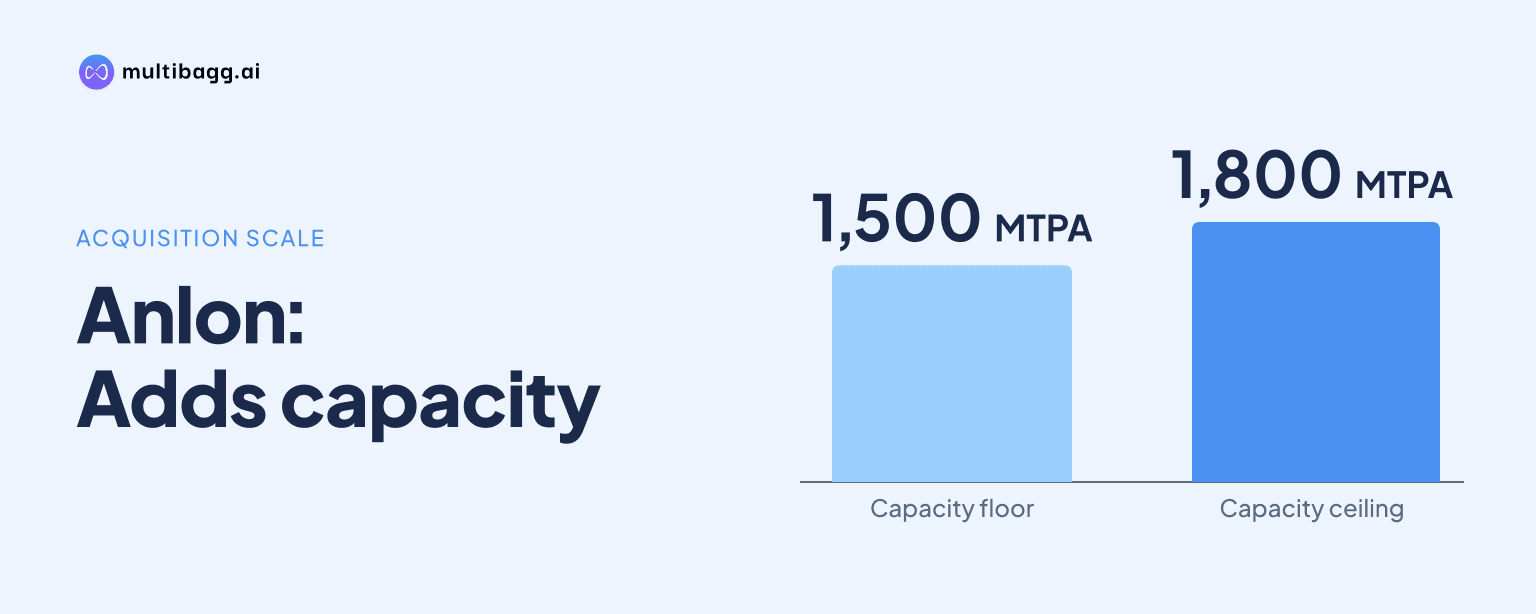
Anlon Healthcare Limited is expanding beyond its standalone intermediates and active pharmaceutical ingredient business through acquisitions spanning fine chemicals, APIs and finished formulations. The three acquired platforms provide 1,500-1,800 metric tonnes per annum of installed capacity, while consolidated H1 FY27 revenue rose 125.9% year on year to Rs 193.172 crore.
Know Anlon Healthcare inside out
Results, valuation, peers and who's buying, in one view.
What capacity did Anlon acquire across the pharmaceutical chain?
Anlon acquired 1,500-1,800 metric tonnes per annum (MTPA) of stated installed capacity through Apiqo Organics, Bizotic Lifescience and Anlon Medicos. Apiqo adds 700-800 MTPA of intermediates and fine chemicals, Bizotic adds 300-400 MTPA of API capacity, and Anlon Medicos adds 500-600 MTPA of finished formulation capacity.
Apiqo is the largest acquired facility by the disclosed capacity range, at 700-800 MTPA versus 300-400 MTPA at Bizotic and 500-600 MTPA at Anlon Medicos. Its portfolio includes pharmaceutical intermediates, key starting materials, industrial chemicals and fine chemicals for pharmaceutical and agrochemical applications, with bromination chemistry identified as a core capability.
Anlon says Apiqo’s raw-material integration supports margin sustainability, providing the stated mechanism for linking upstream inputs with the wider manufacturing chain. Bizotic, by contrast, is described as a ready-to-operate facility, which management says reduces greenfield execution risk and timelines while strengthening service capability in domestic API markets.
How does Anlon Medicos extend Anlon into formulations?
Anlon Medicos moves Anlon into finished pharmaceutical formulations through tablets, capsules and other products for domestic retail and hospital markets. Incorporated in December 2020, the business has access to more than 30 formulation dossiers and a stated installed capacity of 500-600 MTPA.
The formulations operation occupies a different stage of the pharmaceutical chain from Apiqo’s intermediates and Bizotic’s APIs. Anlon identifies the intended benefit as integration of manufacturing and quality-control processes, while the 500-600 MTPA facility is 200 MTPA below Apiqo’s lower disclosed capacity range of 700-800 MTPA.
Anlon’s standalone operations also have a loxoprofen gel filing underway with the Central Drugs Standard Control Organisation and the Drugs Controller General of India. Management anticipates approval in FY28 and says Anlon produces loxoprofen sodium dihydrate in-house, linking its API capability to a planned Indian topical formulation product.
What do the latest revenues show about Anlon’s changed structure?
Anlon’s H1 FY27 revenue split shows the acquired chemical and API platforms contributed 55.4% of group revenue, compared with 44.6% from Anlon Healthcare Limited. Apiqo represented 43.7% and Bizotic 11.7%, indicating that the reported group revenue base includes substantial contributions beyond the standalone parent.
Consolidated revenue increased 102.3% year on year in Q2 FY27, while earnings before interest, tax, depreciation and amortisation increased 84.1% and profit after tax rose 84.4%. In H1 FY27, revenue increased 125.9% from Rs 85.499 crore, compared with 104.7% growth in earnings before interest, tax, depreciation and amortisation and 97.9% growth in profit after tax.
Within Anlon Healthcare Limited, intermediates remained the largest H1 FY27 revenue category at 81.1%, ahead of APIs at 17.1%, nutraceuticals at 1.5% and other activities at 0.3%. The parent’s mix therefore remained concentrated in intermediates even as the group added facilities in fine chemicals, APIs and finished formulations.
Got a follow-up? Ask IRIS
What new healthcare businesses is Anlon building?
Anlon has established Anlon Biologics for peptides, biosimilars and biological compositions, and Anlon Medicare for surgical implants and medical devices. These are newly built subsidiaries rather than acquisitions, and the presentation says Anlon’s majority ownership allows it to direct their strategic and operational development.
Anlon Biologics is intended to add biological-products manufacturing alongside the group’s chemical intermediates, APIs and formulation activities. The presentation does not disclose a capacity figure, commercial product, revenue contribution or approval timetable for the biologics subsidiary, unlike the 1,500-1,800 MTPA capacity range disclosed for the three acquired businesses.
Anlon Medicare is set up to manufacture surgical implants and medical devices, extending the group outside pharmaceutical products. Management characterises this as part of an FY27 shift toward an end-to-end pharma and healthcare platform, but does not provide a launch date, installed capacity or revenue target for the medical-device business.
How does Anlon plan to use its expanded base?
Anlon plans to expand its API and contract development and manufacturing organisation activities through FY27 and FY28. Three molecules are under development for two global innovators: one had supplied validation quantities and was targeted for commercial supply from Q3 FY27, while the other two were in validation in Q2 FY27 with commercialisation targeted from Q4 FY27 to Q1 FY28.
The standalone business plans seven new APIs and three to five additional Drug Master File filings in FY27, adding to 21 filings with global authorities. Its disclosed regulatory portfolio includes loxoprofen Drug Master File approvals from ANVISA, NMPA and PMDA, as well as a ketoprofen Certificate of Suitability from the European Directorate for the Quality of Medicines; a US ketoprofen filing was in progress.
Anlon also targets commissioning eight clean lines in Q1 FY28, adding roughly 1,200 MTPA and enabling eight APIs to operate simultaneously. This planned 1,200 MTPA addition is separate from the 1,500-1,800 MTPA capacity attributed to Apiqo, Bizotic and Anlon Medicos.
Conclusion
Anlon’s acquisitions extend its disclosed manufacturing footprint from the standalone business’s intermediates and API activities into fine chemicals, key starting materials and finished dosage formulations. The H1 FY27 revenue split supports the broader group structure: Apiqo and Bizotic generated a combined 55.4% of revenue, while Anlon Healthcare Limited remained primarily an intermediates business with an 81.1% category share.
Management’s next disclosed milestones are commercial supply for the three contract development and manufacturing organisation molecules between Q3 FY27 and Q1 FY28, seven planned API launches and three to five new Drug Master File filings in FY27, and eight clean lines targeted for Q1 FY28. Loxoprofen gel approval is anticipated in FY28, while operating milestones for Anlon Biologics and Anlon Medicare remain undisclosed.