










Anlon approvals and KSM production gate loxoprofen access
Key highlights
- Anlon reports PMDA approval in Japan for Loxoprofen Sodium Dihydrate and Loxoprofen Acid, plus NMPA approval in China and ANVISA approval in Brazil for Loxoprofen Sodium Dihydrate.
- The global loxoprofen market is forecast to grow from USD 1.8 billion in 2025 to USD 3.1 billion in 2034, a 6.2% CAGR.
- Anlon has 21 loxoprofen-related drug master files on file across markets including the European Union, Japan and South Korea, but says these filings do not represent 21 approvals.
- Anlon anticipates approval for its Indian loxoprofen gel in FY28 and plans to commission 8 clean lines in Q1 FY28, adding roughly 1,200 MTPA of capacity.
powered by IRIS
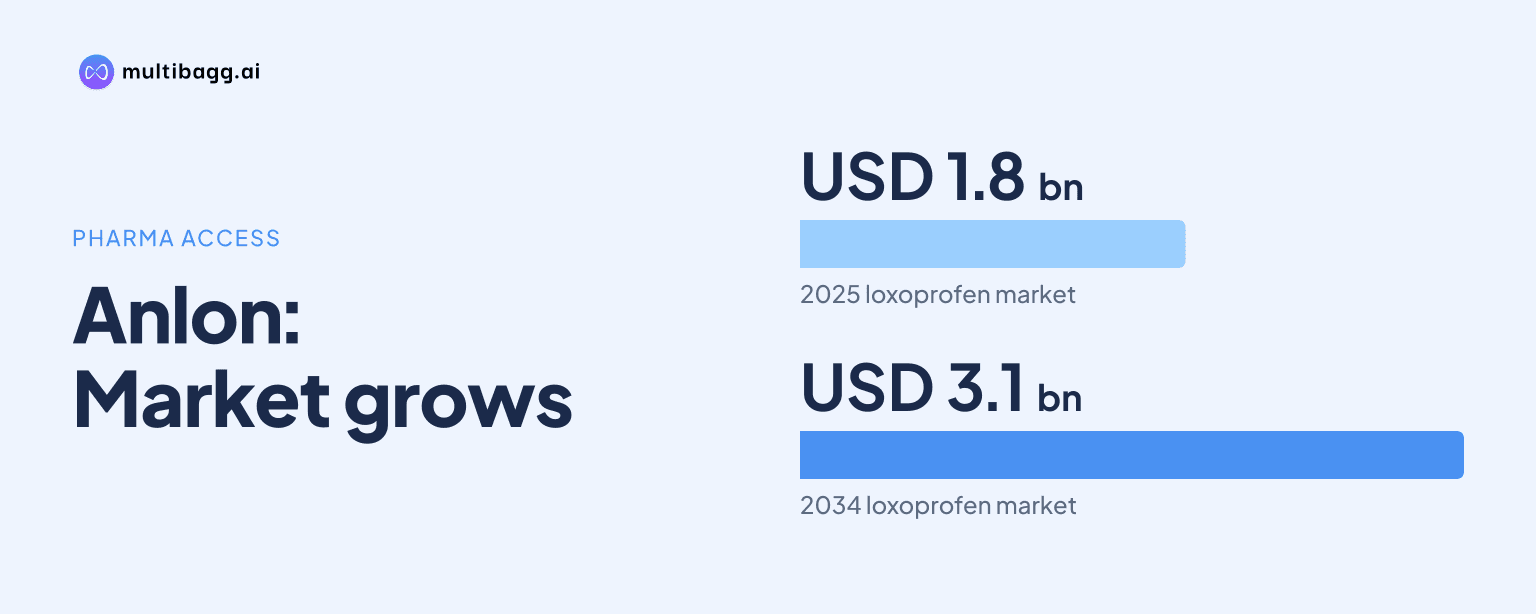
Anlon Healthcare Limited’s loxoprofen position depends on approvals in Japan, China and Brazil and on its in-house manufacture of Loxoprofen Acid, the key starting material for Loxoprofen Sodium Dihydrate. The presentation forecasts the global loxoprofen market will rise from USD 1.8 billion in 2025 to USD 3.1 billion by 2034.
Know Anlon Healthcare inside out
Results, valuation, peers and who's buying, in one view.
Why is Anlon’s loxoprofen access regulator-gated?
Anlon’s loxoprofen access is regulator-gated because a drug master file, customer validation and jurisdiction-specific approval are required before commercial supply can begin. The presentation says this process takes years in each market, so a potential supplier must establish its chemistry, file regulatory documentation and pass customer audits before quoting for business.
The stated barrier matters because loxoprofen demand is concentrated in Japan, China, South Korea, Brazil and wider Latin America rather than the more crowded United States and European Union generic markets. The presentation describes Japan as the molecule’s deepest single-country market, where loxoprofen is the most prescribed non-steroidal anti-inflammatory drug, or NSAID, in real-world prescription data.
The loxoprofen market is forecast to expand at a 6.2% compound annual growth rate, or CAGR, from USD 1.8 billion in 2025 to USD 3.1 billion in 2034. Anlon also cites growth of more than 6% a year for loxoprofen sodium active pharmaceutical ingredient, or API, demand, aided by what the presentation describes as better gastrointestinal tolerability than older NSAIDs.
Which loxoprofen approvals has Anlon disclosed?
Anlon has disclosed approval from Japan’s Pharmaceuticals and Medical Devices Agency, or PMDA, for both Loxoprofen Sodium Dihydrate and Loxoprofen Acid. This covers the commercial API and its key starting material, or KSM, in the country that the presentation identifies as loxoprofen’s largest single-country prescription pool.
In China, Anlon reports approval from the National Medical Products Administration, or NMPA, for Loxoprofen Sodium Dihydrate. In Brazil, it reports approval from the Brazilian Health Regulatory Agency, or ANVISA, for the same API, giving the company disclosed approvals in each of the three markets central to its loxoprofen proposition.
Anlon also says it has 21 drug master files, or DMFs, on file in markets including the European Union, Russia, Japan, South Korea, Iran, Jordan and Pakistan. The presentation distinguishes those filings from the PMDA, NMPA and ANVISA approvals, so the 21-DMF total should not be read as 21 approvals with the same status.
How does in-house Loxoprofen Acid affect Anlon’s model?
In-house Loxoprofen Acid manufacturing gives Anlon a captive KSM for Loxoprofen Sodium Dihydrate, its commercial loxoprofen API. The company says it manufactures Loxoprofen Acid for captive use and third-party supply, linking an upstream material directly to its finished API chain.
The presentation says backward integration allows two stages of value capture from one customer order: the KSM and the API. Anlon uses a comparable model in ketoprofen, where ketonitrile and CEBA feed into the finished API, but the loxoprofen chain specifically runs from Loxoprofen Acid to Loxoprofen Sodium Dihydrate.
This manufacturing structure does not replace regulatory clearance. Anlon’s stated position is that a new entrant must combine upstream chemistry with a DMF filing and customer qualification in each target jurisdiction, while Anlon already holds the cited PMDA, NMPA and ANVISA approvals and makes the KSM internally.
Got a follow-up? Ask IRIS
How significant is loxoprofen within Anlon’s molecule portfolio?
Loxoprofen is one of Anlon’s two largest individually cited molecule markets in 2025, at USD 1.8 billion, equal to dexketoprofen trometamol and larger than ketoprofen API at USD 381 million. By 2034, the presentation forecasts loxoprofen at USD 3.1 billion, compared with USD 3.2 billion for dexketoprofen and USD 585 million for ketoprofen.
Oral tablets account for USD 0.98 billion, or 54.3%, of 2025 loxoprofen revenue, according to the presentation. It describes the market as a two-tier structure of Taisho’s Loxonin originator brand and a limited number of qualified generic suppliers, making the tablet dosage form an important potential outlet for API volumes.
The presentation aggregates the three cited molecule forecasts into roughly USD 4.0 billion of formulation value in 2025 and about USD 6.9 billion in 2034. It specifies that this is an arithmetic sum of the cited forecasts rather than an independent market estimate; loxoprofen therefore forms a substantial part of the stated opportunity, although dexketoprofen has the slightly higher forecast growth rate.
What milestones has Anlon disclosed for the franchise?
Anlon has disclosed a loxoprofen gel filing with the Central Drugs Standard Control Organisation and the Drugs Controller General of India for the Indian market, with approval anticipated in FY28. The company positions the proposed topical formulation against diclofenac-based pain-relief products and says it would use Loxoprofen Sodium Dihydrate made in-house.
Management has also targeted three to five additional DMF filings and seven new API launches in FY27, but the presentation does not state that these actions will all relate to loxoprofen. Separately, Anlon plans to commission eight clean lines in Q1 FY28, adding roughly 1,200 metric tonnes per annum, or MTPA, and enabling eight APIs to run simultaneously.
Anlon states that its installed API and intermediate capacity was 1,400 to 1,600 MTPA following the Apigo, Bizotic and Anlon Medicos acquisitions. The planned 1,200 MTPA addition is therefore a material expansion against that stated range, but the presentation does not give a loxoprofen-specific capacity allocation or expected output from the new lines.
Conclusion
Anlon’s loxoprofen position is based on linked regulatory and manufacturing elements: PMDA approval in Japan for the API and Loxoprofen Acid, NMPA approval in China, ANVISA approval in Brazil, 21 DMFs on file and internal KSM production. The distinction is not broad NSAID demand alone, but the ability to supply a molecule chain after regulatory filing and customer qualification in selected markets.
The next disclosed milestones are management’s FY27 targets for three to five DMF filings and seven API launches, followed by the planned Q1 FY28 commissioning of eight clean lines. For loxoprofen specifically, the unresolved regulatory event is approval of the Indian topical gel, which Anlon anticipates in FY28.