










Anlon Healthcare targets Rs 70-80 crore surgical revenue
Key highlights
- Anlon Healthcare expects Rs 70 crore to Rs 80 crore of surgical-business revenue within three years.
- Medical-device revenue was excluded from Anlon Healthcare’s Rs 680 crore to Rs 700 crore FY28 projection.
- Management said surgical devices should earn better EBITDA than Anlon Healthcare’s pharma and medicine business.
- Anlon Healthcare plans a Rs 65 crore to Rs 70 crore term loan for ongoing capital expenditure.
powered by IRIS
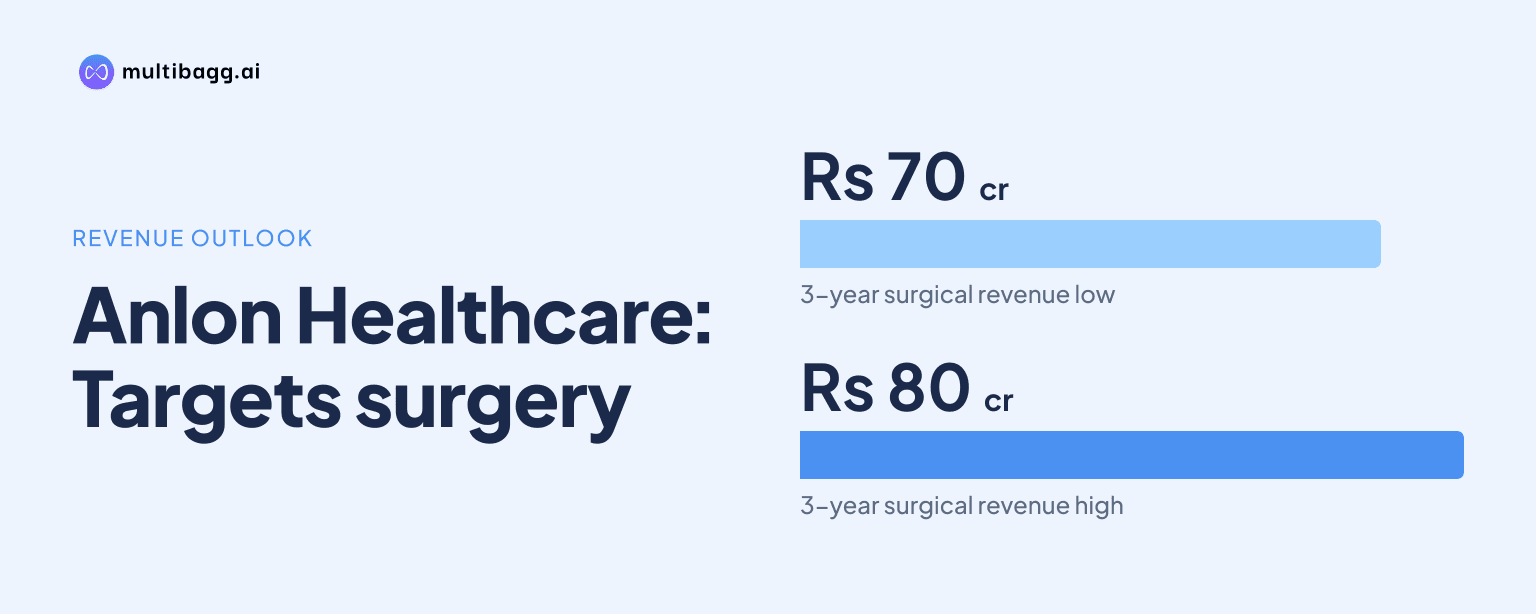
Anlon Healthcare Limited expects its surgical-device business to generate Rs 70 crore to Rs 80 crore of revenue within the next three years, management said on its November 3, 2026 earnings call. Management also said the implants business should deliver higher earnings before interest, tax, depreciation and amortisation, or EBITDA, than its pharma and medicine business.
Know Anlon Healthcare inside out
Results, valuation, peers and who's buying, in one view.
What surgical-device revenue does Anlon Healthcare expect?
Anlon Healthcare expects Rs 70 crore to Rs 80 crore of revenue from its surgical business within the next three years. Management gave that range when asked about medical devices, describing the planned offering as implants, joints and related products. This is a management expectation rather than reported revenue or formal consolidated guidance.
Anlon Healthcare did not include a material medical-device contribution in its FY28 revenue projection of Rs 680 crore to Rs 700 crore. Management said the business was expected to begin contributing revenue by Q3, but that its first-year contribution would not be significant. The FY28 projection instead relied mainly on ongoing business, existing products and products filed one or two years earlier that were approaching commercialisation.
The distinction places the three-year surgical target outside Anlon Healthcare’s stated FY28 base projection. Management said it had customer clarity and two to three years of visibility for products already developed, alongside capacity expansion plans, supporting the Rs 680 crore to Rs 700 crore FY28 outlook. The medical-device business was presented separately as a new line with a longer revenue build-up.
Why is Anlon Healthcare entering medical devices?
Anlon Healthcare said it is entering medical devices to extend its presence in pain-management treatment channels, rather than diverting from active pharmaceutical ingredients, or APIs. Management cited Ketoprofen, Dexketoprofen and Loxoprofen as non-steroidal anti-inflammatory drugs, or NSAIDs, used by patients in orthopaedic hospitals and other pain-management settings. The proposed portfolio would add implants and joints to this treatment ecosystem.
Management’s stated mechanism is that doctors, patients and marketing channels would more or less remain the same. It said the device business would require additional promotional effort for implants and related products, while its medicines were already used by the relevant end users. The plan therefore links device sales to pain-management channels rather than describing a move into an unrelated market.
Anlon Healthcare also identified Loxoprofen as part of its broader formulation plan. Management said it was developing a topical Loxoprofen gel and expected approval from the Drugs Controller General of India, or DCGI, by at least Q1 of FY28. Following approval, it plans pan-India marketing of its own Loxoprofen formulation, although this product is not described as surgical-device revenue.
Got a follow-up? Ask IRIS
Will Anlon Healthcare’s surgical business have higher margins?
Yes. Anlon Healthcare said its surgical-device business would deliver better EBITDA than its pharma and medicine business, but it did not disclose a numerical EBITDA margin for the new segment. When an analyst asked whether medical-device EBITDA would be above 25%, management said the business gives better EBITDA than pharma and medicine without confirming that specific percentage.
The available comparison is with management’s profitability expectations for existing operations. For Anlon Healthcare’s pharmaceutical intermediate and API business, management cited expected EBITDA margins of about 25% to 27% and profit after tax, or PAT, margins of 13% to 14%. For Apiqo, a volume-products operation with lower-value products, it cited sustainable EBITDA margins of 20% to 23% and PAT margins of 11% to 13%.
Management said it expected sustainable consolidated EBITDA margins of 23% to 25% and PAT margins of 11% to 13% after combining these businesses. It attributed lower margins in the preceding quarter to pricing pressure and raw-material shortages, while saying the current quarter had improved. The medical-device comment indicates a potentially different margin mix, but management has not quantified the effect on consolidated profitability.
What other plans could affect Anlon Healthcare’s device rollout?
Anlon Healthcare said it was pursuing a Rs 65 crore to Rs 70 crore term loan for ongoing capital expenditure at its current capacity, with the remaining balance to be funded through internal accruals. Management separately described the device business as expected to begin contributing by Q3, with an insignificant contribution in its first year. It did not specify the capital spending allocated to implants and other devices.
The company has also proposed fund raising of up to Rs 250 crore for capital expenditure at parent and subsidiary operations, including Anlon Biologics’ planned peptide, oligonucleotide and biosimilar facility. Management said the exact amount and structure were still being decided and expected to be finalised before the end of November 2026. These planned projects are separate from the surgical-device revenue target.
In formulations, management said Anlon Medicos’ existing tablet and capsule product set could generate Rs 80 crore to Rs 90 crore at peak level. It added that the topical Loxoprofen gel could raise revenue to two or three times that level after approval and marketing, though this was an expectation rather than a committed forecast. Management also said injectable-facility expansion at Anlon Medicos had started and that injectables could be available by the end of the next year.
Conclusion
Anlon Healthcare’s Rs 70 crore to Rs 80 crore three-year surgical-business target sets out management’s intended scale for medical devices, while its higher-EBITDA comment differentiates the planned business from pharma and medicine. However, the company excluded medical devices from its Rs 680 crore to Rs 700 crore FY28 revenue projection because management expects only an insignificant first-year contribution.
The next disclosed markers are whether device revenue begins by Q3 as management expects, whether management provides a numerical segment-margin target, and progress towards the three-year revenue range. Management also expects to finalise the proposed fund-raising structure before the end of November 2026, expects DCGI approval for Loxoprofen gel by at least Q1 of FY28, and is scheduled to update the market after its Q3 results.