










Anlon targets commercial supply of three CDMO molecules by FY28
Key highlights
- Anlon targets commercial supply of 3 CDMO molecules for 2 global innovators by FY28.
- The first molecule has supplied validation quantities and is targeted for commercial supply from Q3 FY27.
- Molecules 2 and 3 entered validation in Q2 FY27 and are targeted for commercialisation from Q4 FY27 to Q1 FY28.
- Anlon plans 8 new clean lines in Q1 FY28, adding roughly 1,200 MTPA of capacity and enabling 8 APIs to run simultaneously.
powered by IRIS
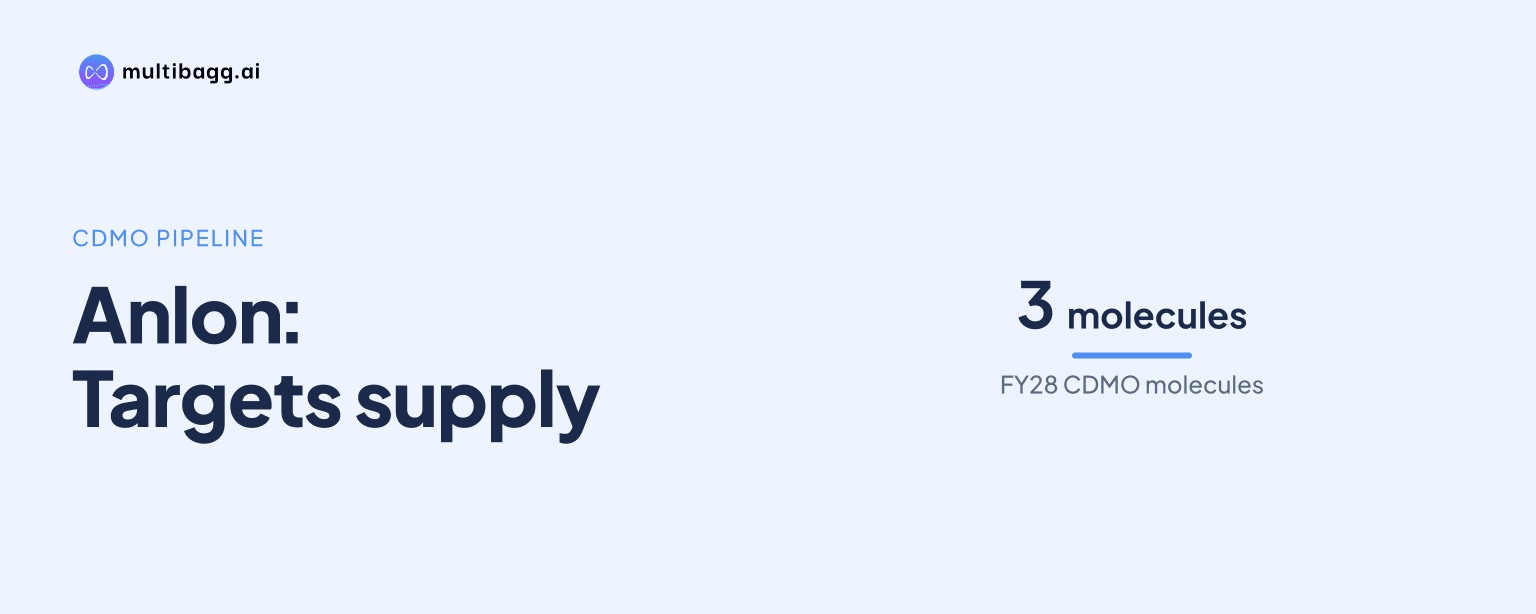
Anlon Healthcare Limited targets commercial supply of three contract development and manufacturing organisation, or CDMO, molecules for two global innovators by FY28. The first project has supplied validation quantities and is targeted for commercial supplies from Q3 FY27, while the other two entered validation in Q2 FY27 and are targeted for commercialisation from Q4 FY27 to Q1 FY28.
Know Anlon Healthcare inside out
Results, valuation, peers and who's buying, in one view.
What is Anlon's CDMO plan for global innovators?
Anlon plans to commercialise three custom-manufactured molecules for two global innovators, extending its active pharmaceutical ingredient, or API, and intermediate operations into CDMO work. The presentation places this CDMO vertical alongside Anlon's regulatory filing portfolio and loxoprofen gel plan within the standalone company.
The first molecule is at a later development stage because Anlon has supplied validation quantities. The presentation does not identify the three molecules or the two customers, and it does not disclose projected volumes, pricing, contract duration or revenue contribution. The disclosed information is therefore a development and commercial-supply timetable rather than an order book or revenue forecast.
Anlon says the CDMO model creates high switching costs because development to commercial revenue takes a minimum of three to four years. That time frame covers the customer-specific development and validation work before regular commercial manufacturing, according to management's description of the programme.
When does Anlon expect commercial CDMO supply to begin?
Anlon targets commercial supplies of molecule one from Q3 FY27, while molecules two and three are targeted for commercialisation between Q4 FY27 and Q1 FY28. The first molecule is therefore scheduled to reach commercial supply before the other two projects, which were in validation in Q2 FY27.
Validation is not the same as commercial supply. For molecule one, validation quantities are the most advanced operating milestone disclosed, while molecules two and three have a stated Q2 FY27 validation stage and a later commercialisation window. Anlon does not specify whether process qualification, customer approval, regulatory activity or other steps remain before each commercial launch.
The FY28 timing is a management target rather than reported CDMO revenue. The presentation links the target to a three-to-four-year development-to-commercial cycle, meaning the transition from validation to commercial production remains the central operating milestone for each of the three molecules.
How will Anlon run three CDMO projects in parallel?
Anlon plans to commission eight new clean lines in Q1 FY28, adding roughly 1,200 metric tonnes per annum, or MTPA, and allowing eight APIs to run simultaneously. Management presents the lines as additional capacity for parallel production as the three CDMO molecules move towards the Q3 FY27 to Q1 FY28 commercialisation timetable.
The schedule separates the first CDMO target from the new clean-line commissioning date. Molecule one is targeted for commercial supplies from Q3 FY27, whereas the eight new clean lines are planned for Q1 FY28. Anlon does not disclose the production site for any CDMO molecule, capacity reserved for CDMO work, or the volume expected from the planned 1,200 MTPA addition.
Anlon reports installed API and intermediate capacity of 1,400-1,600 MTPA following the Apiqo Organics, Bizotic Lifescience and Anlon Medicos acquisitions. The presentation lists 700-800 MTPA for Apiqo Organics, 300-400 MTPA for Bizotic Lifescience and 500-600 MTPA for Anlon Medicos across industrial and fine chemicals, APIs and finished formulations.
Apiqo Organics manufactures pharmaceutical intermediates and key starting materials, or KSMs, while Bizotic Lifescience operates an API manufacturing facility. Anlon Medicos manufactures finished formulations, including tablets and capsules, and has access to more than 30 formulation dossiers. The presentation does not assign the three CDMO projects to a particular acquired business or manufacturing location.
Got a follow-up? Ask IRIS
What regulatory and product work accompanies Anlon's CDMO programme?
Anlon plans seven new API launches and three to five new drug master file, or DMF, filings in FY27 alongside the three-molecule CDMO programme. Management says these additions are intended to broaden therapeutic coverage and deepen regulated-market access, but the presentation does not name the seven APIs or connect them directly to the two global innovators.
Anlon reports 21 DMFs filed with global authorities. Its disclosed approvals include loxoprofen DMFs from Brazil's ANVISA, China's NMPA and Japan's PMDA, plus a Certificate of Suitability, or CEP, from the European Directorate for the Quality of Medicines and HealthCare for ketoprofen. A United States DMF filing for ketoprofen remains in progress.
These filings principally concern Anlon's existing API portfolio, including loxoprofen and ketoprofen, rather than the unnamed CDMO molecules. The presentation also states that Anlon is World Health Organization Good Manufacturing Practices, or WHO-GMP, certified and has filings across the European Union, Japan, Korea, Russia and other markets.
Outside the CDMO programme, Anlon has filed loxoprofen gel forms with the Central Drugs Standard Control Organisation and the Drugs Controller General of India, with approval anticipated in FY28. The proposed Indian topical formulation would use in-house loxoprofen sodium dihydrate and is positioned by management against diclofenac-based topical products. This filing is separate from the three custom-manufacturing projects for global innovators.
Conclusion
Anlon's disclosed CDMO opportunity is a three-molecule programme for two global innovators, rather than a reported commercial revenue stream. One molecule has progressed to supplied validation quantities and is targeted for commercial supplies from Q3 FY27, while two others were in Q2 FY27 validation with commercialisation targeted from Q4 FY27 to Q1 FY28. The programme operates alongside 21 filed DMFs, seven planned API launches in FY27 and existing intermediate, API and formulation operations.
The next disclosed milestones are whether molecule one reaches its Q3 FY27 commercial-supply target, whether molecules two and three advance from validation into their Q4 FY27 to Q1 FY28 commercialisation window, and whether eight clean lines are commissioned in Q1 FY28 as planned. Molecule identities, customer names, capacity allocation, sales terms and project revenue remain unresolved in the presentation.