










Ansal Properties and Infrastructure seeks SEBI halt to EGM
Key highlights
- APIL has asked SEBI to halt a November 23, 2026 EGM proposing 14 board changes.
- The proposed EGM involves removal of 6 directors and appointment of 8 directors.
- APIL's forensic audit covers transactions from April 1, 2016 to March 31, 2026.
- The ED said it attached Agra land worth more than Rs 598 crore in a separate money-laundering investigation.
powered by IRIS
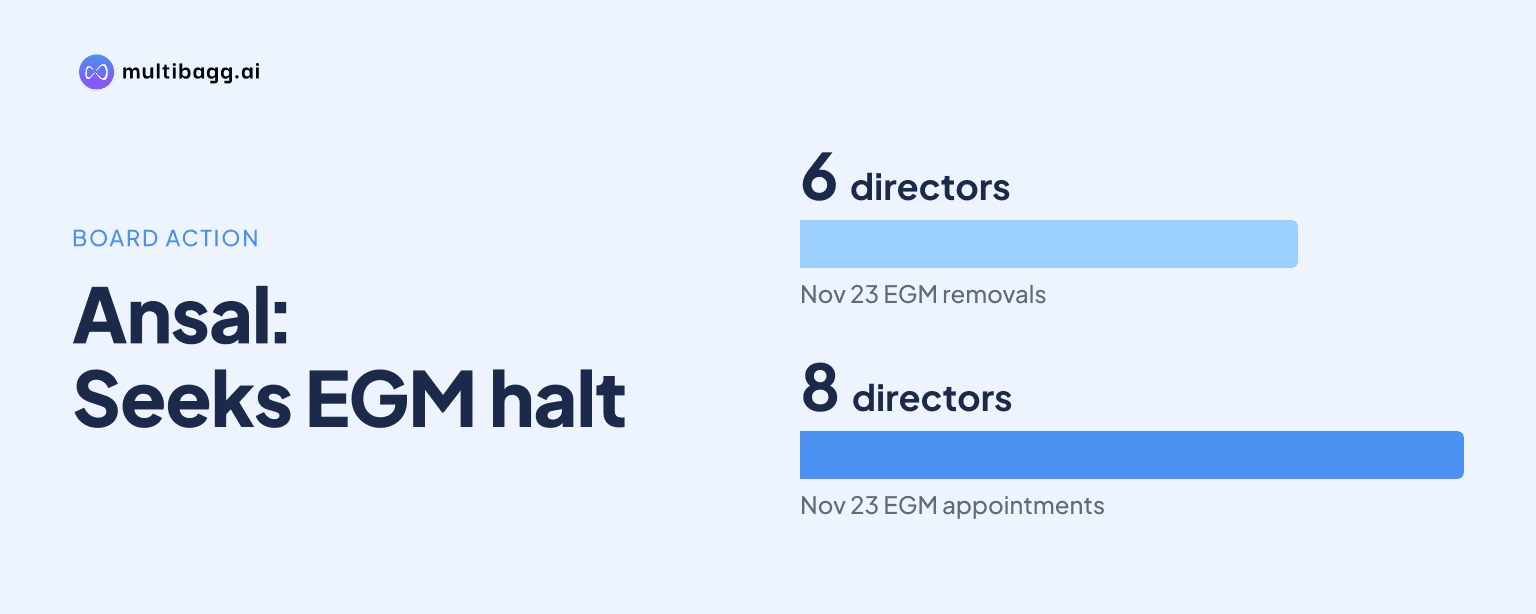
Ansal Properties and Infrastructure Limited has asked SEBI to halt its November 23, 2026 extraordinary general meeting, which proposes removing six directors and appointing eight new directors, saying the exercise could disrupt a forensic audit covering April 1, 2016 to March 31, 2026. The request adds another governance issue while the company remains in the corporate insolvency resolution process.
Know Ansal Properties & Infrastructure inside out
Results, valuation, peers and who's buying, in one view.
Why has APIL asked SEBI to halt the November 23 EGM?
APIL has asked the Securities and Exchange Board of India to stop the proposed extraordinary general meeting because it believes the planned changes to the board could interfere with an ongoing forensic audit. The audit period spans a decade, from April 1, 2016 through March 31, 2026, and the company has linked its request directly to the need to avoid disruption to that review.
The EGM is scheduled for November 23, 2026. Its stated agenda includes the removal of six directors and the appointment of eight new directors. The information provided does not state whether SEBI has accepted, rejected or otherwise acted on APIL's request. It also does not provide the identities of the proposed outgoing or incoming directors, or the detailed findings being examined in the forensic audit.
The dispute is significant because the proposed meeting would change the composition of the board while the company says a review of historical transactions is under way. A forensic audit commonly examines transaction trails and supporting records, but APIL has not disclosed any conclusions from its audit in the material provided. Therefore, the request to SEBI should not be read as a finding of wrongdoing against any individual.
What is APIL's current insolvency position?
APIL has been undergoing the corporate insolvency resolution process, or CIRP, under the Insolvency and Bankruptcy Code since an NCLT order dated February 25, 2025. The National Company Law Tribunal, New Delhi Bench, Court IV, admitted the matter in a petition filed by IL&FS Financial Services Limited and appointed Navneet Kumar Gupta as interim resolution professional, later designated as resolution professional.
The company has previously stated that the powers of its board were suspended during CIRP and that its affairs, business and assets were being managed by the resolution professional. This governance framework provides important context for the proposed EGM and APIL's request for regulatory intervention, although the supplied information does not specify how the meeting was called or how it would operate alongside the resolution process.
A National Company Law Appellate Tribunal order dated January 7, 2026 confined APIL's CIRP to selected assets and projects. These include the Mother City, Mother City Extension and Golf Plots projects in Lucknow, as well as assets and built-up properties in Ajmer, Jodhpur and Jaipur. Projects in Haryana, Punjab, Agra and Noida were stated to be excluded from the CIRP's scope and may be dealt with under their contractual terms and applicable law.
Got a follow-up? Ask IRIS
What other enforcement and legal matters involve APIL?
The EGM-related request comes amid separate enforcement and litigation matters concerning APIL and people connected with the company. The Enforcement Directorate said on Wednesday that it had provisionally attached land worth more than Rs 598 crore in Agra, Uttar Pradesh, under the Prevention of Money Laundering Act. According to the agency, its investigation concerns alleged large-scale irregularities in the acquisition and subsequent release of land in Gurugram sectors 58-63 and 65-67.
This attachment is a separate matter from APIL's request to SEBI over the EGM. The information supplied does not establish that the proposed board changes, the forensic audit and the ED's Agra attachment arise from the same set of transactions. Investors should distinguish between the company's regulatory request, the insolvency process and the enforcement investigation.
In an earlier disclosure dated October 7, 2025, APIL said the ED had provisionally attached six immovable properties valued at Rs 10.55 crore in Gurugram, Greater Noida and Ludhiana. That action involved directors, shareholders or beneficial owners of the accused company and was linked to alleged environmental-law violations at the Sushant Lok-I and Esencia real-estate projects in Gurugram.
APIL also disclosed in June 2026 that it had filed a commercial civil suit in the Saket District Court, Delhi, against DMI-related entities, Vistra ITCL (India) Limited and Trait IT Park Private Limited. The suit sought accounts and an injunction involving securities, including 55,564,816 equity shares pledged by promoters or the promoter group. The court's June 16, 2026 order directed parties to maintain status quo and restrained the defendants from creating third-party rights in the securities until the next date of hearing.
How do the EGM request and legal matters affect investors?
For investors, the immediate disclosed issue is procedural rather than a reported financial result: APIL wants SEBI to prevent the November 23 meeting from proceeding while the forensic audit continues. The proposed replacement of six directors with eight new directors could affect governance arrangements, but no final regulatory decision has been disclosed and no forecast of the outcome can be drawn from the available information.
The CIRP structure remains a central consideration. APIL's prior disclosures indicate that the resolution professional manages the company's affairs during the process, while the NCLAT has limited the CIRP to specified projects and assets. This divided position means that stakeholders must assess individual projects based on whether they fall inside or outside the CIRP perimeter.
The ED's stated attachment of Agra land worth more than Rs 598 crore is material because it concerns a sizeable asset value and an ongoing money-laundering investigation. However, provisional attachment is an investigative step and does not by itself determine liability. Similarly, APIL's civil suit and the status quo order address pledged securities and alleged third-party rights, not a concluded ownership or enforcement outcome.
The available disclosures offer no confirmed timetable for completion of the forensic audit, no SEBI decision date and no stated resolution of the proposed EGM agenda. These unresolved matters, together with the CIRP and enforcement proceedings, remain relevant to shareholders, creditors, homebuyers and counterparties dealing with APIL projects.
Conclusion
APIL's request to halt the November 23 EGM places a proposed board overhaul alongside a forensic audit of transactions dating back to 2016. The company is also operating within a limited CIRP framework, while separate ED action and civil litigation add to the legal and governance issues surrounding its assets and securities.
The next disclosed event to watch is the November 23, 2026 EGM and any SEBI response to APIL's request. Stakeholders should also monitor updates on the forensic audit, the CIRP restricted to specified Lucknow and Rajasthan assets, the ED investigation and the pending proceedings concerning pledged shares.