










Antony Waste says FY28 accounting will dilute reported EBITDA margins
Key highlights
- Antony Waste expects about Rs 300 crore of low-margin AP contract revenue in FY 2028.
- Management targets core EBITDA of about 22%-23% from the first quarter of FY 2028.
- AP power sales are expected to start in FY 2029 after commissioning in about 20 months.
- The two AP projects are expected to generate close to Rs 150 crore of annual revenue after commissioning.
powered by IRIS
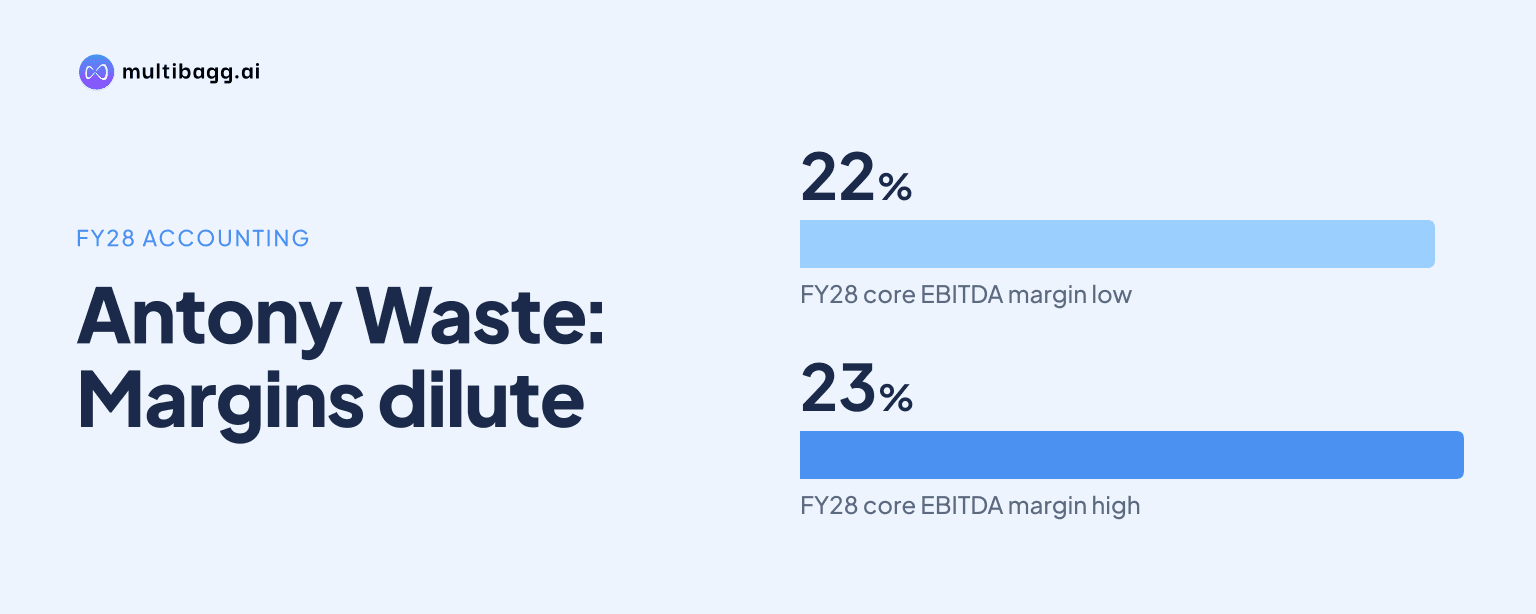
Antony Waste Handling Cell Limited expects about Rs 300 crore of low-margin Andhra Pradesh contract revenue in FY 2028 to dilute reported earnings before interest, tax, depreciation and amortisation (EBITDA) margins, even as management targets core EBITDA of around 22%-23% from the first quarter of FY 2028.
Know Antony Waste Handling Cell inside out
Results, valuation, peers and who's buying, in one view.
Why will Antony Waste's reported EBITDA margin soften in FY 2028?
Antony Waste says reported EBITDA margins will be softer in FY 2028 because Andhra Pradesh contract revenue is expected to be about Rs 300 crore and carries a low margin. Management described this as an accounting outcome of construction capital expenditure rather than recurring operating income from electricity generation, and said investors should track core EBITDA separately from reported EBITDA.
The Andhra Pradesh projects involve planned capital expenditure of about Rs 670 crore to Rs 680 crore, and Antony Waste expects at least Rs 700 crore to pass through the income statement as contract revenue over the next two and a half years. A proportionate contract cost will also be recorded, meaning this revenue raises the reported top line while contributing less to EBITDA margin than core waste-management activities.
Under Indian Accounting Standards, or Ind AS, Antony Waste records contract revenue in waste-processing projects when incremental capital expenditure creates a right to charge income through the profit and loss account. Management cited capital expenditure at its Kanjur and PCMC projects as existing examples, and said the pace of Andhra Pradesh capital expenditure will determine recognition of the associated contract revenue.
When will Antony Waste recognise AP revenue and begin power sales?
Antony Waste expects a large Andhra Pradesh contract-revenue contribution in the fourth quarter of FY 2027, while FY 2028 will account for the lion's share and power-sale revenue will begin in FY 2029. Management said civil work started after the monsoon, with fourth-quarter recognition dependent on work completed and certified by independent and lead engineers.
The difference between contract revenue and power revenue drives the FY 2028 margin outlook. Contract revenue will be recognised during construction, but recurring revenue begins only when the plants are operating. Management said the two Andhra Pradesh projects are expected to be commissioned in about 20 months and should generate annual revenue of close to Rs 150 crore after commissioning, or about Rs 70 crore to Rs 75 crore per project.
The disclosed sequence is therefore different across the three financial years. FY 2027 is expected to receive a meaningful fourth-quarter accounting contribution after limited revenue in the second and third quarters, FY 2028 should contain most construction-related recognition, and FY 2029 is when Antony Waste expects core revenue from the sale of power.
Got a follow-up? Ask IRIS
Can Antony Waste's core EBITDA margin return to its historical range?
Antony Waste is targeting a quarterly return towards its historical margin range by the third or fourth quarter of FY 2027, and management said core EBITDA should return to around 22%-23% from the first quarter of FY 2028. On a full-year basis, management said the company should be nearing its earlier margin levels in FY 2028 or FY 2029, although reported margins will remain affected by Andhra Pradesh contract revenue.
Management referred to historical EBITDA margins of about 23%-25% in response to an investor question, while separately setting out a 22%-23% core EBITDA objective from the first quarter of FY 2028. This means operational margin recovery can coincide with a lower consolidated reported margin if the Rs 300 crore construction-accounting component is a material part of FY 2028 revenue.
The Mumbai collection and transportation, or C&T, contract is another part of the operating outlook. Management said the Mumbai contract should be fully operational in the fourth quarter of FY 2027 and generate about Rs 80 crore of revenue. Unlike Andhra Pradesh construction accounting, that contribution is expected to come from operating activity after commissioning.
What affected Antony Waste's recent margins and profit conversion?
Antony Waste attributed first-quarter margin pressure to high disposal costs associated with closure of its bio-mining entity and second-quarter pressure mainly to expected credit loss, or ECL, provisioning. Management said the second-quarter provision followed recognition of a past-period client escalation that had been approved, but required impairment accounting because of the receivable's ageing under Ind AS 109.
Other operating expense rose because of higher disposal costs related to refuse-derived fuel, or RDF, sales and a Rs 27 crore ECL provision, management said. It added that other operating expense would have been almost flat compared with the first quarter without the provision, identifying the accounting charge as the principal reason for the quarter-on-quarter increase.
Antony Waste also booked Rs 20 crore of exceptional items for the PCMC project. Management said insurance partially covers the amount, but the company recognised the profit-and-loss charge while the survey continues. It said it had conservatively brought the expenses into the second quarter and did not expect further incremental expenses in the third quarter.
Finance cost declined from the first quarter because a Rs 6.8 crore refinancing cost recorded in that period did not recur in the second quarter. Management said the borrowing rate has eased, though total interest could rise slightly in volume terms as capital expenditure proceeds for the Mumbai C&T contract and new projects. It does not foresee a significant increase in depreciation or interest beyond effects already associated with the Mumbai contract.
Conclusion
The FY 2028 margin picture at Antony Waste will combine two distinct effects: an expected Rs 300 crore of low-margin Andhra Pradesh contract revenue and management's target of restoring core EBITDA to around 22%-23% from the first quarter of FY 2028. Reported EBITDA margin may therefore remain softer even if the underlying operating businesses move towards the company's historical range.
The next milestones are the expected large Andhra Pradesh contract-revenue contribution in the fourth quarter of FY 2027, full operationalisation of the Mumbai C&T contract in that quarter, and commissioning of the two Andhra Pradesh plants in about 20 months. Management expects power-sale revenue from those projects to begin in FY 2029, when the two plants are projected to generate close to Rs 150 crore of annual revenue combined.