










Antony Waste books Rs 20 crore charge after PCMC incident
Key highlights
- Antony Waste recognised a Rs 20 crore exceptional item in Q2FY27 after the July 2026 PCMC incident.
- PCMC energy operations remained suspended, while resumed MRF and composting work processed about 33,600 tonnes.
- Antony Waste expects the PCMC facility to be functional by December 2026.
- Q2FY27 revenue from operations rose 25% to Rs 330.3 crore, while profit after tax was a Rs 1.7 crore loss.
powered by IRIS
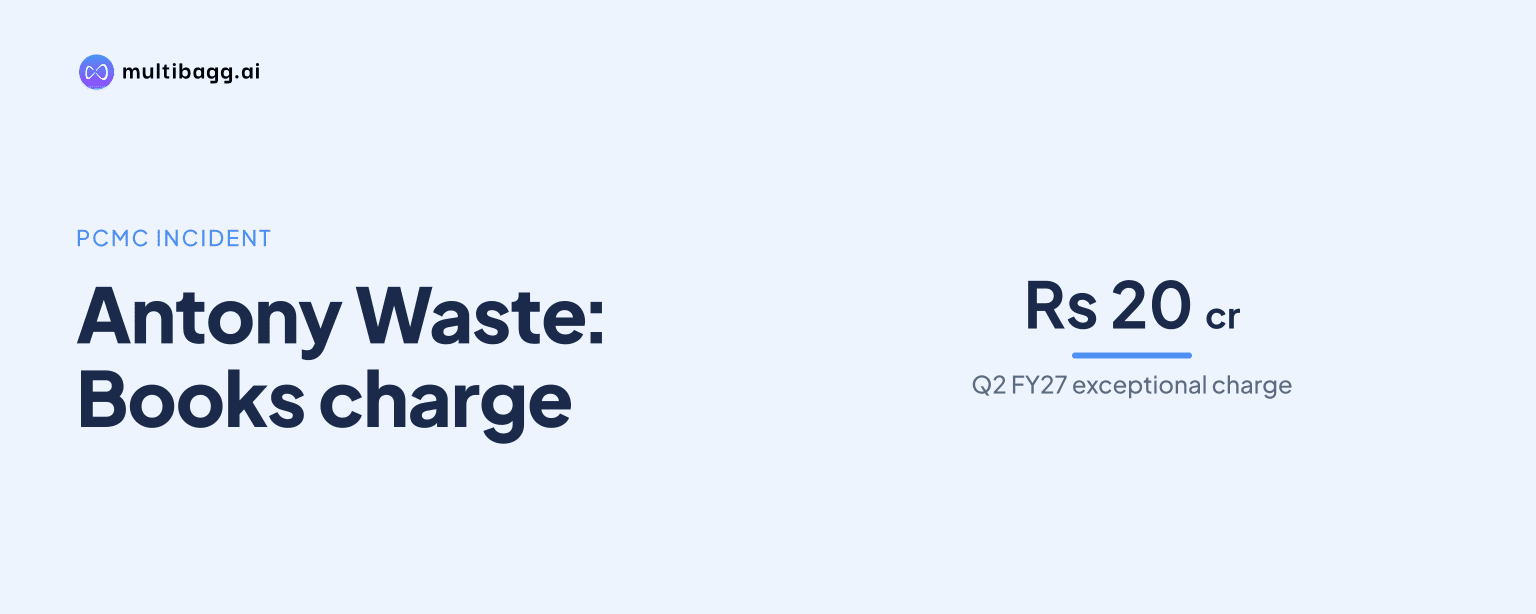
Antony Waste Handling Cell Limited recorded a Rs 20 crore exceptional item in Q2FY27 after a July 2026 incident suspended energy operations at its PCMC waste-to-energy facility, while material recovery facility and composting work resumed to process about 33,600 tonnes and management expects the plant to be functional by December 2026.
Know Antony Waste Handling Cell inside out
Results, valuation, peers and who's buying, in one view.
What happened at Antony Waste's PCMC facility?
Antony Waste said an incident occurred at its PCMC waste-to-energy facility in July 2026 and disrupted operations during Q2FY27, the quarter ended September 30, 2026. Energy operations remained suspended at the November 6, 2026 results announcement, while restoration and recommissioning work was under way.
Antony Waste said it was coordinating restoration with PCMC, relevant authorities and original equipment manufacturer, or OEM, partners. The announcement does not specify the nature of the incident, the extent of physical damage or the date on which energy generation stopped, but it identifies impairment, restoration costs and compensation linked to the event.
The PCMC asset is described by Antony Waste as Maharashtra's first waste-to-energy plant selling power under the Green Energy Open Access Rules. That energy activity remained halted, whereas other processing operations at the site resumed during Q2FY27.
Management expects the PCMC facility to be functional by December 2026. This is a forward-looking timetable rather than a completed milestone, and Antony Waste said actual results may differ from anticipated target dates and other forward-looking statements.
What does Antony Waste's Rs 20 crore exceptional item include?
Antony Waste recognised a Rs 20 crore exceptional item in Q2FY27 relating to the July 2026 PCMC incident. It comprises impairment of property, plant and equipment, restoration and other related costs, and compensation paid to employees or their next of kin.
The release does not split the Rs 20 crore amount among impairment, restoration and compensation. It also does not quantify the effect of each component on Q2FY27 profit after tax, which moved to a Rs 1.7 crore loss from a Rs 17.3 crore profit in Q2FY26.
Revenue from operations increased by Rs 66.2 crore year on year, but earnings before interest, tax, depreciation and amortisation, or EBITDA, rose by Rs 1.2 crore. Antony Waste reported a Q2FY27 EBITDA margin of 17.6%, compared with 21.6% in Q2FY26, alongside the separately disclosed incident-related item.
Got a follow-up? Ask IRIS
Which PCMC operations resumed after the July incident?
Antony Waste said material recovery facility, or MRF, and composting operations resumed while the energy operation remained suspended, processing about 33,600 tonnes of waste in Q2FY27. The disclosure shows that the PCMC site retained limited processing activity despite the energy shutdown.
The release does not provide a prior-period comparison for the 33,600 tonnes, the PCMC facility's capacity or revenue from the restarted activities. It also does not state electricity volumes forgone during the suspension or give a more specific restart date than December 2026.
Across the group, Antony Waste handled about 1.28 million tonnes of municipal solid waste, or MSW, in Q2FY27, up about 0.8% year on year. Collection and transportation volumes rose about 11.5% to about 0.60 million tonnes, while processing volumes declined about 7.2% to about 0.68 million tonnes.
The higher collection and transportation volumes and lower processing volumes provide the wider operating context for the PCMC disruption, although Antony Waste did not attribute the group processing-volume decline solely to the incident. Q2FY27 sales included about 49,000 tonnes of refuse-derived fuel and about 2,000 tonnes of compost.
How did the PCMC disruption coincide with Antony Waste's wider results?
Antony Waste's total operating revenue increased 25% year on year to Rs 321.2 crore in Q2FY27. Management attributed collection and transportation growth to the ramp-up of newly commenced Mumbai operations awarded by the Brihanmumbai Municipal Corporation, higher volumes at existing projects and recognition of contractual cost escalations.
Revenue from MSW collection and transportation rose 42% to Rs 227.5 crore, while revenue from MSW processing declined 32% to Rs 49 crore. Other operating income increased 78% to Rs 44.7 crore, changing the revenue mix from Q2FY26 toward collection and transportation and other operating income.
Management said certain client-approved escalation claims related to earlier periods and that Antony Waste made an expected credit loss, or ECL, provision against the associated receivables under Indian Accounting Standard 109 and applicable audit requirements. It said the provision constrained margin expansion and is expected to be written back as the receivables are realised.
For H1FY27, revenue from operations was Rs 599.2 crore, up 15% from Rs 519.2 crore in H1FY26, while EBITDA declined 13% to Rs 103.3 crore from Rs 119.3 crore. Profit after tax moved to a Rs 1 crore loss in H1FY27 from a Rs 40.2 crore profit in H1FY26, while the EBITDA margin declined to 17.2% from 23.0%.
Conclusion
The July 2026 PCMC incident resulted in a Rs 20 crore exceptional item and left Antony Waste's energy operations suspended, although MRF and composting activities resumed and processed about 33,600 tonnes. The disruption coincided with revenue from operations rising 25% to Rs 330.3 crore in Q2FY27 while profit after tax shifted from a Rs 17.3 crore profit to a Rs 1.7 crore loss.
The next disclosed milestone is management's expectation that the PCMC facility will be functional by December 2026. Progress on restoration and recommissioning with PCMC, authorities and OEM partners, as well as the realisation of escalation-related receivables that could permit an ECL provision write-back, are the disclosed matters to watch next.