










Antony Waste reaches Rs 1,084 crore as revenue mix broadens
Key highlights
- Antony Waste reported Rs 1,084 crore of revenue from operations across 30 ongoing projects in FY26.
- Collection and transportation generated Rs 646 crore, or 60%, of Antony Waste's FY26 revenue.
- MSW processing generated Rs 274 crore in FY26 and the presentation states a 23-year average duration for seven related contracts.
- Antony Waste supplied more than 1.77 lakh tonnes of RDF and sold more than 15,500 tonnes of compost in FY26.
powered by IRIS
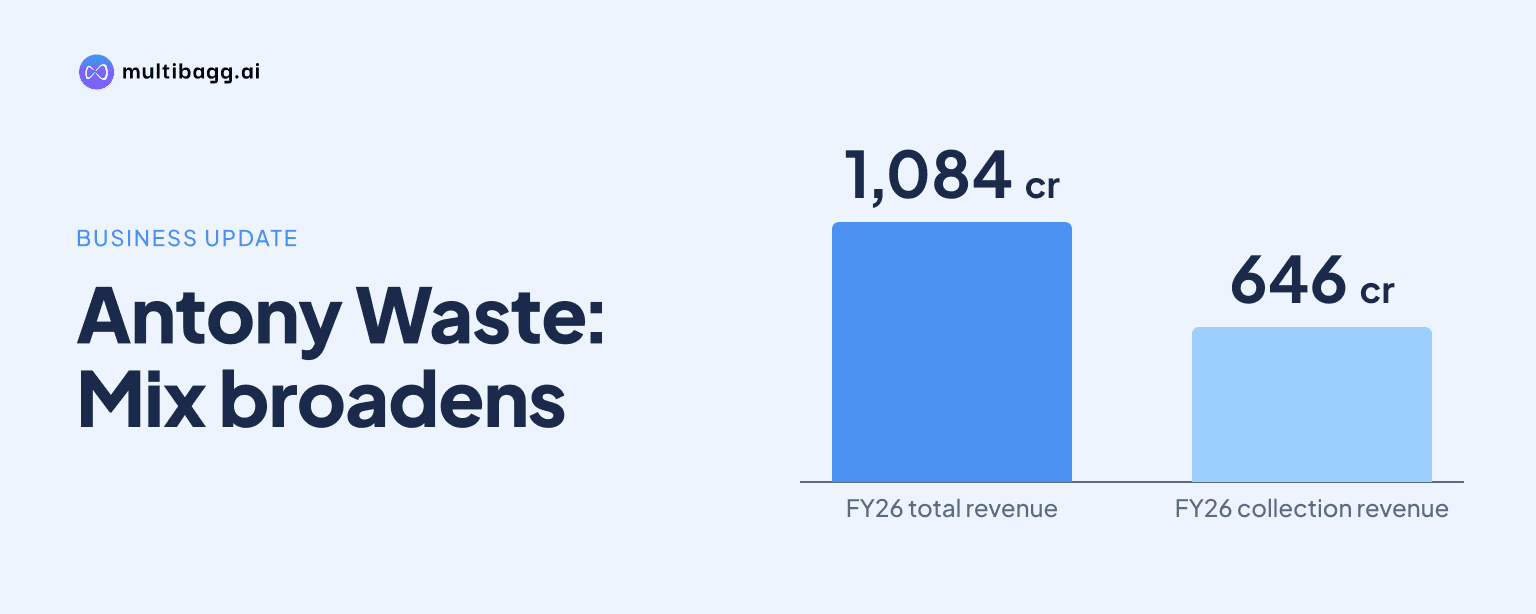
In FY26, Antony Waste Handling Cell Ltd. reported Rs 1,084 crore of revenue from operations across 30 ongoing projects. Antony Waste generated 60% of revenue from collection and transportation, while municipal solid waste processing contributed 25% and contract and other activities contributed 15%, extending its revenue base beyond collection-led work.
Know Antony Waste Handling Cell inside out
Results, valuation, peers and who's buying, in one view.
How has Antony Waste expanded beyond waste collection?
Antony Waste has expanded into an end-to-end municipal solid waste (MSW) chain spanning collection, transportation, segregation, landfill management, resource recovery, composting and waste-to-energy (WTE). Its door-to-door collection activity handles more than 8,330 tonnes of MSW a day, supported by more than 2,600 specialised vehicles, while its segregation infrastructure can handle more than 5,000 tonnes daily.
The processing operation sorts and segregates waste before composting, recycling, shredding and compressing it into refuse-derived fuel (RDF). In FY26, Antony Waste supplied more than 1.77 lakh tonnes of RDF to cement companies and sold more than 15,500 tonnes of compost. It also operates three integrated WTE plants, adding power generation to its collection, processing and disposal activities.
The 30-project portfolio comprises 19 collection-and-transport projects, six waste-processing and disposal projects, four mechanised-sweeping projects and one construction-and-demolition waste project. Collection and transport remains the largest category by project count, but the 11 projects outside that category cover processing, sweeping and construction-and-demolition waste handling.
What does Antony Waste's FY26 revenue mix show?
Antony Waste remained principally a collection-and-transport operator in FY26, although processing and contract-and-other activities supplied a combined 40% of its Rs 1,084 crore revenue from operations. Collection and transport generated Rs 646 crore, MSW processing generated Rs 274 crore, and contract and other activities generated Rs 164 crore.
From FY21 to FY26, collection-and-transport revenue increased by Rs 349 crore, processing revenue increased by Rs 142 crore and contract-and-other revenue increased by Rs 112 crore. Contract and other activities increased their revenue share to 15% from 11%, although the segment reached 26%, or Rs 232 crore, in FY23 before reporting Rs 164 crore in FY26.
Processing revenue rose from Rs 132 crore in FY21 to Rs 274 crore in FY26, while its share moved from 27% to 25%. The presentation identifies six waste-processing and one construction-and-demolition contracts with an average ongoing duration of 23 years, compared with 7.7 years for the 19 ongoing collection-and-transport contracts.
Got a follow-up? Ask IRIS
How are Antony Waste's contracts structured to limit risk?
Antony Waste says collection-and-transport revenue may be calculated by trip, tonne or fixed daily rate, with escalation based on a flat rate, inflation or tender conditions. Processing and contract-and-other work is described as being calculated by hectare, kilometre or hour, with flat-rate or inflation-based escalation. Management says it focuses on contracts with pass-through escalations for major costs and conducts viability analysis before bidding.
The presentation reports average ongoing contract durations of eight years for MSW collection and transportation, six years for sweeping and 20 years for waste processing. It also identifies five design, build, own, operate and transfer (DBOOT) projects and four mechanical-sweeping projects within contract and other activities, which includes revenue arising from Indian Accounting Standard treatment of capital expenditure at DBOOT projects.
Antony Waste says it selects municipal corporations with strong financials or credit ratings to limit counterparty exposure. It also collects user fees from waste generators in Noida, Jhansi and Varanasi, a mechanism the presentation says reduces collections risk. Management describes its bidding approach as rational selection following background research and alignment with an internal financial hurdle rate.
What changed as Antony Waste reached 30 projects?
Antony Waste increased its project count to 30 in FY26 from 16 in FY20 and 14 in FY10. Revenue from operations rose to Rs 1,084 crore in FY26 from Rs 465 crore in FY20 and Rs 109 crore in FY10. Between FY20 and FY26, the project count increased by 14 and revenue increased by Rs 619 crore.
Management follows a cluster-based bidding approach, with 11 ongoing projects in the Mumbai Metropolitan Region and six in the National Capital Region. It says it plans to bid for projects in new states through clusters to increase profitability and efficiency, while continuing to select projects it considers viable in urban and semi-urban markets.
Kanjurmarg illustrates the scale of the processing and disposal portfolio. The Mumbai facility manages about 6,000 tonnes per day, has MSW handling capability of about 7,500 tonnes per day, and had managed about 20.76 million metric tonnes since inception through September 2026. Its stated project tenure is 2010 to 2036, with about 11 years of balance tenure as of September 2026.
What is Antony Waste planning to prioritise next?
Management says Antony Waste will prioritise WTE, segregation, bio-mining, recyclable sales and RDF sales, alongside cluster-based growth. Its bio-mining focus is on reclaiming legacy dump sites across Tier 1 and Tier 2 cities, while its WTE strategy is based on assured raw-material availability and secured power-offtake arrangements.
At Pimpri-Chinchwad, Antony Waste's integrated WTE project processes 1,000 tonnes of MSW daily and has 14 megawatts of stated power capacity. Commercial power sales to Pimpri Chinchwad Municipal Corporation began in October 2023, and the concession runs from 2019 to 2040. The presentation says the corporation will purchase power at 5 rupees per unit during the concession period.
Conclusion
Antony Waste's FY26 results show a broader operating model alongside larger scale: 30 ongoing projects produced Rs 1,084 crore of revenue from operations, with Rs 438 crore, or 40%, coming from MSW processing and contract-and-other activities. Collection and transportation remains the largest revenue source at Rs 646 crore, but processing, sweeping, DBOOT and recovery-related work have added other mechanisms of revenue generation.
The next areas to watch are management's disclosed plan to bid in new state clusters, its pursuit of WTE and bio-mining opportunities, and execution at long-tenure assets. Kanjurmarg has stated tenure through 2036, while the Pimpri-Chinchwad WTE concession runs through 2040; volumes, power offtake and contract performance at these projects are relevant disclosed milestones.