










Antony Waste revenue more than doubled while margins fell
Key highlights
- Antony Waste's total revenue increased to Rs 1,084.0 crore in FY26 from Rs 480.8 crore in FY21.
- Antony Waste's EBITDA margin declined to 21.8% in FY26 from 27.1% in FY21.
- Antony Waste's ROCE fell to 11.5% in FY26 as capital employed rose to Rs 1,308 crore.
- Antony Waste generated Rs 139.4 crore of net cash from operating activities in FY26, below Rs 184.0 crore in FY25.
powered by IRIS
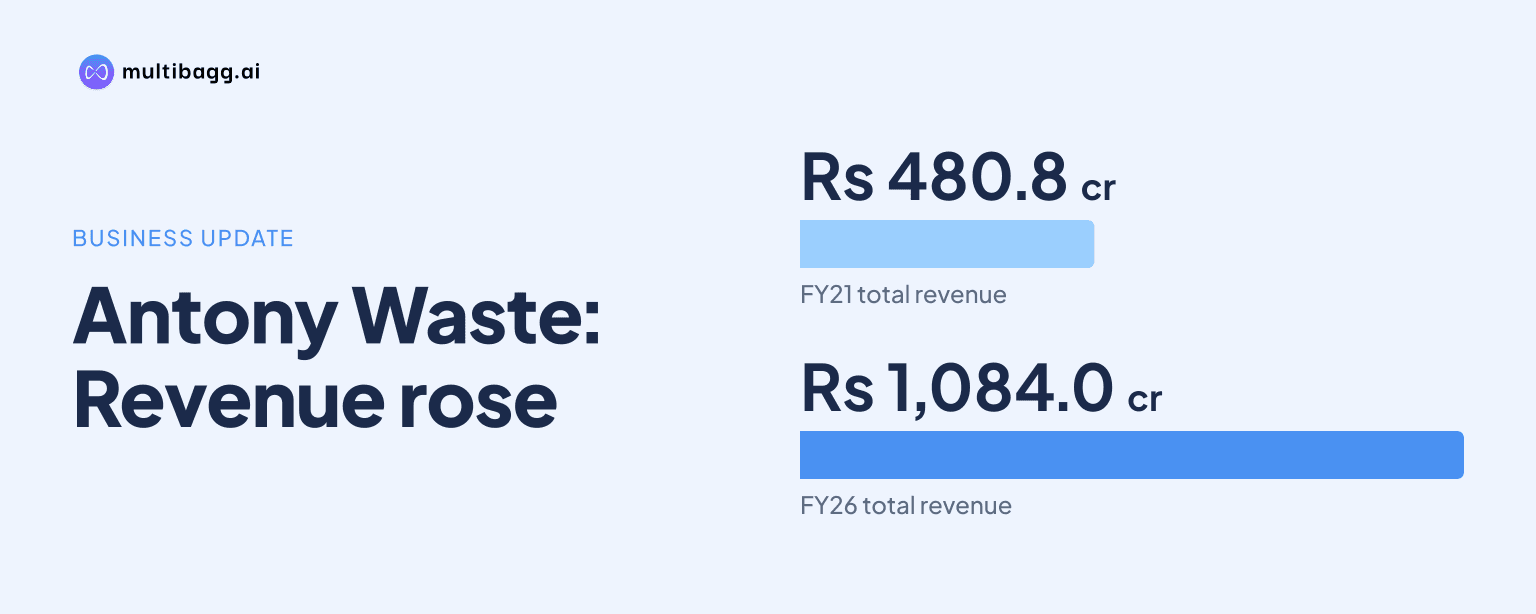
Antony Waste Handling Cell Ltd. more than doubled revenue to Rs 1,084.0 crore in financial year 2026 (FY26) from Rs 480.8 crore in FY21, but earnings before interest, tax, depreciation and amortisation (EBITDA) margin fell to 21.8% from 27.1%, while return on capital employed was 11.5%, down from 16.7%.
Know Antony Waste Handling Cell inside out
Results, valuation, peers and who's buying, in one view.
How did Antony Waste's revenue change from FY21 to FY26?
Antony Waste's total revenue increased by Rs 603.2 crore between FY21 and FY26, reaching Rs 1,084.0 crore from Rs 480.8 crore. Collection and transportation of municipal solid waste (MSW) was the largest revenue stream in both years, rising to Rs 646.4 crore in FY26 from Rs 297.3 crore in FY21.
Operating revenue, comprising MSW collection and transportation and MSW processing, grew to Rs 920.0 crore in FY26 from Rs 429.2 crore in FY21. Contract and other revenue also increased over the five years, but its trajectory was uneven: it reached Rs 232.2 crore in FY23, declined to Rs 117.3 crore in FY25 and recovered to Rs 164.0 crore in FY26.
The two MSW operating segments supplied Rs 920.0 crore of FY26 revenue, compared with Rs 164.0 crore from contract and other activities. MSW processing rose to Rs 273.6 crore from Rs 131.9 crore over the period, while collection and transportation increased by Rs 349.1 crore, making it the larger contributor to total revenue growth.
Why did Antony Waste's profitability not track revenue growth?
Antony Waste's EBITDA rose to Rs 236.3 crore in FY26 from Rs 130.3 crore in FY21, but its EBITDA margin declined by 5.3 percentage points to 21.8%. Profit before tax (PBT) before exceptional items increased to Rs 89.7 crore from Rs 70.6 crore, while the corresponding margin fell to 8.3% from 14.7%.
The profit and loss statement records employee cost of Rs 346.2 crore in FY26, compared with Rs 154.1 crore in FY21, alongside other expenses of Rs 491.8 crore versus Rs 183.1 crore. Depreciation rose to Rs 85.8 crore from Rs 31.2 crore and finance cost reached Rs 60.8 crore from Rs 28.5 crore, while earnings before interest and tax margin declined to 13.9% from 20.6%.
FY25 reported PBT included Rs 23.9 crore of exceptional income from an arbitration settlement. Excluding that item, FY25 PBT was Rs 94.5 crore and FY26 PBT before exceptional items was lower at Rs 89.7 crore; PAT also decreased to Rs 91.7 crore in FY26 from Rs 100.6 crore in FY25. PAT attributable to owners was Rs 75.4 crore in FY26, below Rs 85.4 crore in FY25.
Got a follow-up? Ask IRIS
What happened to Antony Waste's capital returns and funding?
Antony Waste's capital employed expanded to Rs 1,308 crore in FY26 from Rs 591 crore in FY21, while return on capital employed (ROCE) declined to 11.5% from 16.7%. Return on equity (ROE) also fell to 10.0% in FY26 from 14.5% in FY21, after reaching 17.0% in FY22.
The balance sheet shows total assets of Rs 1,738.7 crore at March 2026, compared with Rs 792.8 crore at March 2021. Non-current assets grew to Rs 1,229.9 crore from Rs 481.2 crore, including property, plant and equipment of Rs 409.0 crore and other intangible assets of Rs 295.1 crore at March 2026.
Total equity was Rs 915.2 crore at March 2026, up from Rs 442.6 crore at March 2021. Non-current borrowings were Rs 270.2 crore and current borrowings were Rs 155.3 crore at March 2026; non-current borrowings were lower than Rs 331.3 crore at March 2025, while current borrowings rose from Rs 141.8 crore.
The net debt-to-equity ratio was 0.3 in FY26, compared with 0.4 in FY25 and 0.5 in both FY23 and FY24. The ratio was 0.1 in FY21 and FY22, while finance cost rose to Rs 60.8 crore in FY26 from Rs 20.5 crore in FY22, according to the consolidated profit and loss statement.
Did Antony Waste's operating cash flow keep pace with expansion?
Antony Waste generated Rs 139.4 crore of net cash from operating activities in FY26, up from Rs 111.5 crore in FY21 but below Rs 184.0 crore in FY25. Across FY21 to FY26, total revenue increased by Rs 603.2 crore whereas net cash from operating activities increased by Rs 27.9 crore.
Cash generated from operations was Rs 171.2 crore in FY26 after a Rs 47.4 crore working-capital outflow. In FY21, cash generated from operations was Rs 128.6 crore and working capital added Rs 9.4 crore; working-capital movement was also negative in FY22, FY23, FY24 and FY25.
Net cash used in investing activities narrowed to Rs 55.6 crore in FY26 from Rs 147.5 crore in FY25 and Rs 260.4 crore in FY23. Net cash used in financing activities was Rs 93.0 crore in FY26, compared with net financing inflows of Rs 11.5 crore in FY25 and Rs 148.5 crore in FY23.
Cash and cash equivalents ended FY26 at Rs 109.6 crore, down from Rs 118.9 crore at the end of FY25, after a net decrease of Rs 9.3 crore. Current trade receivables were Rs 322.1 crore at March 2026, compared with Rs 265.4 crore at March 2025 and Rs 110.1 crore at March 2021.
Conclusion
Antony Waste's FY21-to-FY26 record shows substantial expansion in revenue and operating assets, led by MSW collection and transportation and supported by processing revenue. However, the revenue increase coincided with lower EBITDA, PBT and PAT margins, declining ROCE and ROE, and growth in operating cash generation that was far smaller than the increase in revenue.
The presentation does not disclose an FY27 financial target, capital-expenditure plan or scheduled financial milestone. The next results will show whether the FY26 working-capital outflow of Rs 47.4 crore, finance cost of Rs 60.8 crore and 11.5% ROCE change as revenue develops beyond Rs 1,084.0 crore.