










Antony Waste’s 30 projects centre on Kanjurmarg and PCMC
Key highlights
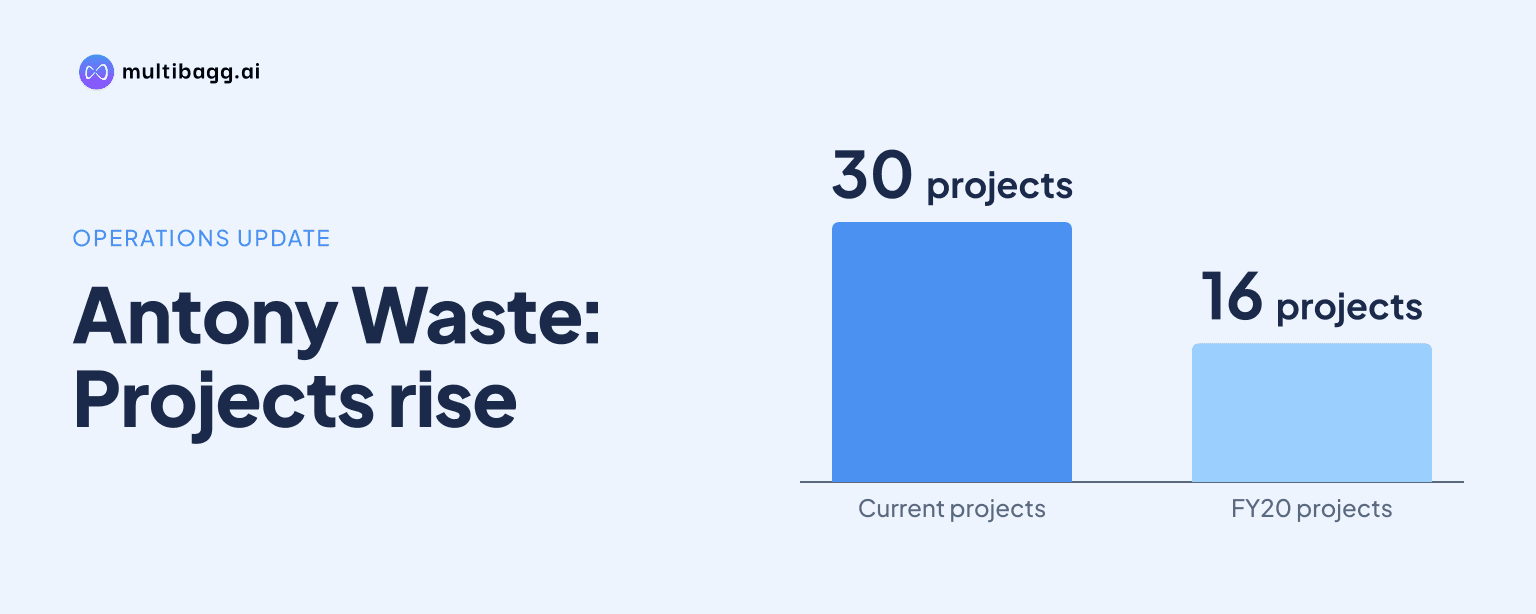
- Antony Waste operates 30 ongoing projects, up from 16 projects in FY20.
- Kanjurmarg handled 90% of Mumbai’s waste and managed about 6,000 TPD in September 2026.
- Antony Waste’s 14-MW project processes 1,000 TPD and began commercial power sales in October 2023.
- Antony Waste reported FY26 revenue from operations of Rs 1,084 crore, including Rs 274 crore from MSW processing.
powered by IRIS
Antony Waste Handling Cell Ltd. operates 30 ongoing municipal waste projects, anchored by its Kanjurmarg facility, which handles 90% of Mumbai’s waste and managed about 6,000 tonnes per day in September 2026, and a 14-megawatt waste-to-energy plant that processes 1,000 tonnes per day and began commercial power sales in October 2023.
Know Antony Waste Handling Cell inside out
Results, valuation, peers and who's buying, in one view.
What does Antony Waste operate at Kanjurmarg?
Antony Waste operates an integrated waste-management facility at Kanjurmarg with about 7,500 tonnes per day (TPD) of municipal solid waste (MSW) handling capability. Its disclosed capacity includes a 6,500-TPD bio-reactor landfill, a 250-TPD sanitary landfill, a 1,000-TPD material-recovery and composting facility, and a 0.97-megawatt (MW) gas-to-energy plant.
The Kanjurmarg concession runs from 2010 to 2036, with about 11 years of balance tenure as presented in September 2026. Antony Waste says the site had managed about 20.76 million tonnes since inception through September 2026, while current waste managed was about 6,000 TPD, below the disclosed 7,500-TPD handling capability.
LARA Central de Tratamento de Resíduos Ltda is the joint-venture technology partner for Kanjurmarg’s scientific landfill. The facility sold about 49,000 tonnes of refuse-derived fuel (RDF) and about 2,000 tonnes of compost in Q2FY27, and its RDF has gross calorific value of more than 4,000 calories per gram.
How does Antony Waste’s 14 MW waste-to-energy project operate?
Antony Waste’s 14-MW waste-to-energy project processes 1,000 TPD of MSW under a 2019-2040 concession. The integrated project includes pre-processing, composting, power generation and landfill management, with Hitachi Zosen Corporation named as technology partner.
Commercial power sales to PCMC began in October 2023 after the project’s inauguration on 1 August 2023. The presentation says PCMC will purchase electricity at Rs 5 per unit during the concession period and supplied 30 acres of land for the facility.
The project uses recycled water from the Chikhali Sewerage Treatment Plant, eliminating the need for fresh water according to the presentation. Management estimates it can save about 7 lakh tonnes of carbon dioxide annually, equivalent in its comparison to emissions from about 1.5 lakh passenger cars; this is an estimated project outcome rather than reported annual performance.
How is Antony Waste’s 30-project network divided?
Antony Waste’s 30 ongoing projects comprise 19 collection-and-transportation assignments, four mechanised-sweeping projects, six waste-processing-and-disposal projects, and one construction-and-demolition waste project. The presentation says projects have been executed in 10 states to date.
Collection and transportation work is listed in locations including Mumbai, Nagpur, Nashik, Navi Mumbai, Noida, North Delhi, Panvel, Thane and Varanasi. Waste-processing and disposal projects are listed in CIDCO, Kadapa, Kurnool, Mumbai, PCMC and Thane, while the construction-and-demolition assignment is in Mumbai.
The network expanded from 16 projects in FY20 to 30 in FY26, while revenue from operations rose from Rs 465 crore to Rs 1,084 crore. Antony Waste also reports 11 ongoing projects in the Mumbai Metropolitan Region and six in the National Capital Region, reflecting its stated cluster-based growth approach.
Got a follow-up? Ask IRIS
What vehicles and technology support Antony Waste’s operations?
Antony Waste reports 2,745 vehicles and equipment units, of which 2,484 were fitted with global positioning system (GPS) tracking devices. The company says GPS tracking supports movement monitoring, route optimisation and higher vehicle utilisation.
The disclosed fleet includes 1,618 small electric tipper vehicles, 611 compactors, 132 big tippers, 62 hook loaders, 52 dumper placers and 12 power-sweeping machines. It also includes 144 drain-stilt machines and other equipment, with Bucher, Hyva, Kärcher, Caterpillar, CP and MOBA Mobile Automation named among vendors.
At Kanjurmarg, Antony Waste uses an aerobic process through its material-recovery facility (MRF) and composting operations, alongside anaerobic processing through bioreactor-landfill technology. At the Dahisar construction-and-demolition waste plant in Mumbai, the presentation says a combination of dry-line and wet-line technology is used.
How have Antony Waste’s revenue mix and contract terms changed?
Antony Waste reported FY26 revenue of Rs 1,084 crore, including Rs 646 crore from collection and transportation of MSW, Rs 274 crore from MSW processing, and Rs 164 crore from contracts and other activities. Collection and transportation remained the largest activity, accounting for 60% of FY26 revenue.
MSW processing revenue increased from Rs 132 crore in FY21 to Rs 274 crore in FY26, while its contribution declined from 27% to 25%. Collection-and-transportation revenue increased from Rs 297 crore to Rs 646 crore over the same period, while contracts and other activities rose from Rs 52 crore to Rs 164 crore.
Antony Waste reports average ongoing contract durations of eight years for MSW collection and transportation, six years for sweeping, and 20 years for waste processing. Management says tipping fees have built-in escalations that partly hedge major costs, while its bidding approach targets municipalities with stable financials and projects meeting an internal hurdle rate that has not been disclosed.
Conclusion
Antony Waste’s footprint combines large processing infrastructure with municipal-service contracts: Kanjurmarg integrates landfill, recovery, composting and gas-to-energy activities while managing about 6,000 TPD, and the 14-MW project converts 1,000 TPD of MSW into electricity sold to PCMC. Across the group, 30 ongoing projects supported Rs 1,084 crore of FY26 revenue.
The next disclosed operating markers are the Kanjurmarg concession’s remaining roughly 11 years through 2036 and the waste-to-energy concession through 2040. Management’s plan is to pursue new-state clusters, while focusing on waste-to-energy, segregation, RDF sales and bio-mining; execution in these areas is relevant as FY26 MSW-processing revenue was Rs 274 crore and waste-processing contracts average 20 years.