










Apsis Aerocom Limited H1 Revenue Rises 55%, Keeps ₹48 Crore Target
Key highlights
- Apsis Aerocom reported H1 FY27 revenue of ₹21.17 crore, up 55% year on year.
- H1 FY27 EBITDA rose 36% to ₹6.52 crore, while EBITDA margin declined to 30.8% from 35.2%.
- Profit after tax increased 21% to ₹3.97 crore in H1 FY27.
- Management retained its FY27 revenue target of about ₹48 crore and reported a ₹31.8 crore order book.
powered by IRIS
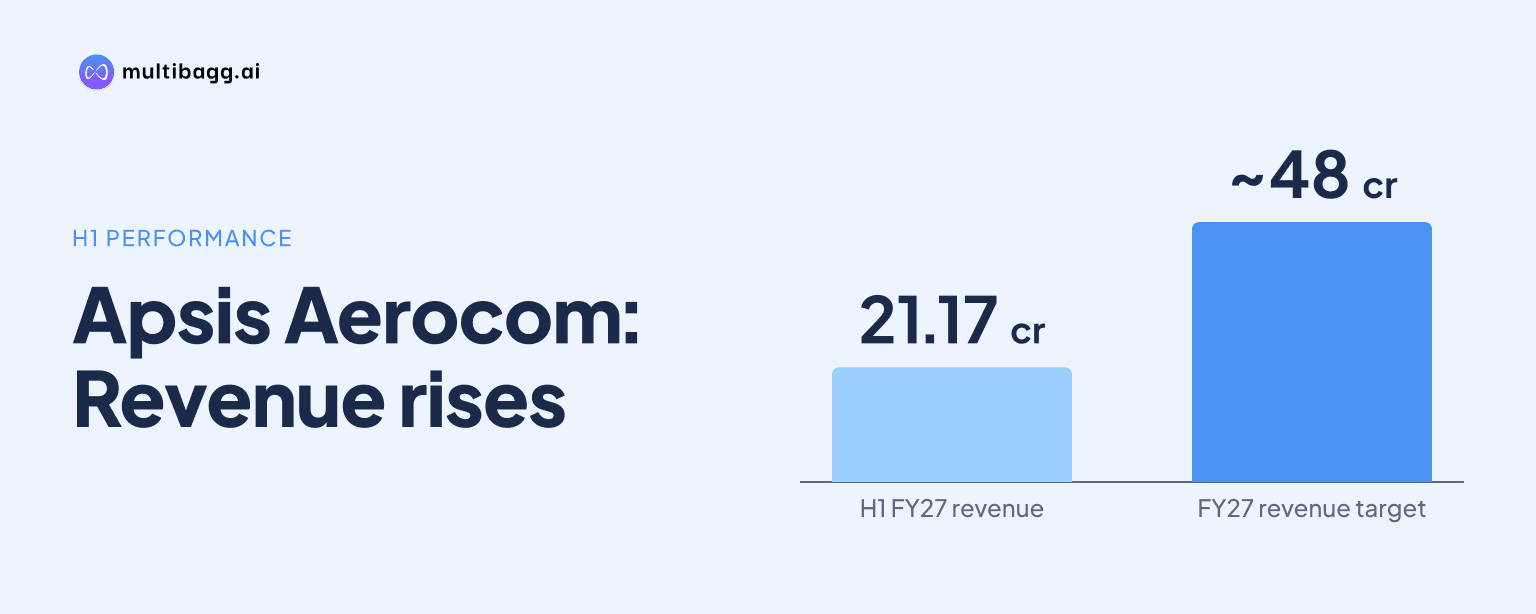
For H1 FY27 ended September 30, 2026, Apsis Aerocom Limited increased revenue 55% year on year to ₹21.17 crore and retained its FY27 revenue target of about ₹48 crore. EBITDA rose 36% to ₹6.52 crore, while the EBITDA margin declined to 30.8% as Unit 2 start-up costs affected profitability.
Know Apsis Aerocom inside out
Results, valuation, peers and who's buying, in one view.
What did Apsis Aerocom report for H1 FY27?
Apsis Aerocom reported revenue from operations of ₹21.17 crore for H1 FY27, up 55% year on year. EBITDA increased 36% to ₹6.52 crore and profit after tax rose 21% to ₹3.97 crore. The company discussed these results in its maiden H1 FY27 earnings conference call on November 14, 2026.
The reported revenue represents 44% of management's FY27 revenue objective of about ₹48 crore. Management said the business serves more than 17 customers and has exports to the US, Israel, India and several European countries. The source also noted that defence revenue rose 56%, while healthcare revenue was about three times the prior-year level.
Why did Apsis Aerocom's EBITDA margin fall?
Apsis Aerocom's EBITDA margin declined by about 4.4 percentage points to 30.8% from 35.2%, despite the rise in revenue and EBITDA. The earnings-call summary attributed the decline to start-up costs related to Unit 2, which was commissioned during the period.
The difference between revenue growth of 55% and EBITDA growth of 36% shows that profit growth did not keep pace with sales growth in the first half. Profit after tax grew 21%, below both revenue and EBITDA growth. The source described this as negative operating leverage, while management expects Unit 2 utilisation to improve over time.
Management said it expects an EBITDA margin of at least 35% over the next two years. This is management guidance rather than a reported financial outcome. The call included a standard caution that forward-looking statements are based on current expectations and can differ materially from actual results.
What is Apsis Aerocom's FY27 revenue guidance?
Apsis Aerocom reiterated its FY27 revenue guidance of about ₹48 crore during the November 14 results call. With ₹21.17 crore reported in H1, the company would need about ₹26.8 crore of revenue in H2 to meet that objective.
Management said its ₹31.8 crore order book covered roughly 1.2 times the H2 revenue requirement. The order book was equivalent to about 1.5 times H1 revenue. The call summary also referred to a pipeline of at least ₹100 crore and more than 100 parts in development, although a pipeline does not represent booked revenue.
Unit 2 is expected to contribute about ₹15 crore of revenue in H2 as utilisation rises, according to management. This contribution forms an important part of the company's second-half plan, but the source does not provide a quarter-by-quarter forecast or a confirmed revenue schedule.
Got a follow-up? Ask IRIS
What expansion plans has Apsis Aerocom outlined?
Apsis Aerocom has outlined a plan for about ₹80 crore of revenue in FY28 at full utilisation. Management indicated that Unit 2 could have peak revenue potential of ₹50 crore to ₹60 crore, with an additional ₹5 crore to ₹6 crore possible from a more complex product mix.
Management also described vertical integration as a potential stretch opportunity that could lift revenue to ₹90 crore to ₹95 crore, or about 10% to 15% above the machining-led level. These figures are plans and targets stated on the call, not financial results or confirmed orders.
For the longer term, management referred to a FY32 objective of about ₹300 crore as committed. It also referred to a contingent ₹500 crore possibility if an early-stage prospect converts and Unit 3 begins from FY29. The source does not disclose confirmed Unit 3 capital expenditure details or identify the prospective customer.
What does the call indicate for investors and operations?
Apsis Aerocom's H1 results show strong growth in revenue and profit, but the lower EBITDA margin places attention on Unit 2's ramp-up and the company's ability to improve utilisation. The ₹31.8 crore order book provides stated coverage for the remaining FY27 revenue requirement, though order-book conversion and timing remain relevant to delivery of the annual target.
Customer concentration was also discussed during the call. Management said it did not plan to reduce customer concentration and stated that it would need to increase customer concentration. The source does not provide a customer-wise revenue breakdown, so the financial contribution of individual customers cannot be assessed from the disclosed information.
The company made the call recording available on its website in compliance with SEBI Listing Obligations and Disclosure Requirements Regulations. Management participants included Managing Director Basavaraj K S, Chairman and Executive Director Mihir Kumar Pradhan, Whole Time Director Vinod Kumar Mariappan, Chief Financial Officer K N Sashidhar and Company Secretary and Compliance Officer Saloni Jayati.
Conclusion
Apsis Aerocom delivered 55% H1 FY27 revenue growth to ₹21.17 crore, while EBITDA and profit after tax increased at slower rates and EBITDA margin fell to 30.8%. The results leave the company with about ₹26.8 crore of revenue required in H2 to achieve its reiterated FY27 target of about ₹48 crore, against a reported ₹31.8 crore order book.
The next points to watch are Unit 2's H2 revenue contribution of about ₹15 crore, progress in utilisation and the stated margin expectation of at least 35% over the next two years. Investors can also track disclosures around the FY28 ₹80 crore plan, vertical-integration opportunity and any further detail on Unit 3 and the FY32 targets.