










Apsis targets 35% EBITDA margin despite Unit-2 cost drag
Key highlights
- Apsis expects about 35% EBITDA margin and 23% PAT margin for FY '27 and FY '28.
- H1 FY '27 material costs increased about 3.83% versus H1 FY '26.
- Unit-2 utilisation was about 30% to 35% in September and October, while Unit-1 was at 100%.
- Units 1 and 2 have Rs 80 crore machining revenue capacity, rising to Rs 90 crore to Rs 95 crore with vertical integration.
powered by IRIS
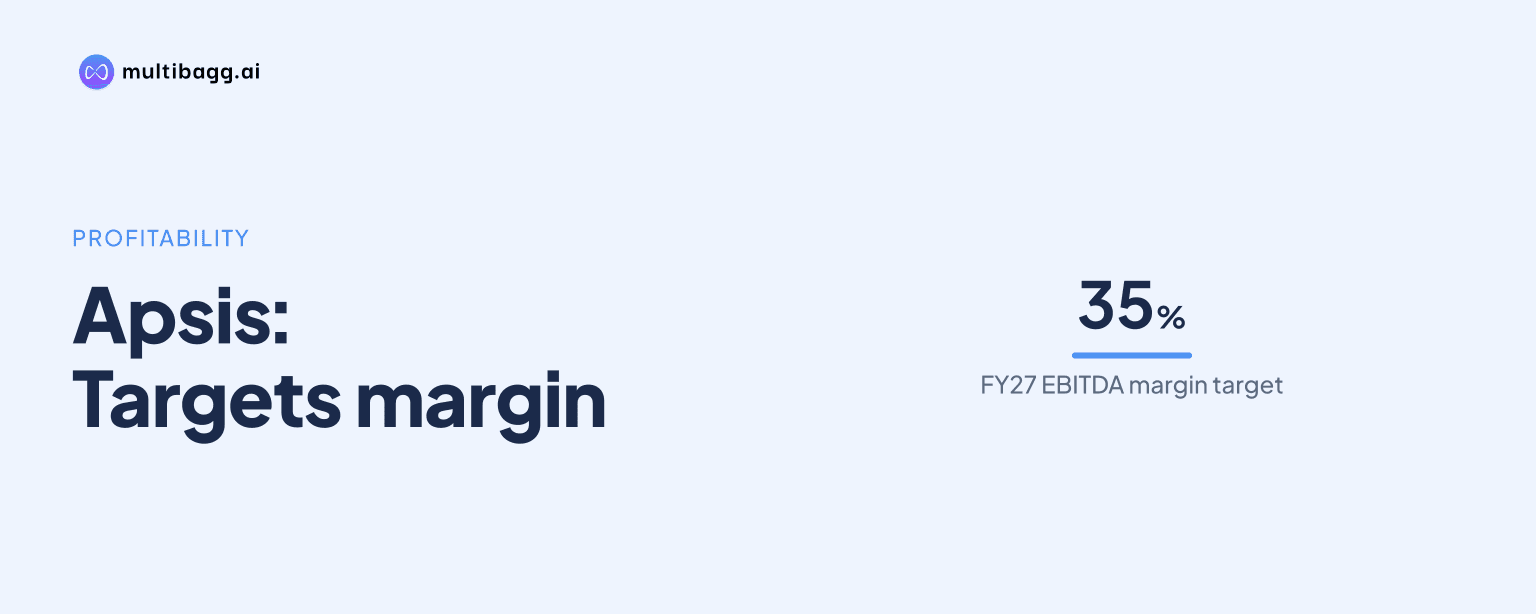
Apsis Aerocom Limited expects about 35% EBITDA margin and 23% profit after tax, or PAT, margin in FY '27 and FY '28, despite H1 FY '27 cost pressure from a 3.83% increase in material costs, Unit-2 fixed expenses and 1.27% higher depreciation. Management expects higher Unit-2 utilisation to support the target.
Know Apsis Aerocom inside out
Results, valuation, peers and who's buying, in one view.
Why did Apsis margins decline in H1 FY '27?
Apsis said EBITDA and PAT margins declined in H1 FY '27 versus H1 FY '26 because cost of material consumed increased by about 3.83%. Management attributed the increase to a changed product mix, higher raw-material prices and other production-related costs. It said price increases are difficult to implement immediately on projects already under execution.
Other expenses increased by 1.75% year on year in H1 FY '27, according to management. The increase reflected rent, electricity, security and other fixed operating costs at Unit-2 before it reached its expected revenue contribution. These costs affected margins because Unit-2 was operating below its intended scale.
PAT also absorbed a 1.27% increase in depreciation associated with fixed assets and machinery bought for Unit-2. Management described the material-cost increase, Unit-2 overheads and depreciation as expansion-related pressures that it expects higher utilisation and revenue to address.
What margins is Apsis targeting for FY '27 and FY '28?
Apsis expects EBITDA margin of about 35% and PAT margin of about 23% for FY '27 and FY '28. Management gave those figures in response to a question on blended margins for the current and following financial year, and then confirmed that the expectation covered the next two financial years.
Management separately said it had committed to at least 35% EBITDA margin for the next two years and was on track with that commitment. In another response, it referred to EBITDA margin of up to 35% and PAT margin of up to 25%, so the more specific 23% PAT figure is the direct guidance provided for FY '27 and FY '28.
Apsis also said H1 performance is generally lower than H2 because demand is higher in the second half. An analyst described the current-year revenue pattern as 40% in H1 and 60% in H2, and management said that pattern is generally applicable to the business. The margin target therefore depends in part on a larger H2 contribution.
How does Unit-2 utilisation affect Apsis's margin plan?
Apsis said Unit-1 was at 100% utilisation, while Unit-2 was only about 30% to 35% utilised in September and October. Fifteen Unit-2 machines had arrived against a total plan for 30 machines, but installation and commissioning were still under way. Fixed costs and depreciation were therefore being incurred before the facility was fully productive.
The existing machining business of Units 1 and 2 can generate up to Rs 80 crore of annual revenue, management said. With vertical integration, the revenue capacity could rise to Rs 90 crore to Rs 95 crore. Management said additional activities could include assemblies and other service work that adds value for customers.
Management said vertical integration could add about 10% to 15% of revenue using the Unit-2 facility. It nevertheless said the business concentration planned for the next two years would be aligned with its margin objective and that currently undisclosed vertical-integration plans would not disturb the stated margins.
Got a follow-up? Ask IRIS
Can Apsis pass higher material costs to customers?
Apsis said it cannot always pass material-cost inflation to customers during an ongoing project. Customers may already have budgets and purchase orders approved, while their own pricing changes can require approval from an original equipment manufacturer, or OEM. Management said the process is particularly difficult for large purchase orders.
Apsis said it seeks revised prices at the next order finalisation or repeat order. Management may absorb an increase where its effect is manageable, but said it would approach the customer for a revision if the effect became significant to the balance sheet. This timing explains why the 3.83% H1 FY '27 material-cost increase affected current-period margins.
The company had an order book of about Rs 30 crore and said it normally maintains a minimum pipeline of Rs 100 crore. Management put the usual conversion ratio for that pipeline at about 30% to 35%, but did not disclose how much of the pipeline includes revised pricing or when it would convert into revenue.
What could support or limit Apsis's two-year margin target?
Apsis identified improved Unit-2 utilisation and higher revenue contribution as the main support for its 35% EBITDA and 23% PAT targets. The company said defence would remain its major revenue contributor over the next two years, while aerospace could account for up to 30% of revenue. Management expects the overall segment mix to remain broadly similar.
Management said the company had produced about 250 parts and had around 140 parts in production. It estimated the part mix at about 50% defence, 40% aerospace and 10% healthcare. Product mix matters because management identified changes in mix as one cause of the higher material-cost ratio in H1 FY '27.
Apsis said it had added about 100 parts and estimated its total number of stock-keeping units, or SKUs, at about 500 to 600. Management said component values range from Rs 200 or Rs 500 to about Rs 1 lakh, indicating that revenue and margin outcomes can vary by component complexity and value rather than by the number of SKUs alone.
Management has 40,000 square feet of additional land near Aerospace Park, but said Unit-3 remains at an initial planning stage. It has not decided Unit-3 configuration, capital expenditure or funding. Management is considering more complex machined components and automation for Unit-3, while the available land could also be used for mechanical assemblies and medium-critical work.
Conclusion
Apsis's two-year margin target rests on a recovery in Unit-2 productivity rather than on the H1 FY '27 cost base remaining unchanged. Material costs rose 3.83%, other expenses increased 1.75% and Unit-2-related depreciation rose 1.27% versus H1 FY '26, while the new facility was only 30% to 35% utilised in September and October.
The next disclosures to watch are progress in installing and commissioning the remaining Unit-2 machines, H2 demand that management says is usually higher than H1, and any decision on Unit-3. Management has not set a Unit-3 budget or funding plan because it has not yet finalised whether to prioritise the specialised facility or further vertical integration.