










Apsis expects ₹15 crore Unit-2 contribution in H2 FY27
Key highlights
- Apsis expects Unit-2 to generate about ₹15 crore in H2 FY27.
- Unit-2 operated at around 30%-35% utilisation in September and October 2026.
- Apsis said Unit-2 can contribute around ₹50 crore to ₹60 crore annually at peak utilisation.
- Apsis reported a ₹31.8 crore order book as of 30 September 2026.
powered by IRIS
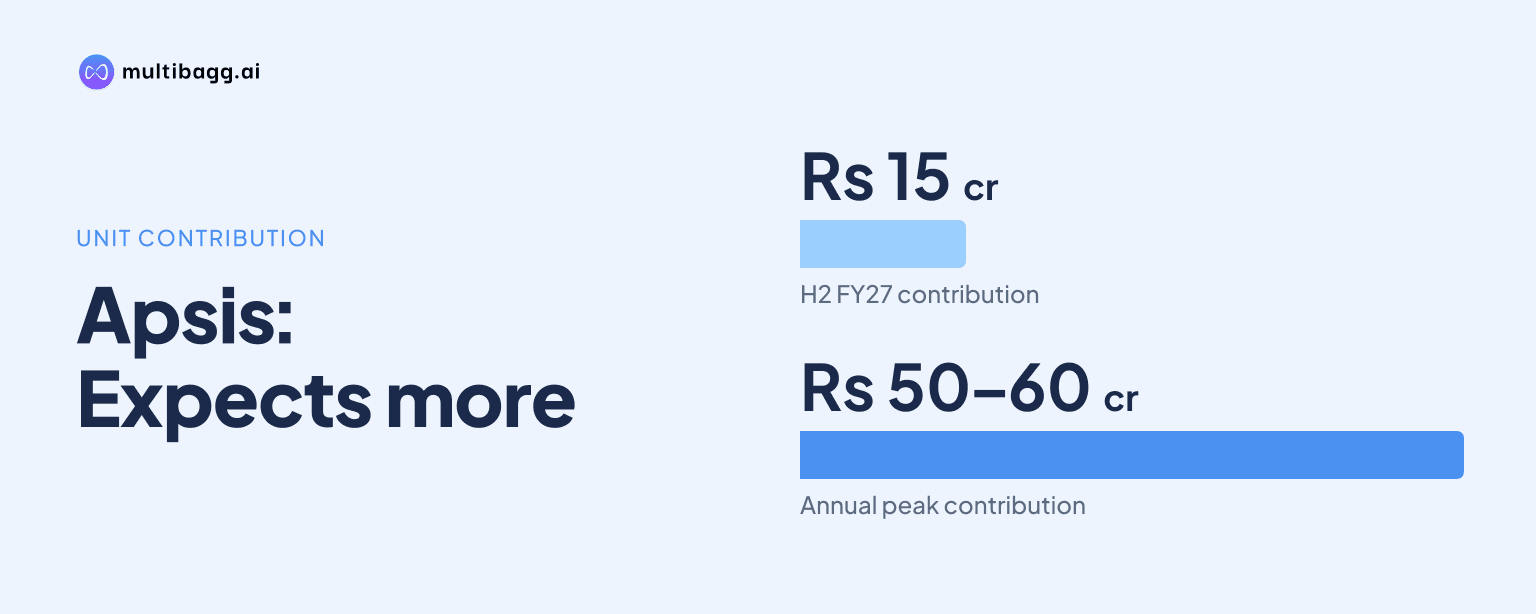
Apsis expects Unit-2 to generate approximately ₹15 crore in H2 FY27, while the facility was operating at about 30%-35% utilisation in September and October during machine installation and commissioning. Management said Unit-2 can support its planned 50%-55% growth scale through FY29, although the next expansion format and funding remain undecided.
Know Apsis Aerocom inside out
Results, valuation, peers and who's buying, in one view.
How much will Unit-2 contribute in H2 FY27?
Apsis expects Unit-2 to generate about ₹15 crore in H2 FY27. Management gave the estimate when asked about the new plant's revenue contribution as utilisation improves. The figure is material against the company-wide H2 FY27 revenue requirement of about ₹26.8 crore to reach its stated FY27 target of about ₹48 crore.
Unit-2 was still being ramped up at the end of September 2026. Apsis had 15 machines at Unit-2, against a planned total of 30, and management said installation and commissioning were continuing. Utilisation was about 30%-35% in September and October, while Unit-1 was fully utilised, leaving room for additional output as Unit-2 becomes operational.
Apsis invested ₹23.33 crore in H1 FY27, including advances for capital assets, using initial public offering proceeds for advanced computer numerical control machines and inspection equipment at Unit-2. Gross additions to fixed assets were ₹13.3 crore, and net block, or fixed assets after depreciation, rose to ₹24.61 crore from ₹12.3 crore.
What annual revenue capacity can Unit-2 reach?
Apsis said Unit-2 can contribute annual revenue of around ₹50 crore to ₹60 crore at peak utilisation. Management described ₹50 crore as an aggressive plan and said work on more complex parts could add another ₹5 crore to ₹6 crore. This is a capacity indication rather than a formal FY29 revenue target.
Apsis said the two operating units can generate up to ₹80 crore in the existing machining business. Management said assemblies and other value-added services could lift that figure to ₹90 crore to ₹95 crore. The difference depends on vertical integration, not simply on placing more machining equipment in the two facilities.
The company has separately outlined a plan for about ₹80 crore of revenue in FY28 as Unit-1 and Unit-2 reach full capacity. It also cited around 50 new components at the request-for-quotation stage and more than 100 developed parts that could become production orders, though these opportunities are not reported orders.
Can Unit-2 support growth through FY29?
Apsis said its Unit-2 plan can support a 50%-55% annual growth scale until FY29. Management made the comment in response to a concern that the two current facilities could be fully utilised by FY28. Its stated roadmap moves from ₹30.65 crore of revenue in FY26 to about ₹48 crore in FY27 and about ₹80 crore in FY28.
Unit-2 has 20,000 square feet of machine-shop and office space at the Hi-Tech Aerospace and Defence Park in Bengaluru. It had 15 machines and more than 45 employees as of September 2026. Across the two operating units, Apsis had 33 machines and 125 employees, compared with Unit-1's 18 machines and 80 employees.
Management acknowledged that FY29 capacity could be constrained if Apsis only performs machining. Its proposed response is vertical integration into assemblies and other service activities. Management estimated this could add at least 10%-15% to revenue using Unit-2 itself, subject to executing those activities and securing the related customer work.
Got a follow-up? Ask IRIS
What is Apsis planning for Unit-3?
Apsis said it expects to decide its further scalability plan around the beginning of the next financial year, with Unit-3 construction or another expansion option contemplated by FY29. Management stressed that Unit-3 remains at an initial stage because the business plan, configuration and budget are not yet finalised.
The proposed Unit-3 is a 40,000-square-foot greenfield facility near Bengaluru Airport and the Aerospace Park. Apsis also said it has around 40,000 square feet of additional land available for construction. That land area is twice Unit-2's 20,000 square feet, but management has not committed to build the proposed facility.
Management said the eventual solution could be Unit-3, further investment in a nearby facility or expansion in the same building. It has not disclosed capital expenditure, equipment costs or a funding mix because the business plan is incomplete. Internal accruals, debt and equity funding were therefore not specified in the discussion.
Does Apsis have orders supporting the ramp?
Apsis reported an order book of ₹31.8 crore as of 30 September 2026, which management said covered its ₹26.8 crore H2 FY27 revenue requirement by about 1.2 times. The order book was led by defence at ₹16 crore, followed by aerospace at ₹9.9 crore and healthcare at ₹4.4 crore.
The reported order book supports the company-wide FY27 delivery plan, while the ₹15 crore Unit-2 estimate is a plant-specific contribution within H2 FY27. Apsis also said it maintains a bid pipeline of at least ₹100 crore, with historical conversion of roughly 30%-35%, but management distinguished this pipeline from confirmed orders.
Management said around 50% of parts were for defence, 40% for aerospace and 10% for healthcare. It expects the broad revenue mix to remain similar during the next two years, with aerospace potentially reaching up to 30% of revenue and defence remaining the largest contributor. Apsis also said 140 components developed in the prior year were already in production.
Conclusion
Apsis has placed Unit-2 at the centre of its H2 FY27 delivery plan, with an expected contribution of about ₹15 crore while the facility moves beyond its September and October utilisation level of 30%-35%. The longer-term plan combines Unit-2's stated ₹50 crore to ₹60 crore potential with machining capacity of up to ₹80 crore across both units and a possible revenue addition from assemblies and related services.
The next item to watch is management's scalability decision around the beginning of the next financial year. Apsis has said FY29 may require either Unit-3 or another expansion route, but its 40,000-square-foot Unit-3 proposal still has no final business plan, capital budget or funding arrangement disclosed.