










Aptus says more than 90% of loans clear within 72 hours
Key highlights
- Aptus says more than 90% of loans are approved within 72 hours through centralized underwriting.
- Aptus uses more than 60 predefined customer-profile templates in its risk-management process.
- Aptus reported Q2 FY27 disbursements of Rs 1,153 crore, up 20% from Rs 963 crore in Q2 FY26.
- Aptus opened 58 branches in H1 FY27, including 25 that became operational in Q2 FY27.
powered by IRIS
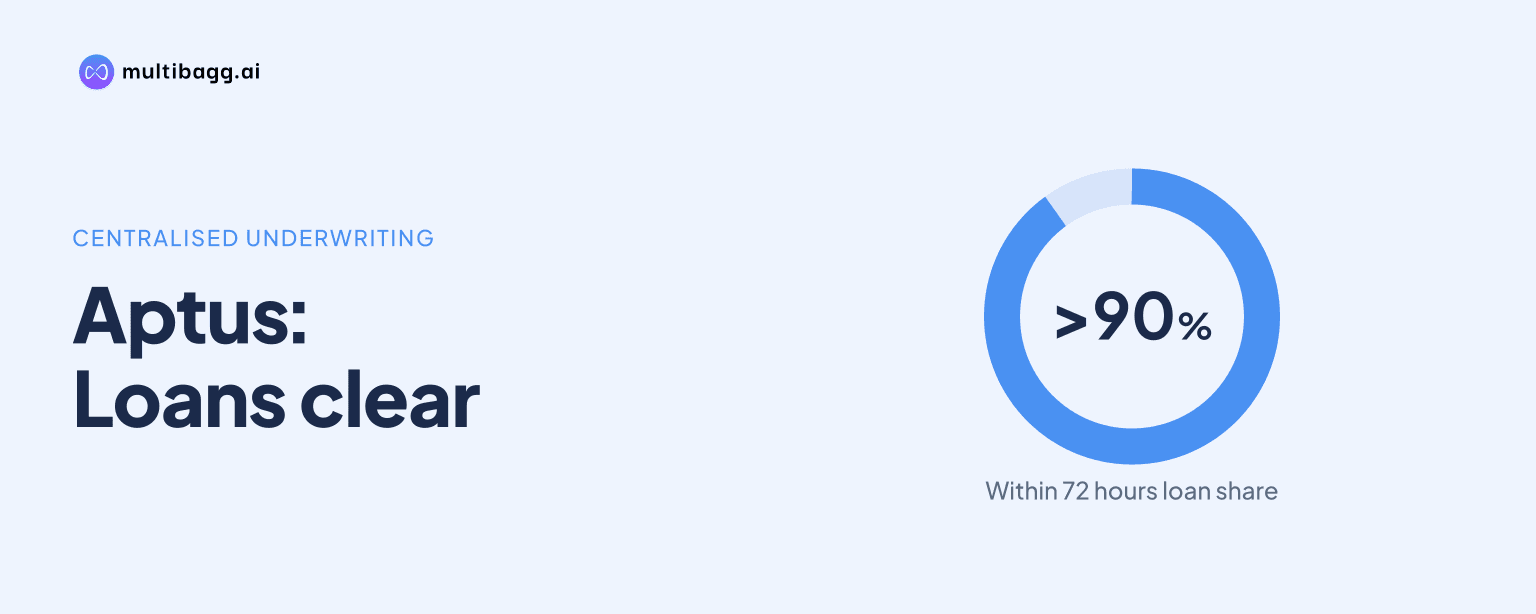
Aptus says more than 90% of loans are approved within 72 hours through centralized underwriting, supported by an integrated credit-evaluation platform and more than 60 predefined customer-profile templates. The presentation places this metric within a mobile-first digital loan-origination system that combines onboarding, credit checks, property verification and disbursement workflows.
Know Aptus Value Housing Finance India inside out
Results, valuation, peers and who's buying, in one view.
How does Aptus approve more than 90% of loans within 72 hours?
Aptus says more than 90% of loans are approved within 72 hours under its centralized underwriting process. The process uses technology-enabled underwriting through an integrated credit-evaluation platform, including a credit scorecard linked to the lending application for credit assessment.
Aptus describes its loan-origination system, or LOS, as a mobile-first, fully integrated platform for customer onboarding, lead management, sanctions and disbursements. Its technology update lists digital applications, document uploads, automated lead allocation, real-time analytics dashboards and integrations for Central Know Your Customer, Unified Payments Interface and E-NACH as features intended to support faster turnaround time, or TAT.
What checks does Aptus use in centralized underwriting?
Aptus uses more than 60 predefined customer-profile templates and multiple verification touchpoints in its risk-management process. The presentation also cites credit bureau information, Account Aggregator data, deed verification and property-location checks as inputs to underwriting.
Aptus retains physical and legal controls alongside digital data checks. Its process includes property identification, geo-tagging, property dimensions and an on-field technical valuation report, while independent legal, technical and title verification is used to assess property eligibility and collateral coverage. Disbursements are released in stages through technical visits.
How does Aptus process digital loan applications?
Aptus uses electronic Know Your Customer and Central Know Your Customer processes, optical character recognition and bank-account verification for digital onboarding. It says real-time application programming interface integrations, optical character recognition and Account Aggregator access enable less data entry and concurrent processing by credit, technical and legal functions.
Aptus also uses digital agreements, E-NACH, electronic signatures and Unified Payments Interface mandates through the disbursement stage. Its technology landscape includes Power BI analytics and machine-learning-based bounce prediction, while the centralized underwriting model uses analysis of borrower-profile behaviour to refine parameters for credit decisions.
Where do Aptus loan applications originate?
Aptus sources applications through its customer app, Bandhu referral app, digital marketing, connector channel and sales executives using the digital LOS. The presentation shows 78.2% for organic sourcing through the LOS, compared with 10.1% for the connector channel and 11.7% for digital marketing.
Aptus also identifies 397 branches as a lead-generation channel and describes sourcing as 100% in-house. It opened 58 branches in H1 FY27, including 25 that became operational in Q2 FY27. The branch-expansion plan focuses on Maharashtra and Odisha, as well as underserved parts of Telangana and Andhra Pradesh.
Got a follow-up? Ask IRIS
How does centralized underwriting fit Aptus's loan portfolio?
Aptus reported consolidated assets under management, or AUM, of Rs 14,177 crore in H1 FY27, compared with Rs 13,107 crore in FY26 and Rs 10,865 crore in FY25. Andhra Pradesh accounted for 43% of H1 FY27 AUM, followed by Tamil Nadu at 30%, Telangana at 18%, Karnataka at 7%, and Odisha and Maharashtra at 2%.
Aptus reports that 81% of its customers are largely self-employed, 86% have a rural focus and 75% are LIC customers. Its housing finance company portfolio had AUM of Rs 10,086 crore, comprising 67% home loans, 26% quasi-home loans, 4% insurance loans and 3% top-up loans. Its non-banking financial company portfolio had Rs 4,091 crore of AUM in small-business loans and non-home loans.
What operating data accompanies Aptus's faster loan process?
Aptus reported Q2 FY27 consolidated AUM of Rs 14,177 crore, up 20% from Rs 11,767 crore in Q2 FY26, while disbursements rose 20% to Rs 1,153 crore from Rs 963 crore. The presentation does not attribute those increases solely to the digital underwriting system, but reports them alongside its technology and risk framework.
Aptus's fully in-house team includes 2,382 people in business origination, 393 in credit, 382 in legal and technical roles, 811 in collections, and 252 in head-office and operations. Its collection framework assigns loans under 18 months to the sales team, uses a centralized tele-calling team of about 25 members for first-bounce accounts, and routes overdue and non-performing loan accounts to field collections and legal recovery respectively.
Conclusion
Aptus's 72-hour approval claim is based on a centralized workflow combining digital onboarding, credit scorecards, more than 60 customer-profile templates, banking and bureau checks, and technical and legal property due diligence. The model operates across a consolidated AUM base of Rs 14,177 crore in H1 FY27, including Rs 10,086 crore in the housing finance company portfolio and Rs 4,091 crore in the non-banking financial company portfolio.
The next disclosed operating development is branch expansion: Aptus opened 58 branches in H1 FY27, with 25 becoming operational in Q2 FY27, and plans additions in Maharashtra, Odisha, Telangana and Andhra Pradesh. The presentation also shows gross non-performing assets at 1.68% in Q2 FY27, 13 basis points above Q2 FY26, alongside the expansion of centralized origination and collection processes.