










Ardee says 50% capacity expansion was no Q2 volume driver
Key highlights
- Ardee increased installed capacity by approximately 50% to 156,950 metric tonnes per annum from 104,025 metric tonnes per annum.
- Management said the debottlenecking capacity made no contribution to Q2 FY27 sales volume of 15,656 metric tonnes.
- Ardee maintained its FY27 target of 10% to 15% volume growth after H1 volume of about 33,300 metric tonnes.
- Domestic raw-material procurement increased from around 15% last year to about 27% to 28%, according to management.
powered by IRIS
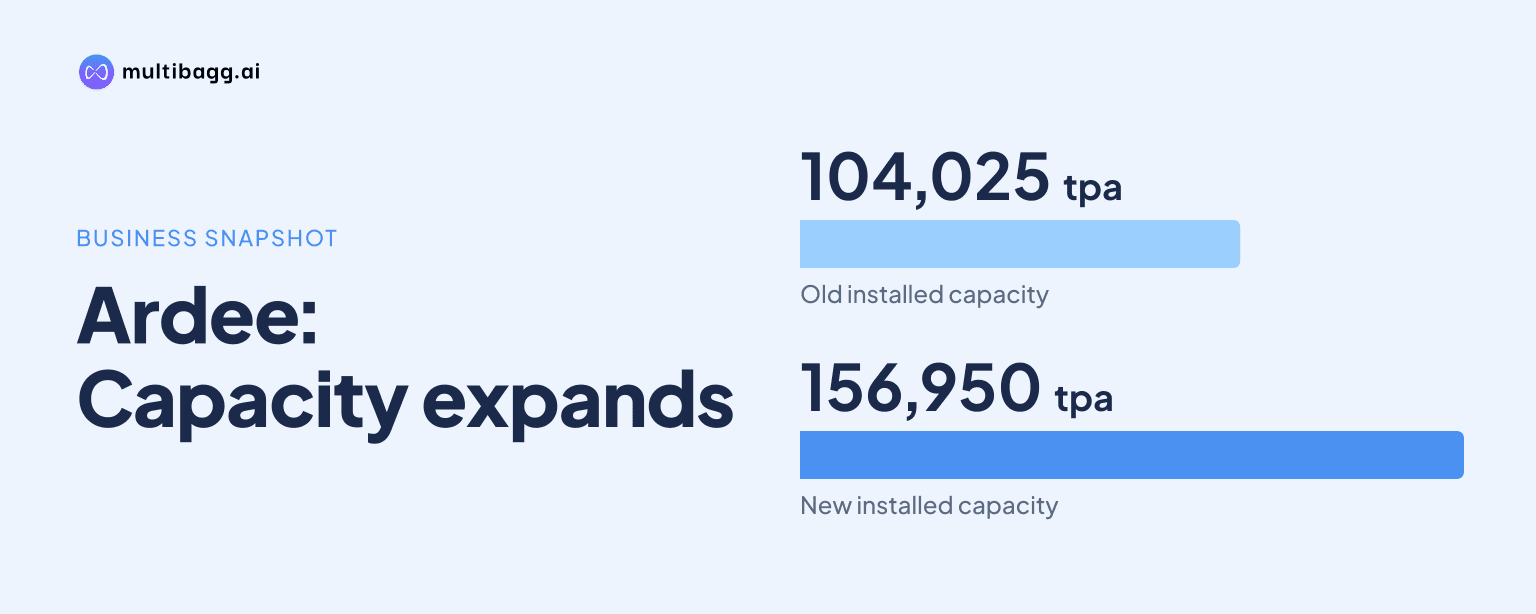
Ardee Industries' Ltd says its installed capacity increased about 50% to 156,950 metric tonnes per annum through debottlenecking, but the added capacity made no contribution to Q2 FY27 sales volumes. Management described the expansion as a buffer to avoid operating at 100% utilisation while maintaining its FY27 volume-growth target of 10% to 15%.
Know Ardee Industries inside out
Results, valuation, peers and who's buying, in one view.
What did Ardee’s capacity expansion change?
Ardee increased installed manufacturing capacity from 104,025 metric tonnes per annum to 156,950 metric tonnes per annum, an expansion of approximately 50% through debottlenecking. Management said the larger base gives it a platform to capture future demand and moves its operating focus toward an optimal utilisation range of 70% to 75%.
The expansion was completed within the existing facility, which management described as a brownfield operation rather than a new plant. It said machinery-size replacements enabled higher output from the facility and required less capital expenditure than a separate build-out. Ardee also received official handover of a 6-acre land parcel beside its Naidupeta, Andhra Pradesh facility, although it has not disclosed a concrete development plan for that land.
Management said the expansion addresses a previous operating constraint: the earlier capacity base would have required near-100% utilisation to reach its output potential. The 156,950-tonne capacity therefore provides operating headroom, allowing Ardee to pursue higher output without immediately running the plant at its prior limit.
Did Ardee’s added capacity contribute to Q2 FY27 volumes?
No, Ardee said the capacity added through debottlenecking did not contribute to Q2 FY27 sales volumes. The company reported Q2 FY27 sales volume of 15,656 metric tonnes, revenue of Rs 325 crore and earnings before interest, tax, depreciation and amortisation, or EBITDA, of Rs 29 crore.
Q2 FY27 revenue rose 33.5% from Rs 243 crore in the corresponding quarter a year earlier, which management attributed to higher volumes and better sales realisation. However, management’s answer on the new capacity was direct: it had no Q2 volume contribution despite the reported expansion to 156,950 metric tonnes per annum.
For H1 FY27, an analyst cited sales volume of about 33,300 metric tonnes and asked whether Ardee was behind its full-year objective. Management maintained its target of 10% to 15% FY27 volume growth and said it expected to achieve the target in the second half. It also said raw-material availability, rather than working-capital availability, was the principal constraint on higher utilisation.
Management initially said the expanded capacity would probably start contributing next year, while also saying FY27 growth would be achieved from existing capacity and partly from the new capacity. The confirmed result is that the debottlenecking did not support Q2 FY27 volume; the degree of any contribution during the remaining FY27 period was not quantified on the call.
Why is Ardee targeting 70% to 75% utilisation?
Ardee is targeting 70% to 75% utilisation because management sees the expanded capacity as operating headroom rather than output that must be filled immediately. It said the earlier capacity created a near-limit operating position, in which it would have needed to reach 100% utilisation to deliver the available output.
That distinction is relevant to the company’s current FY27 plan of 10% to 15% volume growth. Management said it is prioritising absolute revenue and volume growth while procurement, freight and fuel costs remain elevated, instead of setting a near-term target for full use of the 156,950-tonne annual installed capacity.
The immediate limitation is battery-scrap supply. Management said Ardee has funds available and no working-capital issue, but identified raw-material availability as the main reason capacity utilisation has not risen further. It is widening its sourcing network, with imports now coming from more than 80 countries compared with more than 50 countries previously.
Got a follow-up? Ask IRIS
How are sourcing conditions affecting Ardee’s volume plans?
Ardee said raw-material availability will determine how quickly it can use its higher capacity. Management said it is increasing domestic sourcing while developing additional import channels, and it expects these efforts to help it meet its quantitative targets in the second half of FY27.
Domestic procurement increased from around 15% last year to about 27% to 28%, according to management. Ardee has begun participating in auctions conducted by tower companies and domestic corporates, although management said domestic battery scrap can be more expensive because of competition from the unorganised sector.
Management also said it is trying to increase job-work volumes after describing them as much lower in Q2 FY27 than in past periods. It said missed opportunities from the prior two quarters cannot be recovered, but it is seeking higher job-work volumes in the current quarter and the following quarter as part of its volume response.
Regulatory developments could affect supply over a longer period. Management said extended producer responsibility, or EPR, rules and tax changes could formalise battery-scrap channels over the next three to four years, while identifying FY30 as the point at which the initial seven-year EPR window closes.
How are costs affecting Ardee’s capacity and margin outlook?
Ardee reported Q2 FY27 EBITDA of Rs 29 crore, an EBITDA margin of 8.9% and profit after tax of Rs 18 crore. Management attributed margin pressure to higher costs for imported raw material, freight and fuel, while saying the company’s near-term priority is absolute growth rather than an immediate EBITDA-margin increase.
Management said the procurement cycle can take two to three months, meaning recently processed material was purchased during the prior three to four months when costs had risen. It guided to maintaining EBITDA per tonne around prevailing levels for FY27, rather than projecting a near-term recovery, because higher-cost sourced material is still arriving.
For H1 FY27, Ardee reported revenue of Rs 664 crore, EBITDA of Rs 63 crore and export revenue of Rs 244 crore. Exports accounted for about 37% of H1 FY27 revenue, and management said the export business also provides a natural hedge against its large import base, keeping net foreign-currency exposure between 5% and 10%.
What could support use of Ardee’s additional capacity?
Ardee’s use of additional capacity depends primarily on improved scrap sourcing and delivery of its 10% to 15% FY27 volume-growth target. Management said it had seen volume improvement during October and November, but also said margins would broadly remain within the prevailing range because of the cost of extensively sourced material.
Exports may provide another outlet for volumes. Ardee exports to eight countries and generated Rs 244 crore of export revenue in H1 FY27. Management said it is developing markets in Thailand, Malaysia and China after being more focused on Korea, though it described newer business as trial orders rather than established volume commitments.
Ardee said its Ardee Lead 9997 brand has been empanelled with the London Metal Exchange, alongside its existing Multi Commodity Exchange listing. Management said the listing could support greater customer reach and potentially better volumes or realisations, but it provided no export target or schedule for capacity utilisation. It also said new-customer approvals can take about one year to one-and-a-half years from identification through samples and trial lots.
Conclusion
Ardee’s approximately 50% capacity expansion has raised its operating ceiling to 156,950 metric tonnes per annum without lifting Q2 FY27 volume. Management’s comments position the debottlenecking as a utilisation buffer that reduces the need to operate at 100%, while raw-material availability, procurement costs and freight costs remain the more immediate factors affecting output and margins.
The next point to watch is whether Ardee delivers its maintained 10% to 15% FY27 volume-growth target in the second half after H1 volume of about 33,300 metric tonnes. Management also said it expects to share more in a few months on the 6-acre Naidupeta land parcel, while progress in domestic procurement from about 27% to 28% will indicate whether sourcing can support greater utilisation.