










Ardee exports contribute 37% as H1 FY27 revenue reaches Rs 664 crore
Key highlights
- Ardee generated Rs 244 crore of export revenue in H1 FY27, about 37% of Rs 664 crore total revenue.
- H1 FY27 revenue increased 34% to Rs 664 crore from Rs 494 crore in H1 FY26.
- Ardee exports to eight countries and is exploring Thailand, Malaysia and China beyond Korea.
- Installed capacity increased about 50% to 156,950 metric tonnes per annum through debottlenecking.
powered by IRIS
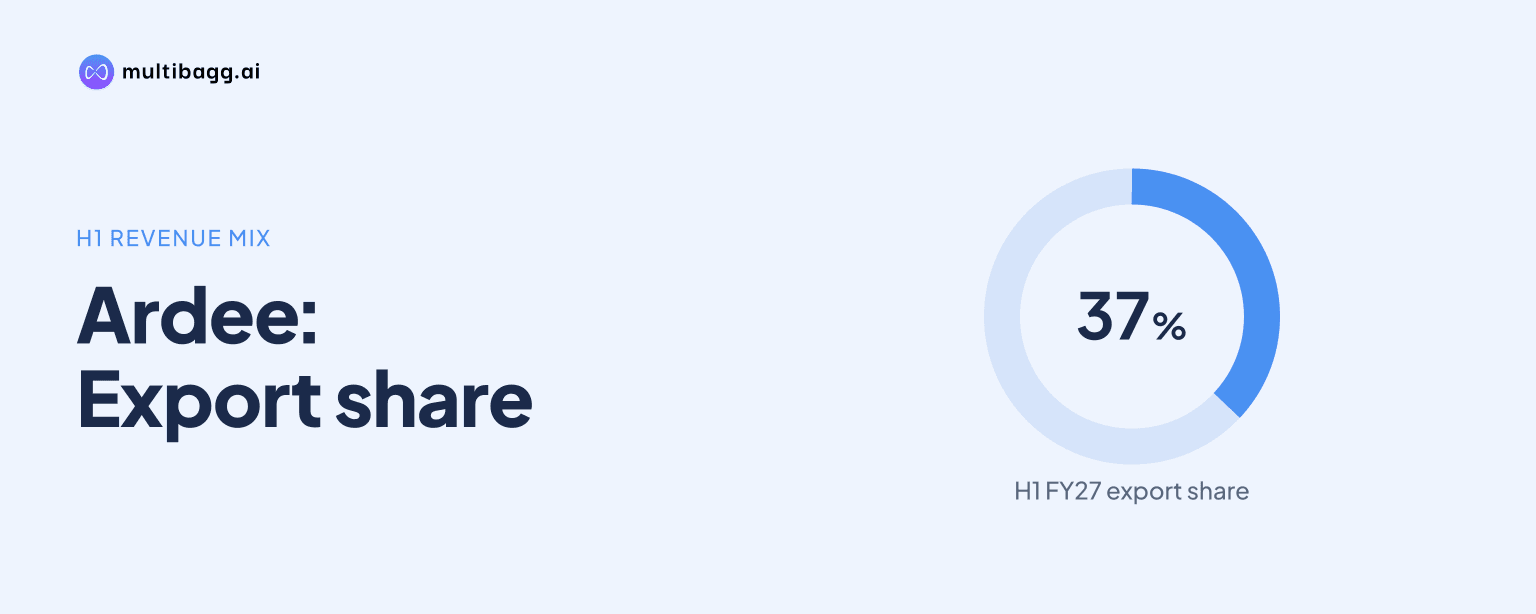
Ardee Industries Limited generated Rs 244 crore of export revenue in the first half of financial year 2027, or H1 FY27, equal to about 37% of its Rs 664 crore revenue, as management expanded sales efforts from Korea into Thailand, Malaysia and China. Ardee said it exports to eight countries and is handling trial orders in newer markets.
Know Ardee Industries inside out
Results, valuation, peers and who's buying, in one view.
How large was Ardee’s export business in H1 FY27?
Ardee’s exports generated Rs 244 crore in H1 FY27, or approximately 37% of its Rs 664 crore first-half revenue. Management described international markets as an increasingly important part of the revenue mix, supported by its wider geographic presence and relationships with overseas customers.
Total revenue increased 34% from Rs 494 crore in H1 FY26 to Rs 664 crore in H1 FY27, while earnings before interest, tax, depreciation and amortisation, or EBITDA, were Rs 63 crore. Ardee did not disclose export revenue for H1 FY26, so the transcript does not establish whether exports grew faster or slower than total revenue.
Second-quarter FY27 revenue was Rs 325 crore, up 33.5% from Rs 243 crore in the corresponding prior-year quarter. Ardee reported second-quarter sales volume of 15,656 metric tonnes and attributed the revenue increase to higher volumes and better sales realisation, without separately identifying the contribution from exports.
Which export markets is Ardee pursuing beyond Korea?
Ardee is developing Southeast Asia and exploring Thailand, Malaysia and China after previously being predominantly focused on Korea. Management said the company had been fulfilling contracts for Korean customers and is using the newer markets to diversify its sales portfolio beyond that concentration.
Ardee currently exports to eight countries, although it did not name all of them or disclose country-level sales. Its lead products include high-purity lead and customised lead alloys produced from end-of-life lead-acid batteries and non-ferrous scrap, with management citing product specifications, consistent quality and timely delivery as factors supporting overseas customer development.
The sales-market push is separate from Ardee’s procurement diversification. Management said it now imports from more than 80 countries, compared with more than 50 countries previously, to broaden its raw-material base. That sourcing change matters for export supply because Ardee said higher imported-material, freight and fuel costs affected profitability in the last two quarters.
How is LME registration supporting Ardee’s overseas sales plans?
Management said empanelment of the Ardee Lead 9997 brand with the London Metal Exchange, or LME, has improved market credibility and customer reach, helping Ardee convert customers in countries beyond Korea. The company also has an existing listing on the Multi Commodity Exchange of India, or MCX, but did not quantify orders gained through either listing.
The opportunity remains at an early commercial stage because management said it was still pursuing trial orders in the newer markets. It said these relationships could produce better volumes or better realisations even at similar volumes, but it gave no export-revenue target, order-book value or timeline for conversion into repeat business.
Alongside pure lead, Ardee is focusing on specialised lead alloys to improve product mix and value-added contribution. Management said this depends on customer approval and validation by original equipment manufacturers, or OEMs, and did not disclose alloy revenue, approved customers or a timetable for validation.
Got a follow-up? Ask IRIS
Can Ardee’s capacity support higher exports?
Ardee increased installed manufacturing capacity by about 50% to 156,950 metric tonnes per annum from 104,025 metric tonnes per annum through debottlenecking. Management said the expansion is intended to allow optimal utilisation of 70% to 75%, rather than requiring operations close to full utilisation of the previous capacity base.
The added capacity did not contribute materially to second-quarter FY27 volumes, according to management. It said the debottlenecking may partly support growth in FY27 and is likely to contribute more next year; the work involved machinery-size replacements at its existing facility, making it a brownfield expansion.
Management maintained its FY27 sales-volume-growth target of 10% to 15%, although an analyst cited H1 sales volume of about 33,300 metric tonnes as below the pace implied by that target. Ardee said it expects to deliver the target in the second half, but it did not provide a separate export-volume target or allocate capacity between domestic and overseas customers.
What could affect Ardee’s export realisations and supply costs?
Ardee said it is prioritising absolute revenue growth and volumes while seeking to maintain current EBITDA per tonne in FY27. An analyst cited EBITDA per tonne of about Rs 18,000 in Q2 FY27, compared with Rs 19,000 in the preceding quarter, and management attributed the decline to higher raw-material, freight and fuel costs.
Management said the two- to four-month procurement cycle for imported materials means higher-cost purchases made in earlier months were reaching production during the last two quarters. This lag can affect the cost base for both domestic sales and export shipments even if selling prices or sales volumes increase.
Domestic battery-scrap procurement has risen to about 27% to 28% from around 15% last year, according to management, which has begun participating in auctions held by tower companies and domestic corporates. Management noted that domestic material can sometimes cost more, but said the shift helps reduce supply uncertainty.
Ardee also cited extended producer responsibility, or EPR, collection targets and reverse-charge mechanism, or RCM, treatment on battery-scrap purchases as measures that could formalise the recycling sector over the next three to four years. As of September 30, 2026, borrowings were Rs 35 crore, and management said it aims to improve cash flows and gradually reduce borrowings while broadening its customer base.
Conclusion
Ardee’s Rs 244 crore export revenue made overseas sales roughly Rs 37 of every Rs 100 of H1 FY27 revenue, while total first-half revenue rose to Rs 664 crore from Rs 494 crore a year earlier. The key change is geographic diversification: management is moving beyond an earlier Korean focus toward Thailand, Malaysia and China, although the newer relationships remain in the trial-order stage.
The next measures to watch are whether trial orders become repeat volumes or improve realisations, whether specialised alloys receive the required customer and OEM approvals, and whether Ardee delivers its maintained FY27 volume-growth target of 10% to 15%. Management expects the debottlenecked capacity to have a larger role next year, while procurement costs remain relevant to EBITDA per tonne.