










Atharva Polyplast H1 revenue rises 77.5% to Rs 36.69 crore
Key highlights
- Atharva Polyplast reported H1 FY27 revenue of Rs 36.69 crore, up 77.5% year on year.
- H1 FY27 EBITDA reached Rs 7.45 crore and profit after tax reached Rs 4.38 crore.
- Premium office furniture represented 53.4% of H1 FY27 revenue, versus 26.9% for home appliances.
- Net worth rose to Rs 46.06 crore in September 2026 from Rs 19.58 crore in March 2026.
powered by IRIS
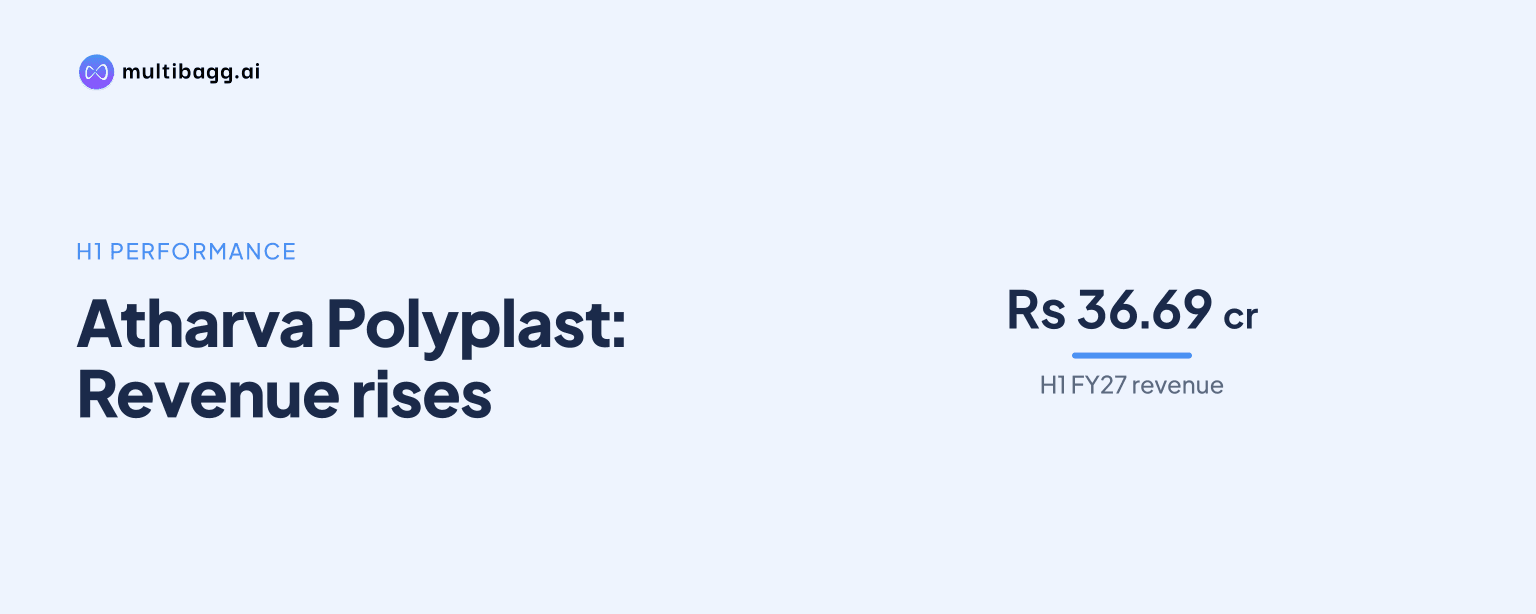
Atharva Polyplast Limited reported revenue from operations of Rs 36.69 crore in the first half of fiscal year 2027 (H1 FY27), up 77.5% from Rs 20.67 crore in H1 FY26. Earnings before interest, tax, depreciation and amortisation (EBITDA) reached Rs 7.45 crore, while management said a one-month polymer-cost pass-through lag affected first-half margins.
Know Atharva Poly-Plast inside out
Results, valuation, peers and who's buying, in one view.
How did Atharva Polyplast perform in H1 FY27?
Atharva Polyplast delivered Rs 36.69 crore of revenue from operations in H1 FY27, compared with Rs 20.67 crore in H1 FY26, an increase of 77.5%. Revenue was also 8.8% higher than H2 FY26, showing that the first-half increase was not solely a comparison with a lower prior-year period.
EBITDA increased to Rs 7.45 crore from Rs 3.88 crore, while profit after tax rose to Rs 4.38 crore from Rs 1.75 crore. Atharva Polyplast reported an EBITDA margin of 20.3% in H1 FY27, compared with 11.5% in H2 FY26 and close to the 20.7% margin reported for full-year FY26.
The H1 FY27 revenue mix was led by premium office furniture at 53.4%, followed by home appliances at 26.9% and engineering solutions and other applications at 19.7%. The mix reflects Atharva Polyplast’s three operating verticals, covering seating components, appliance components and engineering-led product-development assignments.
Why did Atharva Polyplast’s H1 FY27 margins lag the prior-year first half?
Atharva Polyplast said H1 FY27 margins were affected by raw-material input costs that represented about 75% of revenue, as polymer prices rose with crude-oil-market volatility. Management described the effect as a timing issue rather than a permanent margin loss because customer agreements provide for raw-material price adjustments.
The contracts provide a 100% pass-through of raw-material price increases, but the adjustment uses the previous month’s average price. Management said an approximately 20% increase in crude prices resulted in an almost 22% rise in polymer prices, with September costs recorded in H1 FY27 and the related customer recovery reflected in October.
Management said Atharva Polyplast had billed or adjusted almost Rs 1.45 crore at higher prices in October 2026 after the September polymer-cost increase. It said these adjustments generally normalise through the year when input prices stabilise, change further or decline, but it did not provide a revised full-year margin target.
Which businesses generated Atharva Polyplast’s H1 FY27 sales?
Atharva Polyplast generated 53.4% of H1 FY27 revenue from premium office furniture, its largest business vertical. The company makes engineered seating parts including back frames, seat bases, arm assemblies, star bases and headrests for customers named by management as Herman Miller, Steelcase, Haworth and Kokuyo.
Home appliances contributed 26.9% of H1 FY27 revenue and provide a volume base for components used in refrigerators, air conditioners and hair dryers. Management named Godrej and Vasantha among customers in this business, while saying the vertical supports consistency in operating cash flows.
Engineering solutions and other applications accounted for 19.7% of H1 FY27 revenue. This work covers co-design, industrialisation, tooling and series production, and forms part of Atharva Polyplast’s shift since its 2015 manufacturing start from contract manufacturing toward design- and development-led programmes.
Got a follow-up? Ask IRIS
How much capacity does Atharva Polyplast have for growth?
Atharva Polyplast was operating at about 67% capacity utilisation in H1 FY27 and targets an operating-efficiency level of 88%. Management said the difference provides room to take on additional business before significant capacity additions, while mould changes and customer requirements make 100% utilisation impractical.
The company operates on 5.5 acres with about 40,000 square feet of built-up manufacturing space and 20 moulding machines ranging from 100 tonnes to 1,000 tonnes of clamping capacity. It manufactures more than 300 products across its three verticals, providing the current infrastructure base for the stated utilisation plan.
Management plans to reach 88% utilisation in FY28 and said it expects to use 25% more of current capacity by then. Once utilisation approaches that level, it expects to order machines one at a time, with investments contemplated in FY28-FY29; a moulding machine can take about 45 to 60 days to add, according to management.
How did Atharva Polyplast’s initial public offering change its balance sheet?
Atharva Polyplast said its net worth rose to Rs 46.06 crore in September 2026 from Rs 19.58 crore in March 2026 following its initial public offering. The company was listed on the BSE SME platform on July 26, 2026, a milestone management linked to its stronger financial position.
Total borrowings declined by 53% between March 2026 and September 2026, bringing the debt-to-equity ratio to 0.1 times, management said. Over a longer period, EBITDA margin increased from 10.5% in FY23 to 20.7% in FY26, while profit after tax rose from Rs 71 lakh to Rs 6.47 crore.
Management’s growth priorities include increasing revenue per chair with higher-value premium-seating components still imported by customers, pursuing localisation work for global original equipment manufacturers, and co-designing products. It also disclosed a 2025 irrigation project that had moved from an approved pilot mould to building production moulds and assembly machines, with the customer investing in those moulds and machines.
Conclusion
Atharva Polyplast’s first-half performance paired increased earnings with a sales mix led by premium office furniture, which represented 53.4% of H1 FY27 revenue. The company also reported a balance-sheet change following its listing, with net worth reaching Rs 46.06 crore in September 2026 and total borrowings down 53% from March 2026.
The next disclosures to watch are whether October 2026 billing of almost Rs 1.45 crore supports the margin normalisation described by management, and progress toward its FY28 plan to reach 88% utilisation from 67%. Management also expects machine investments in FY28-FY29 as utilisation approaches that threshold and localisation and co-design projects move into production.