










Atharva Poly-Plast says service mix can reach 65% EBITDA
Key highlights
- Atharva Poly-Plast said in-house engineering services can generate EBITDA margins above 50% and close to 60%-65%.
- Management is targeting engineering revenue of about 22%-25% this year.
- Atharva Poly-Plast described its current mix as about 53% premium furniture, 19% engineering and 26% home appliances.
- The company said almost Rs 1.45 crore of deferred raw-material price adjustment was billed or adjusted in October.
powered by IRIS
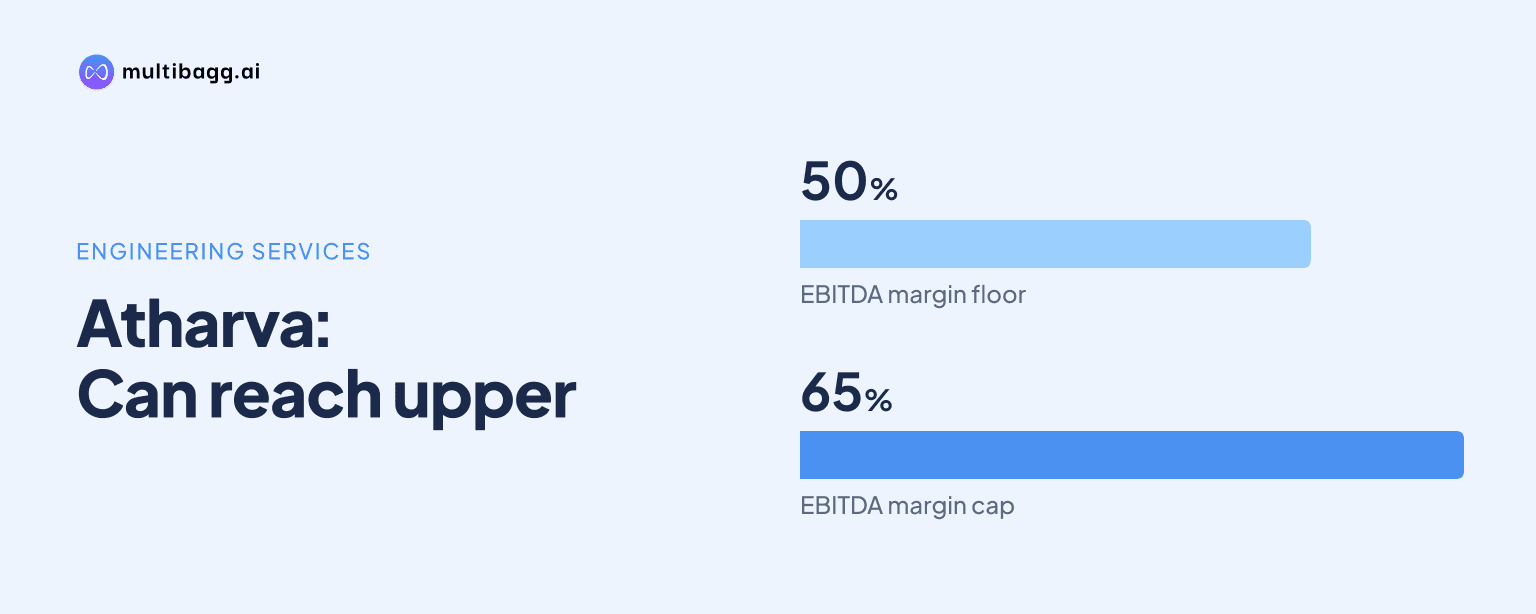
Atharva Poly-Plast Limited said in-house engineering services can generate earnings before interest, tax, depreciation and amortisation (EBITDA) margins above 50% and sometimes close to 60%-65%, while outsourced tooling earns less. Management said the changing mix of these activities helped explain the difference between a prior-year first-half margin of 36% and second-half margin of 12%.
Know Atharva Poly-Plast inside out
Results, valuation, peers and who's buying, in one view.
What can lift Atharva Poly-Plast's EBITDA margin to 65%?
Atharva Poly-Plast said its fully in-house engineering services can produce EBITDA margins above 50% and, at times, close to 60%-65%. These services include concept development, design optimisation, design for manufacturing (DFM), mould-flow analysis, product engineering and design support. Management said these activities are performed by its own team and can have high margins even when the revenue attached to them is relatively low.
Atharva Poly-Plast divides localisation and tooling assignments into two stages, and only one carries the stated 50%-65% potential. The first stage is engineering services, in which the company undertakes design and development work. The second is production-mould development, where it supplies mould designs to a third-party manufacturer, approves and purchases the completed mould, and bills the customer for it.
Management said outsourced mould manufacturing has a relatively lower margin because the supplier performs the production work. The engineering category therefore is not a uniform-margin business: it contains higher-margin in-house service revenue and lower-margin outsourced tooling revenue. A rise in engineering revenue from mould purchases need not have the same effect on profitability as a rise in design, DFM or mould-flow-analysis billing.
Why did Atharva Poly-Plast's half-yearly margins change?
Atharva Poly-Plast said the variation reflected business-vertical mix and the engineering projects completed in each period, rather than a single recurring EBITDA margin. An analyst cited a 36% margin in the prior year's H1, or first half, followed by 12% in H2, or second half. Management said the comparison appeared distorted because the revenue mix changed materially.
In the lower-margin H2, home appliances accounted for almost 30% of revenue, according to management. In the prior H1, about 22% of revenue came from engineering new-product-development and localisation projects. Management said H1 had a high level of engineering-services billing, whereas H2 had a larger contribution from outsourced tooling and home appliances.
The comparison shows why reported profitability can move sharply across half-years. A period with more in-house design and development invoices can have a different EBITDA outcome from one in which Atharva Poly-Plast passes through supplier-made tooling or derives more revenue from home appliances. Management attributed the prior H1-H2 gap to this combination of segment and project-stage mix.
What revenue mix does Atharva Poly-Plast expect this year?
Atharva Poly-Plast said it had a full-year projection for the half-yearly revenue pattern and described the current mix as about 53% premium furniture, 19% engineering and 26% home appliances. Management also cited 1.5% growth in premium furniture. The disclosed shares are approximate and total 98%.
Management said premium-furniture revenue and engineering-services business should both be stronger in H2. It also said deferred raw-material price changes from September should support H2 results. This is an expectation from management, not a disclosed earnings forecast, and it depends partly on the timing of price recovery under customer contracts.
Atharva Poly-Plast said crude prices rose about 20%, resulting in an almost 22% polymer-price increase. Its customer agreements provide 100% raw-material-price pass-through, but use the prior month's average price, creating a one-month lag. Higher costs were reflected in H1, while the related customer recovery was billed in October.
Management said almost Rs 1.45 crore was billed or adjusted in October for that pricing difference. It said such adjustments normally even out over the year as polymer pricing changes, stabilises or declines. For the year, management is targeting engineering revenue of about 22%-25%, but did not disclose what portion of that target would come from the higher-margin in-house service component.
Got a follow-up? Ask IRIS
How could engineering work change Atharva Poly-Plast's business mix?
Atharva Poly-Plast said co-design activity is supporting a drip-irrigation project that could become a separate business vertical once it enters production. Management said the project with a US-based multinational company began in 2025, and that its pilot phase and pilot mould had been completed and approved. The work has moved to building production moulds and assembly machines.
For the irrigation programme, the customer will invest in moulds and assembly machines, while Atharva Poly-Plast expects to invest in plastic-moulding machines, testing equipment and a possible clean-manufacturing setup. Management said it has started work on an in-house flow-testing machine. It also said liquid silicone rubber, or LSR, moulding will not be performed in-house and will be imported from outside India.
Management said working with customers from the design stage can extend through a product lifecycle of perhaps eight to 10 years. It linked this co-design model to customer retention and higher-margin engineering know-how. The irrigation programme would sit alongside premium furniture and home appliances if it moves from engineering development into production as management expects.
When does Atharva Poly-Plast plan to add capacity?
Atharva Poly-Plast said it uses 88% as its operational-efficiency target, compared with 67% capacity utilisation discussed on the call. Management said it does not expect to operate at 100% because factories need changeovers and flexibility for other customers. It plans to reach 88% utilisation in 2028.
Management said it expects to use capacity 25% above the current level by 2028 and may invest in additional machines in 2028-29. It described capacity expansion as modular: an injection-moulding machine can take about 45-60 days to add, while generic 350-tonne and 450-tonne machines may be available and running in about 15 days. Product qualification, testing cycles and customer forecasts determine when a machine order is placed.
Conclusion
Atharva Poly-Plast's disclosed margin message is that engineering revenue quality matters as much as engineering revenue volume. In-house design and development services can reach EBITDA margins above 50% and near 65%, according to management, while outsourced mould development and a higher home-appliance contribution reduce the blended outcome. The prior-year movement from 36% in H1 to 12% in H2 illustrates the scale of mix-related variation cited on the call.
The next disclosures to watch are management's target for engineering to contribute 22%-25% of revenue this year, its expectation of stronger premium furniture and engineering services in H2, and the effect of the almost Rs 1.45 crore October price adjustment. Management's plan to reach 88% utilisation in 2028, possible machine investment in 2028-29 and the irrigation project's move toward production are the other stated milestones.