










Atlanta Electricals FY26 revenue rose 49% as margins widened
Key highlights
- Atlanta Electricals’ FY26 revenue from operations rose 48.8% to Rs 1,851.52 crore from Rs 1,244.18 crore in FY25.
- FY26 EBITDA increased to Rs 344.44 crore, lifting the EBITDA margin to 18.60% from 15.56%.
- Profit after tax rose to Rs 201.77 crore in FY26 from Rs 118.65 crore, while the PAT margin increased to 10.90% from 9.54%.
- Operating cash flow more than doubled to Rs 184.33 crore in FY26 from Rs 83.58 crore, as the debt-equity ratio fell to 0.05 times.
powered by IRIS
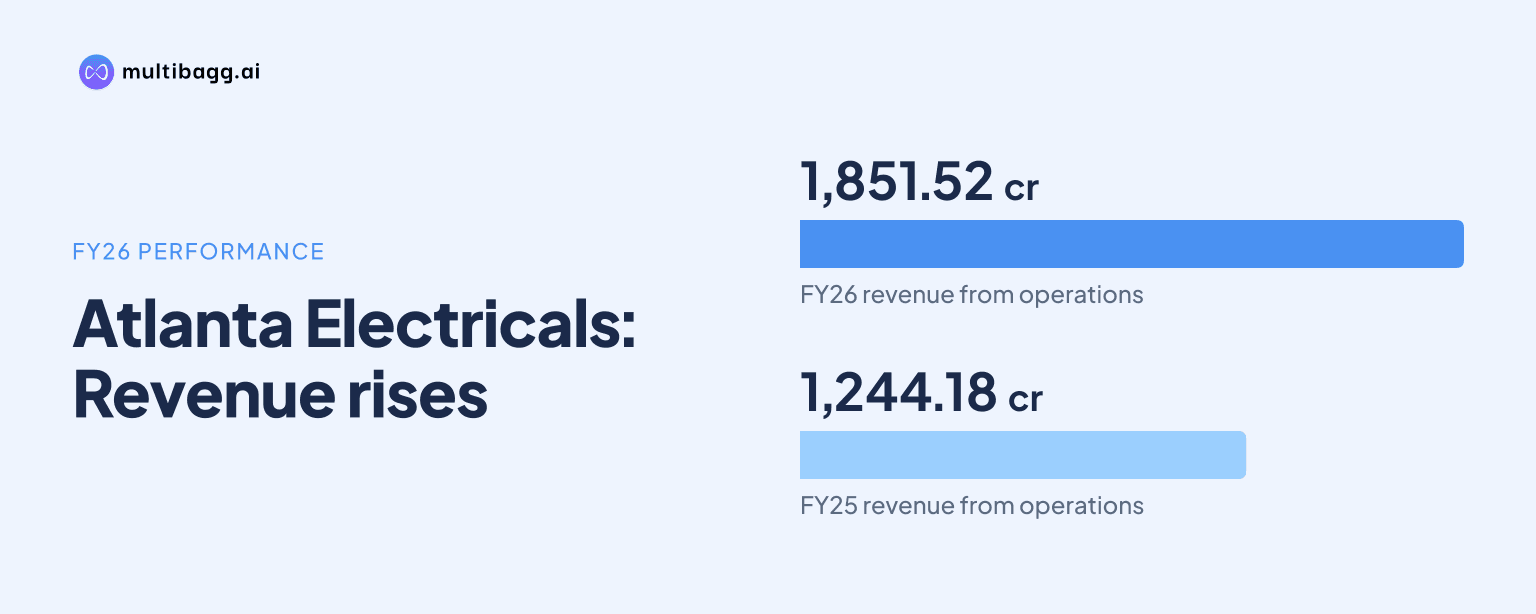
Atlanta Electricals Ltd. reported revenue from operations of Rs 1,851.52 crore in FY26, 48.8% above FY25 and nearly three times its FY22 level. The company’s EBITDA margin reached 18.60% from 15.56%, while the debt-equity ratio fell to 0.05 times and operating cash flow rose to Rs 184.33 crore.
Know Atlanta Electricals inside out
Results, valuation, peers and who's buying, in one view.
How quickly did Atlanta Electricals grow through FY26?
Atlanta Electricals grew revenue from operations to Rs 1,851.52 crore in FY26 from Rs 625.66 crore in FY22, a 31.2% compound annual growth rate over the disclosed four-year period. Revenue increased by Rs 607.34 crore from Rs 1,244.18 crore in FY25, after a smaller decline between FY23 and FY24.
Revenue was Rs 873.88 crore in FY23, before falling by Rs 6.33 crore to Rs 867.55 crore in FY24. It then rose to Rs 1,244.18 crore in FY25 and Rs 1,851.52 crore in FY26, showing that the expansion resumed after the FY24 interruption.
Atlanta Electricals also reported a higher gross-profit percentage in FY26. Gross profit was Rs 551.3 crore, or 29.8% of revenue, compared with Rs 327.8 crore, or 26.3%, in FY25; cost of materials consumed rose to Rs 1,413.6 crore from Rs 861.4 crore over the same period.
Did Atlanta Electricals improve profitability in FY26?
Atlanta Electricals improved reported profitability in FY26, with earnings before interest, tax, depreciation and amortisation, or EBITDA, reaching Rs 344.44 crore and 18.60% of revenue. This compared with Rs 193.58 crore and 15.56% in FY25, and the company’s historical presentation defines EBITDA as including other income.
Profit after tax, or PAT, increased to Rs 201.77 crore in FY26 from Rs 118.65 crore in FY25, lifting the PAT margin to 10.90% from 9.54%. PAT had been Rs 63.52 crore in FY24, when the margin was 7.32%, below the FY26 level.
The consolidated income statement records employee-benefit expense of Rs 41.9 crore in FY26 against Rs 29.4 crore in FY25, while other expenses increased to Rs 165.0 crore from Rs 104.8 crore. Depreciation and amortisation rose to Rs 26.1 crore from Rs 6.3 crore, but earnings before interest and tax increased to Rs 318.3 crore from Rs 187.3 crore.
Finance cost was Rs 56.6 crore in FY26, compared with Rs 34.2 crore in FY25, while profit before tax rose to Rs 276.2 crore from Rs 159.3 crore. Total tax expense was Rs 74.4 crore, compared with Rs 40.7 crore, and basic and diluted earnings per share increased to Rs 27.17 from Rs 16.57.
How did Atlanta Electricals’ return ratios change?
Atlanta Electricals reported lower return ratios in FY26, with return on equity, or RoE, at 21.71% and return on capital employed, or RoCE, at 34.11%. RoE was 33.91% and RoCE was 39.43% in FY25, while RoCE was also below its FY24 reading of 42.34%.
The FY26 balance sheet showed total equity of Rs 929.2 crore, compared with Rs 349.9 crore at FY25 end. This comprised Rs 15.4 crore of equity share capital and Rs 913.8 crore of other equity, compared with Rs 14.3 crore and Rs 335.6 crore, respectively, in FY25.
Property, plant and equipment stood at Rs 476.3 crore at FY26 end, up from Rs 69.2 crore at FY25 end. Capital work-in-progress fell to Rs 29.7 crore from Rs 112.8 crore, while total non-current assets increased to Rs 580.8 crore from Rs 210.1 crore.
Got a follow-up? Ask IRIS
Did Atlanta Electricals reduce leverage and raise operating cash flow?
Atlanta Electricals reduced its debt-equity ratio to 0.05 times in FY26 from 0.40 times in FY25 and 0.97 times in FY22. The FY26 ratio was the lowest in the five-year series, following 0.44 times in FY23 and 0.21 times in FY24.
Non-current borrowings were Rs 3.1 crore at FY26 end, down from Rs 93.0 crore at FY25 end, while current borrowings declined to Rs 43.5 crore from Rs 48.0 crore. Over the same period, total equity increased by Rs 579.3 crore to Rs 929.2 crore.
Cash flow from operations increased to Rs 184.33 crore in FY26 from Rs 83.58 crore in FY25 and Rs 88.31 crore in FY24. Net working capital was 64 days in FY26, one day below FY25’s 65 days but 16 days above the 48 days reported in FY22.
What changed in Atlanta Electricals’ H1FY27 balance sheet?
Atlanta Electricals reported total assets of Rs 1,818.2 crore in H1FY27, compared with Rs 1,508.6 crore at FY26 end. H1FY27, the first half of FY27, included Rs 1,195.4 crore of current assets and Rs 622.8 crore of non-current assets.
Inventories increased to Rs 632.9 crore in H1FY27 from Rs 364.1 crore in FY26, while trade receivables declined to Rs 372.0 crore from Rs 424.0 crore. Bank balances rose to Rs 96.3 crore from Rs 93.2 crore, whereas cash and cash equivalents declined to Rs 4.5 crore from Rs 6.7 crore.
Total equity rose to Rs 1,007.8 crore in H1FY27 from Rs 929.2 crore at FY26 end, while total liabilities increased to Rs 810.4 crore from Rs 579.4 crore. Current liabilities were Rs 780.1 crore, including trade payables of Rs 513.2 crore, compared with Rs 547.8 crore and Rs 397.8 crore, respectively, in FY26.
Conclusion
Atlanta Electricals combined a 48.8% increase in FY26 revenue with higher gross, EBITDA and PAT margins, while operating cash flow reached Rs 184.33 crore. The debt-equity ratio fell to 0.05 times from 0.97 times in FY22, although FY26 RoE and RoCE were below their FY25 readings.
Next, Atlanta Electricals’ disclosed plan calls for improved capacity utilisation, investment in projects, research and development, infrastructure and critical transformer components, and expansion in ultra-high-voltage and extra-high-voltage markets. The H1FY27 increase in inventories to Rs 632.9 crore and current liabilities to Rs 780.1 crore remains relevant to future working-capital and cash-flow outcomes.