










Atlanta Electricals Q2 FY27 Revenue Rises 23.1%, PAT Gains 28%
Key highlights
- Atlanta Electricals reported Q2 FY27 revenue of ₹390.08 crore, up 23.07% year-on-year and down 16.35% quarter-on-quarter.
- Q2 FY27 net profit rose 28.01% year-on-year to ₹32.13 crore but fell 31.40% from Q1 FY27.
- EBITDA margin declined 201 basis points year-on-year to 15.3% in Q2 FY27.
- Atlanta Electricals reported an order book of ₹3,196.97 crore as of September 2026.
powered by IRIS
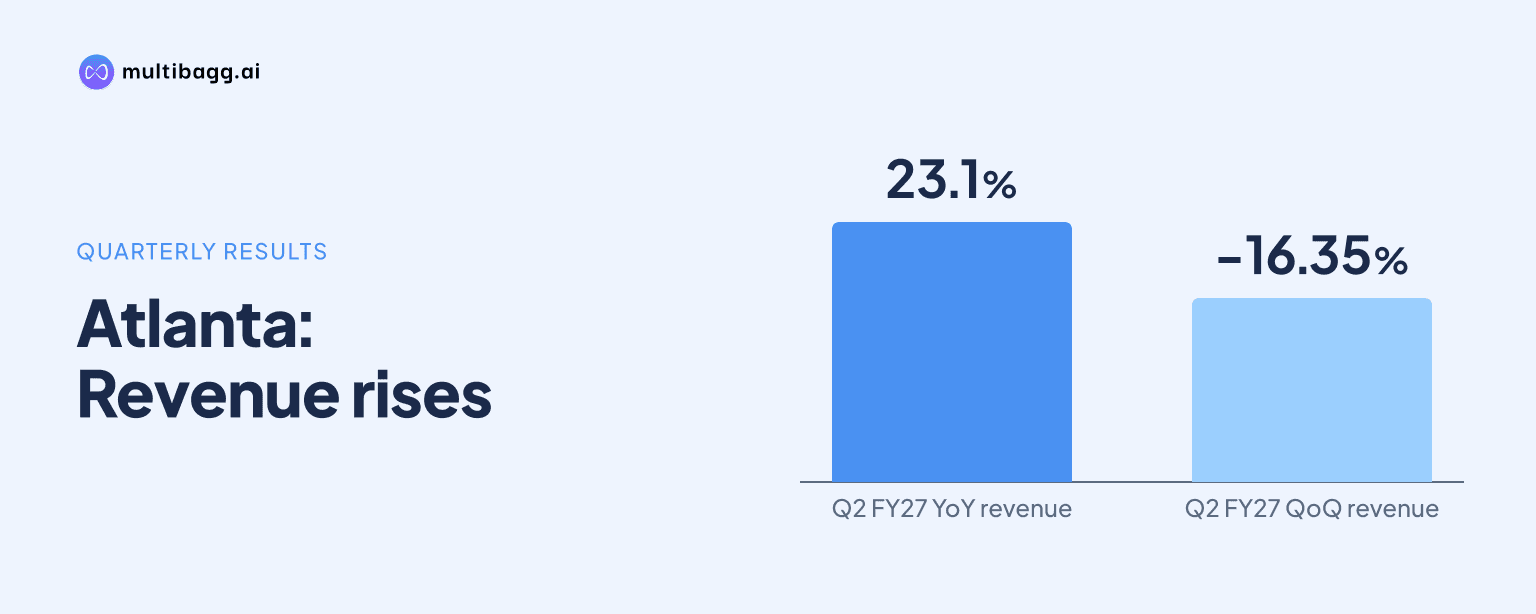
Atlanta Electricals Limited reported Q2 FY27 revenue of ₹390.1 crore, up 23.1% year-on-year, and profit after tax of ₹32.1 crore, up 28.0%, although revenue fell 16.4% sequentially and EBITDA margin declined to 15.3%. The results show continued year-on-year growth alongside pressure from raw-material costs and firm-price order execution.
Know Atlanta Electricals inside out
Results, valuation, peers and who's buying, in one view.
How did Atlanta Electricals perform in Q2 FY27?
Atlanta Electricals delivered year-on-year growth in revenue and profit during the quarter ended September 30, 2026, while its performance declined from the preceding quarter. Consolidated revenue from operations was ₹390.08 crore, compared with ₹317.0 crore in Q2 FY26 and ₹466.33 crore in Q1 FY27. This resulted in 23.07% year-on-year growth and a 16.35% quarter-on-quarter decline.
Operating profit, reported as EBITDA in the company’s results presentation, stood at ₹59.60 crore. That was 8.78% higher than ₹54.8 crore a year earlier, but 22.70% lower than ₹77.10 crore in the previous quarter. Profit before depreciation and tax was ₹54.56 crore, up 26.35% year-on-year but down 25.98% sequentially.
Profit before tax came in at ₹44.54 crore, increasing 18.24% from the year-earlier quarter but decreasing 29.95% from ₹63.58 crore in Q1 FY27. Net profit was ₹32.13 crore, against ₹25.1 crore in Q2 FY26 and ₹46.84 crore in Q1 FY27. The company therefore recorded a 28.01% year-on-year increase in net profit and a 31.40% sequential decline.
Why did Atlanta Electricals' margins decline?
Atlanta Electricals' margins declined because of elevated raw-material prices and the execution of firm-price orders, according to the Q2 FY27 results material. Gross profit rose 6.1% year-on-year to ₹103.6 crore from ₹97.8 crore, but gross margin narrowed to 26.6% from 30.9% in Q2 FY26.
The EBITDA margin was 15.3% in Q2 FY27, down 201 basis points from 17.3% a year earlier. EBITDA growth of 8.8% lagged the 23.1% increase in revenue, reflecting the effect of higher costs and lower operating leverage cited in the results summary.
The margin movement is important because revenue growth alone does not show how much of additional sales converts into operating earnings. In this quarter, Atlanta Electricals reported higher absolute operating profit and net profit, but a smaller percentage of revenue was retained at the EBITDA level compared with the corresponding period last year.
Got a follow-up? Ask IRIS
What does the first-half performance show?
Atlanta Electricals reported stronger growth for the first half of FY27, with revenue rising 35.5% year-on-year to ₹856.4 crore and net profit increasing 40.4% to ₹79.0 crore for the six months ended September 30, 2026. The half-year figures place the Q2 sequential decline in the context of a higher first-quarter base.
The company’s reported revenue profile was supported by demand from transmission, renewable-energy and industrial segments. The supplied results material also referred to temporary weather-related disruptions, though it did not quantify their financial effect. The Q2 result should therefore be assessed alongside both the half-year growth rate and the cost-related pressure on quarterly margins.
Atlanta Electricals had an order book of ₹3,196.97 crore as of September 2026, according to the investor-presentation summary supplied with the results. The same material reported that the company secured its first order in the United States, marking an export-related operational development. No financial value or execution timeline for that order was provided.
The company also reported that the acquisition of Atlanta Trafo made 15,780 MVA of capacity available. The supplied information does not state the utilisation rate of that capacity or the timing of any related revenue contribution.
What do these results mean for investors and operations?
Atlanta Electricals' Q2 FY27 results show that year-on-year sales and profit growth continued, but the sequential fall in revenue and profit, together with lower margins, remains relevant for investors assessing earnings quality. Revenue fell ₹76.25 crore from Q1 FY27, while net profit declined ₹14.71 crore over the same period.
The order book provides visibility of work available for execution, but it is not the same as recognised revenue. Its conversion into sales will depend on project schedules and execution. Similarly, the stated demand exposure to transmission, renewable energy integration and industrial customers outlines the operating markets cited in the results material, without establishing a quantified outlook.
For customers and project counterparties, the reported capacity availability and order backlog are operational indicators. For shareholders, the key disclosed financial trade-off was growth in revenue and profit against a reduction in gross and EBITDA margins. The company did not provide management guidance in the supplied material.
Conclusion
Atlanta Electricals posted Q2 FY27 revenue of ₹390.1 crore and net profit of ₹32.1 crore, extending its year-on-year growth record. However, the quarter also showed lower sequential earnings and a 201-basis-point decline in EBITDA margin, as higher raw-material prices and firm-price orders affected profitability.
The next disclosed reference point is the execution of the ₹3,196.97 crore order book and the contribution from available 15,780 MVA capacity following the Atlanta Trafo acquisition. Investors can also track whether revenue growth in transmission, renewable-energy and industrial segments is accompanied by stabilisation in gross and EBITDA margins.