










Atlanta Electricals margin recovery hinges on H2 execution
Key highlights
- Atlanta Electricals reported a 16% EBITDA margin in H1 FY27 and retained its 16% to 18% target range for FY27 and FY28.
- Atlanta Electricals aims for 80% facility utilisation and expects higher utilisation in Q3 and Q4 FY27.
- Atlanta Electricals expects the maximum portion of remaining firm-price orders to be executed in Q3 FY27, with none left in Q4 FY27.
- Atlanta Electricals produced 8,664 MVA in H1 FY27, while 220 kV orders represented 47% of its current order book.
powered by IRIS
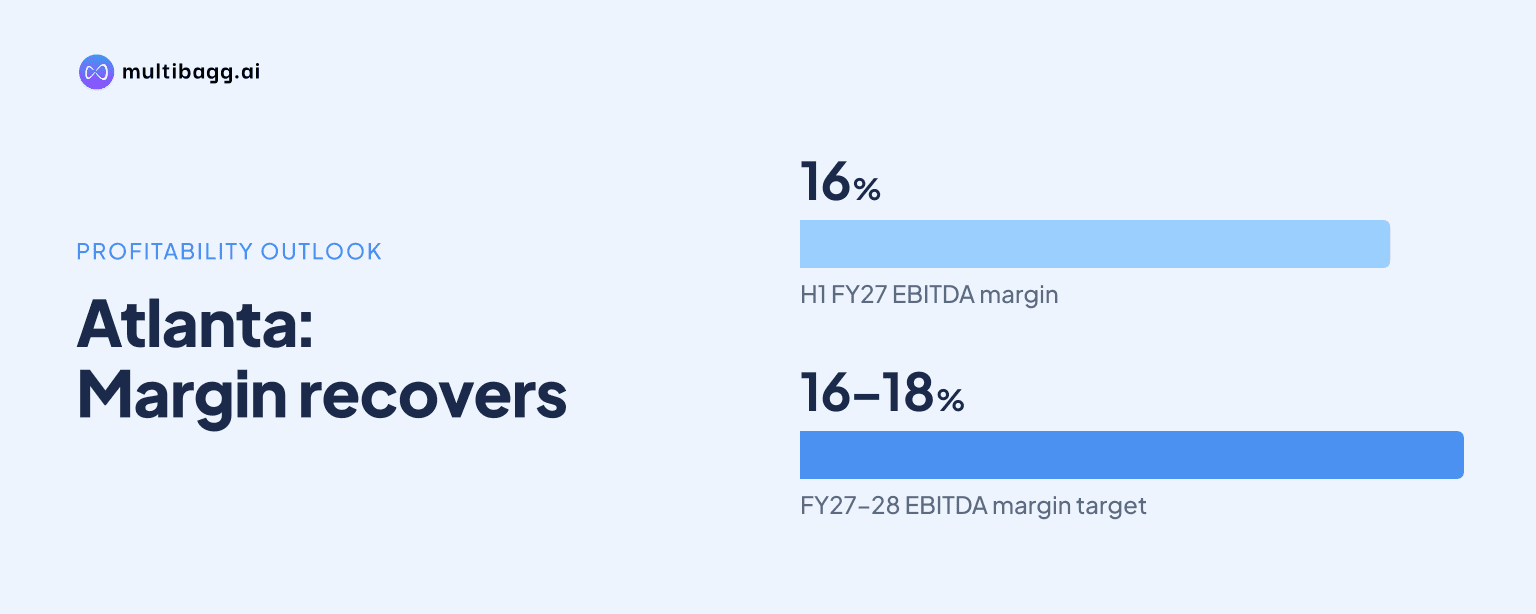
Atlanta Electricals Limited expects second-half FY27 profitability to improve after reporting a 16% earnings before interest, tax, depreciation and amortisation (EBITDA) margin in H1 FY27, with seasonally heavier execution, utilisation moving toward its 80% target and the remaining firm-price contracts largely completed in Q3 FY27.
Know Atlanta Electricals inside out
Results, valuation, peers and who's buying, in one view.
Why does Atlanta Electricals expect H2 FY27 margins to improve?
Atlanta Electricals expects H2 FY27 margins to improve because its transformer business is normally more execution-heavy in the second half than in the first. Management said H1 is generally quieter while H2 is seasonally stronger, with better quarter-on-quarter EBITDA levels. It said Q2 FY27 was disrupted by monsoon conditions in Gujarat and at customer locations, which prevented transformer shipments.
Atlanta Electricals has identified 80% as optimum facility utilisation and expects higher utilisation in Q3 and Q4 FY27 to generate economies of scale. Management said its order book has healthy margins and that operating leverage from H2 execution should lift the full-year average into its 16% to 18% EBITDA-margin range. It did not provide a separate quarterly margin forecast for Q3 or Q4.
The outlook therefore depends on execution timing rather than a higher formal margin target. The 16% H1 FY27 EBITDA margin is at the lower end of Atlanta Electricals’ maintained 16% to 18% range for FY27 and FY28. Management said margins should correct in both Q3 and Q4 as utilisation and dispatches improve.
How much firm-price contract exposure remains for Atlanta Electricals?
Atlanta Electricals said the remaining firm-price contracts should have a limited effect on Q3 FY27 margins because customers have supported price revisions. Anand Sharma said the company reapproached customers after the Middle East conflict in March and received responses that brought remaining contract prices closer to current levels. Management therefore does not expect the residual work to create a negative margin effect in Q3.
The call included differing estimates of firm-price exposure. Mehul Mehta said orders without price-variation clauses represented about 10% to 12% of current orders, with the maximum portion to be manufactured and dispatched in Q3 FY27. In an earlier exchange on the Rs 3,197 crore order book, Anand Sharma put firm-price work at 3% to 4%, after Mehul initially cited 10% to 12%.
The common management position was that no firm-price orders should remain in Q4 FY27. Atlanta Electricals said it stopped quoting most enquiries on a firm-price basis from March, including for private and corporate customers, and now uses price-variation clauses. It said occasional firm-price orders may still be accepted but would comprise no more than 1% to 2% of orders booked in the preceding six months.
Is Atlanta Electricals maintaining its FY27 and FY28 margin guidance?
Atlanta Electricals is maintaining its 16% to 18% EBITDA-margin range for FY27 and FY28. Mehul Mehta said management remained confident that it could achieve the range in the current and following financial years despite the Q2 FY27 disruption. The range, rather than the analyst-referenced 18% to 19% aspiration, was the guidance management explicitly reaffirmed.
Management linked the maintained target to the 16% H1 FY27 margin, heavier H2 execution and improved operating leverage. Niral Patel said the business is cyclical, with H1 usually slower and H2 sharper and more growth-heavy, so quarterly performance should not be assumed to be even. This is management’s forward-looking assessment, dependent on planned production and dispatch activity occurring in H2.
Atlanta Electricals also reiterated its commitment to a 40% compound annual growth rate through FY27 and FY28. Management said 40% was a minimum it aimed to deliver and noted that the Green Energy Corridor announcement was not assumed when that commitment was made. It declined to provide guidance for FY29.
Got a follow-up? Ask IRIS
What could affect Atlanta Electricals’ margin recovery plan?
Atlanta Electricals said execution and supply-chain timing remain relevant to the recovery plan, although it described the Q2 FY27 disruptions as temporary. In addition to monsoon-related delivery constraints, management cited typhoons in China and Japan and reduced container availability linked to the Middle East conflict. Those issues affected the availability and movement of critical components during the quarter.
Atlanta Electricals said its inventory could tentatively support one quarter of raw-material requirements and that it did not see ongoing procurement difficulties for copper conductors, bushings or other components. Its strategy is to deepen supplier relationships and improve forward planning. Management said tank and radiator backward integration, expected in October 2027, is intended to improve quality and reduce supply timelines rather than address a stated current shortage.
New-order pricing is another variable. Anand Sharma said Atlanta Electricals had not seen pressure in its enquiry pipeline or in the margins at which it was booking orders as of the call. He said future pricing conditions remained uncertain as industry capacity expands, although management expects expansion to be spread across transformer voltage classes and sees the Green Energy Corridor as a potential source of demand.
How does Atlanta Electricals’ order mix support the outlook?
Atlanta Electricals’ disclosed order book is weighted toward the 220 kilovolt (kV) class, which accounted for 47% of current orders, while the 400 kV class represented 8.60%. The 220 kV category is therefore a substantially larger part of the book. Management did not disclose separate margins by voltage class, so the transcript does not identify either category as the source of the expected H2 FY27 margin improvement.
Atlanta Electricals produced 8,664 megavolt-amperes (MVA) during H1 FY27 and linked its margin plan to higher utilisation rather than a stated H2 production target. It is also entering the United States with products of 220 kV and below, manufactured in India. Management said US margins are better but declined to quantify any gross-margin benefit.
Conclusion
Atlanta Electricals’ margin-recovery case rests on a specific sequence: Q2 FY27 shipment disruptions held back utilisation, H2 FY27 should carry more execution, and remaining firm-price work should be substantially completed in Q3. With H1 EBITDA margin at 16%, management is maintaining its 16% to 18% range for FY27 and FY28 rather than raising guidance.
The next items to watch are Q3 FY27 execution, customer repricing on the residual firm-price contracts and progress toward 80% utilisation. Management’s October 2027 tank-and-radiator backward-integration plan, as well as order pricing amid industry capacity additions, will also indicate whether its execution and margin assumptions remain on track.