










Atlanta Electricals Reaffirms Minimum 40% CAGR Through FY28
Key highlights
- Atlanta Electricals reaffirmed a minimum 40% revenue CAGR commitment for FY27 and FY28, not FY29.
- Management maintained a 16% to 18% EBITDA-margin range for FY27 and FY28; H1 EBITDA margin was 16%.
- Atlanta Electricals said Green Energy Corridor projects were not included in its original 40% CAGR baseline.
- Atlanta Electricals said 400 kV orders were 8.60% and 220 kV orders were 47% of its current order book.
powered by IRIS
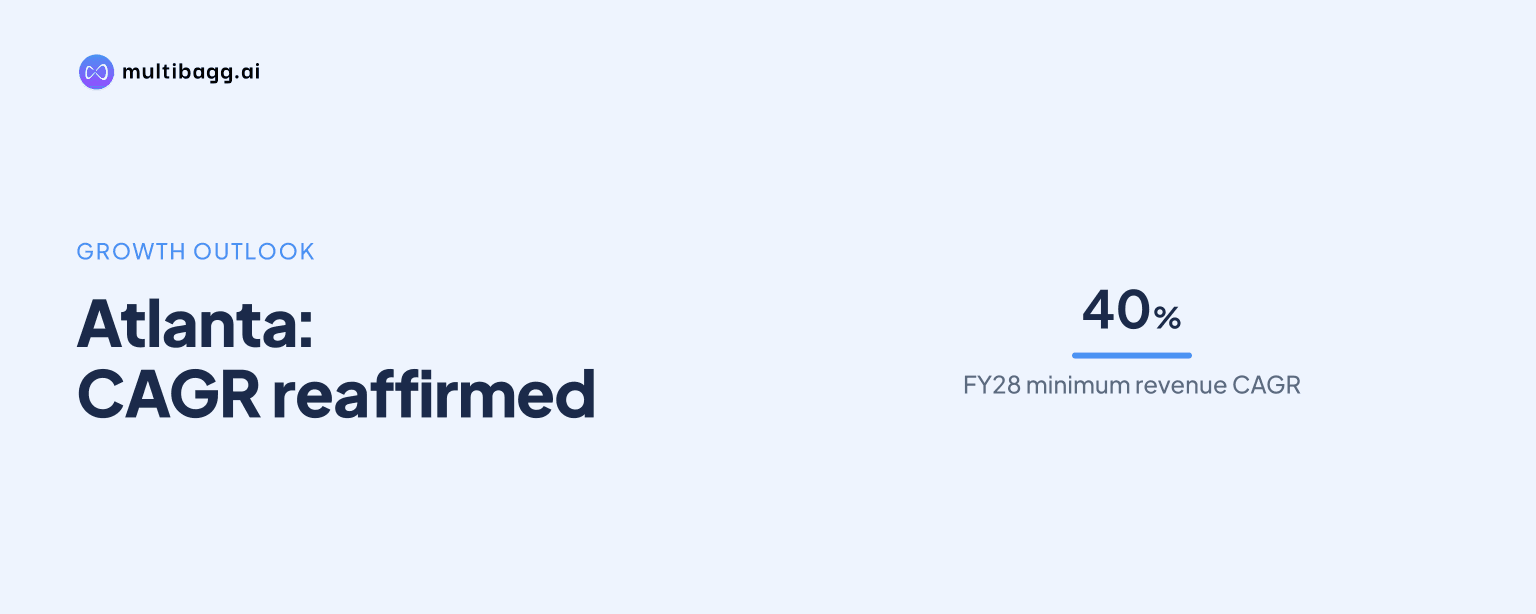
Atlanta Electricals Limited reaffirmed that its minimum 40% compound annual growth rate, or CAGR, revenue commitment covers FY27 and FY28, not FY29, and said newly announced Green Energy Corridor projects were not included in that baseline. Management also maintained its FY27-FY28 earnings before interest, tax, depreciation and amortisation, or EBITDA, margin range of 16% to 18%.
Know Atlanta Electricals inside out
Results, valuation, peers and who's buying, in one view.
What years does Atlanta Electricals’ 40% CAGR target cover?
Atlanta Electricals’ 40% CAGR commitment covers FY27 and FY28, while management gave no guidance for FY29. Niral Patel said the company had committed to 40% CAGR for three years when it went public, but one year had passed since listing. When an investor asked whether the remaining commitment therefore applied to FY27 and FY28 rather than FY29, Patel replied, “Yes, 100%.”
Atlanta Electricals did not commit to an identical quarterly or annual growth pattern during FY27 and FY28. Patel said year-on-year growth could be averaged “to a certain extent,” but described the transformer business as cyclical, with H1 generally slow and H2 more growth-heavy. The company therefore does not present the 40% commitment as a quarter-on-quarter target.
Atlanta Electricals explicitly declined to provide a FY29 estimate when asked for a ballpark figure. Anand Sharma said it would not be appropriate to give FY29 guidance at that point. The clarification confines the public growth commitment to the two remaining years of the original three-year framework.
Are Green Energy Corridor projects included in Atlanta Electricals’ target?
Atlanta Electricals said Green Energy Corridor projects were not included in the original 40% CAGR commitment and could improve transformer demand beyond that minimum target. Patel said the company had been working toward its CAGR commitment since the prior year, when there had been no announcements of such corridors. He described 40% as the minimum growth rate Atlanta Electricals would seek to achieve.
Management did not quantify potential revenue, order inflow or the timing of any corridor-related business. Patel said the corridors would “definitely improve the demand,” but Atlanta Electricals did not raise its FY27-FY28 CAGR commitment. The company therefore presented the projects as a demand opportunity rather than revenue already incorporated in guidance.
Sharma said capacity additions by transformer makers were spread across voltage classes because not every competitor was expanding in the same category. He also said Atlanta Electricals had not seen pressure on either its inquiry pipeline or the margins at which it was booking orders as of the call.
Which transformer segments could benefit from the demand opportunity?
Atlanta Electricals said Green Energy Corridor development could create transformer demand across voltage classes, including 400 kilovolt, or kV, and 765 kV equipment. Sharma declined to estimate market demand because Central Electricity Authority, or CEA, and National Electricity Plan, or NEP, data mainly cover interstate transmission and generation-side requirements, rather than intrastate transmission development.
Management said intrastate projects could add to the visible demand picture after the corridor announcement. Sharma said the company saw substantial potential requirements for 400 kV and 765 kV transformers over coming years, while adding that it would not be justified to state an exact market number. This was management’s view of sector demand, not a forecast of Atlanta Electricals’ sales.
Atlanta Electricals disclosed two higher-voltage categories within its current order book. Mehul Mehta said 400 kV-class orders accounted for 8.60% of the order book, while 220 kV-class orders represented another 47%. The disclosed 220 kV share was therefore materially larger than the 400 kV share.
The disclosed mix indicates current exposure to higher-voltage transformer categories, but it does not show future Green Energy Corridor order wins. Management did not disclose the revenue, margin or delivery timing associated with either the 400 kV or 220 kV portions of the order book.
Got a follow-up? Ask IRIS
What will determine Atlanta Electricals’ delivery of the FY27-FY28 target?
Atlanta Electricals said H2 execution, capacity utilisation and operating leverage will be important to delivering its FY27-FY28 revenue and margin commitments. Management described H1 as generally slow and H2 as seasonally stronger, with EBITDA typically improving quarter on quarter in H2. It said monsoon conditions had temporarily affected transformer shipments in Q2.
Mehta said H1 EBITDA margin was 16% and repeated management’s 16% to 18% EBITDA-margin range for FY27 and FY28. He said heavier execution and operating leverage in H2 were expected to increase the second-half margin and leave the full-year average within that range. That outcome remains management’s expectation rather than a reported full-year result.
Management identified 80% as optimum facility utilisation and said higher utilisation should provide economies of scale. It also cited healthy order-book margins and repriced orders in expecting margin correction in Q3 and Q4. Atlanta Electricals did not provide quarterly margin guidance, distinguishing instead between expected H2 improvement and its full-year 16%-18% range.
Raw-material availability is another execution consideration. Atlanta Electricals said inventory procured in the previous quarter could tentatively support one quarter of raw-material requirements. Sharma said its planned backward-integration facility for transformer tanks and radiators was intended to improve quality and reduce supply timelines, rather than remedy a current shortage of those items.
Management said it had not seen procurement difficulty for copper conductors, bushings or other components, citing vendor relationships and forward planning. It attributed the Q2 disruption to back-to-back typhoons in China and Japan and container-availability effects connected with the Middle East war, while saying its supply planning remained on track at the time of the call.
Conclusion
Atlanta Electricals has clarified that its public commitment is a minimum 40% revenue CAGR through FY28, covering FY27 and FY28 only, alongside a 16%-18% EBITDA-margin range. Green Energy Corridor announcements were outside the original baseline, leaving management to present them as potential demand support rather than a quantified addition to guidance. Its disclosed order-book mix includes 47% in 220 kV equipment and 8.60% in 400 kV equipment.
The next measures to watch are H2 execution after the Q2 shipment disruption, progress toward management’s 80% optimum facility-utilisation target, and whether corridor-related demand converts into inquiries and orders. Management has not given FY29 guidance or quantified corridor-related revenue, leaving subsequent order-book, voltage-class and capacity disclosures as the relevant tests of growth beyond the minimum FY27-FY28 commitment.