










Adani Welspun Exploration Ltd cuts pipeline to 30 km for FY29
Key highlights
- AWEL targets first gas production in FY29 through Phase 1 partial development of the MB block.
- The proposed new evacuation pipeline has been reduced to about 30 km from about 180 km.
- AWEL says the ONGC-based plan can bring revenue realisation within about two years, versus about four years previously.
- AWEL reports collective GIIP of about 1.1 TCF across the B-9, C-37 and MB blocks.
powered by IRIS
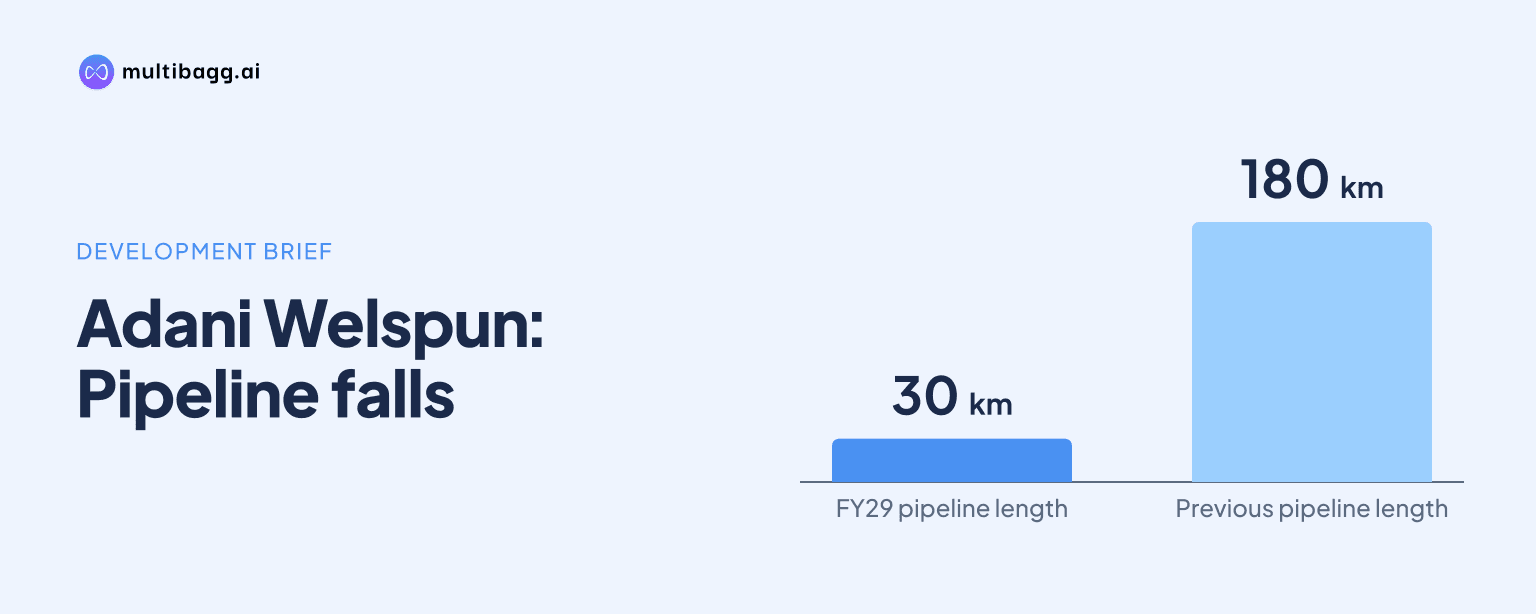
Adani Welspun Exploration Ltd targets first gas production by FY29 by using ONGC infrastructure, reducing its proposed new evacuation pipeline to about 30 km from about 180 km. AWEL says the revised development concept lowers capital expenditure, brings indicative revenue realisation within about two years and supports Phase 1 partial development of the MB block.
Know Welspun Enterprises inside out
Results, valuation, peers and who's buying, in one view.
What is AWEL’s FY29 gas-production plan?
AWEL expects first gas production by FY29, subject to implementation of its Phase 1 development plan. AWEL is a 65:35 joint venture between the Adani Group and WEL, and its B-9, C-37 and MB block cluster has collective gas initially in place, or GIIP, of about 1.1 trillion cubic feet, or TCF.
The FY29 objective is linked specifically to Phase 1, which proposes partial development of the MB block. AWEL says approval of the Phase 1 EDP is expected shortly, although the presentation does not expand the term EDP or provide a specific approval date. Successful Phase 1 implementation would pave the way for Phase 2 development and a strategic call on asset monetisation.
AWEL cites three policy and regulatory milestones in its development pathway: legislation in April 2025, an order under the Petroleum and Natural Gas Rules, 2025 in December 2025, and a Directorate General of Hydrocarbons order for the MB block in July 2026. These developments sit alongside an agreement with ONGC for infrastructure sharing, which AWEL says remains under process.
How does ONGC infrastructure change AWEL’s pipeline plan?
Using ONGC infrastructure changes AWEL’s proposed new evacuation pipeline from a 36-inch line of about 180 km to a 24-inch line of about 30 km. The new concept uses ONGC platforms and a processing unit rather than requiring AWEL to build a substantially longer standalone evacuation route.
AWEL identifies the previous scenario as requiring new infrastructure, high capital expenditure and an elongated timeline of about four years. Its surface-facilities diagram shows the previous 36-inch, roughly 180-km evacuation route being replaced by the 24-inch, roughly 30-km route, with connections to ONGC facilities and existing processing infrastructure.
AWEL presents the revised arrangement as a lower-capital-expenditure alternative that mitigates corresponding risk. The stated mechanism is not only the shorter 30-km construction requirement: it also depends on sharing existing energy assets, which AWEL says avoids sub-optimal utilisation of infrastructure already in place.
What does the shared-infrastructure plan mean for timing and capital needs?
AWEL says the ONGC-based plan can bring revenue realisation within about two years, compared with an earlier development timeline of about four years. This is an indicative timing comparison in the presentation, while first production is separately targeted for FY29 and remains dependent on Phase 1 implementation.
AWEL does not disclose a rupee capital-expenditure budget, tariff, gas price, production volume or expected revenue for the MB development. It nevertheless identifies capital outlay, operational risk and revenue visibility as its central value considerations, and says the present configuration requires lower capital expenditure than the 180-km standalone-pipeline scenario.
The revision cuts the stated new-line requirement by about 150 km, from about 180 km to about 30 km. AWEL also cites foreign-exchange savings and optimal use of existing energy assets as expected benefits of accessing ONGC platforms and processing facilities instead of developing all facilities independently.
The infrastructure arrangement is not yet described as complete. AWEL says its agreement with ONGC for sharing infrastructure is under process, leaving a commercial and implementation step outstanding before the FY29 first-gas target can be delivered.
Got a follow-up? Ask IRIS
Which blocks and facilities are involved in AWEL’s Phase 1?
Phase 1 covers partial development of the MB block, while AWEL’s wider cluster includes B-9, C-37 and MB. The surface-facilities concept labels B9A, MBB, MBA and C37, together with existing ONGC wellhead platforms C24-P1A/RP and B12-11P, showing that the concept is designed around several offshore assets.
The diagram also identifies the ONGC Hazira Terminal, the Sunpetro Terminal and an existing processing facility labelled TCPP. It marks other existing lines, including a 20-inch x 80-km line from TCPP, an 18-inch x 69-km line from TPP, and 25-inch and 36-inch SBHT lines, alongside the proposed 24-inch x 30-km new evacuation line.
AWEL does not provide separate GIIP volumes for B-9, C-37 or MB. The disclosed approximately 1.1 TCF therefore applies to the collective blocks rather than the Phase 1 MB portion alone, and AWEL does not disclose how much of that collective gas volume would be developed by FY29.
The phased structure is intended to optimise overall risk metrics, according to AWEL. Phase 1 is the immediate partial MB development, whereas Phase 2 remains contingent on successful delivery of the initial phase and is not presented as an approved or scheduled production project.
What remains unresolved before AWEL can monetise gas?
The immediate unresolved items are Phase 1 EDP approval and the ONGC infrastructure-sharing agreement, both of which AWEL identifies as pending or under process. AWEL expects the EDP approval shortly but gives no date for either the approval or the final ONGC agreement.
AWEL also refers to a strategic call on asset monetisation after successful Phase 1 implementation. That wording does not specify whether monetisation would involve a sale, partnership, financing transaction or another structure, and the presentation provides no valuation, percentage interest or timetable.
The FY29 production target therefore depends on a sequence of disclosed steps: Phase 1 approval, implementation of the 24-inch x about 30-km evacuation system, use of ONGC platforms and processing facilities, and commencement of gas production. AWEL’s stated rationale is reduced capital expenditure and mitigation of associated risk, rather than a quantified financial forecast.
Conclusion
AWEL has changed the development concept for its approximately 1.1-TCF gas cluster by replacing a proposed 36-inch, roughly 180-km evacuation line with a 24-inch, roughly 30-km line using ONGC infrastructure. The presentation says this changes the indicative revenue-realisation timeline from about four years to about two years while supporting its FY29 first-gas objective.
The next points to watch are the expected Phase 1 EDP approval for partial MB development and progress on the ONGC infrastructure-sharing agreement, which remains under process. AWEL says successful Phase 1 would enable Phase 2 development and a later strategic asset-monetisation call, but does not disclose a date or structure for that decision.