










Bajaj Auto plans Chetak capacity of 80,000 units monthly
Key highlights
- Bajaj Auto plans to increase Chetak capacity from 60,000-64,000 to 80,000 units a month in the next quarter.
- Supply-chain and arrival issues held Chetak shipments to 40,000 units in the previous month.
- Bajaj Auto had 550 exclusive Chetak stores and is targeting about 1,000 stores within 12 months.
- Management estimated electric vehicles represent 25% of scooter sales, versus 40% in Odisha and 10%-12% in Gujarat.
powered by IRIS
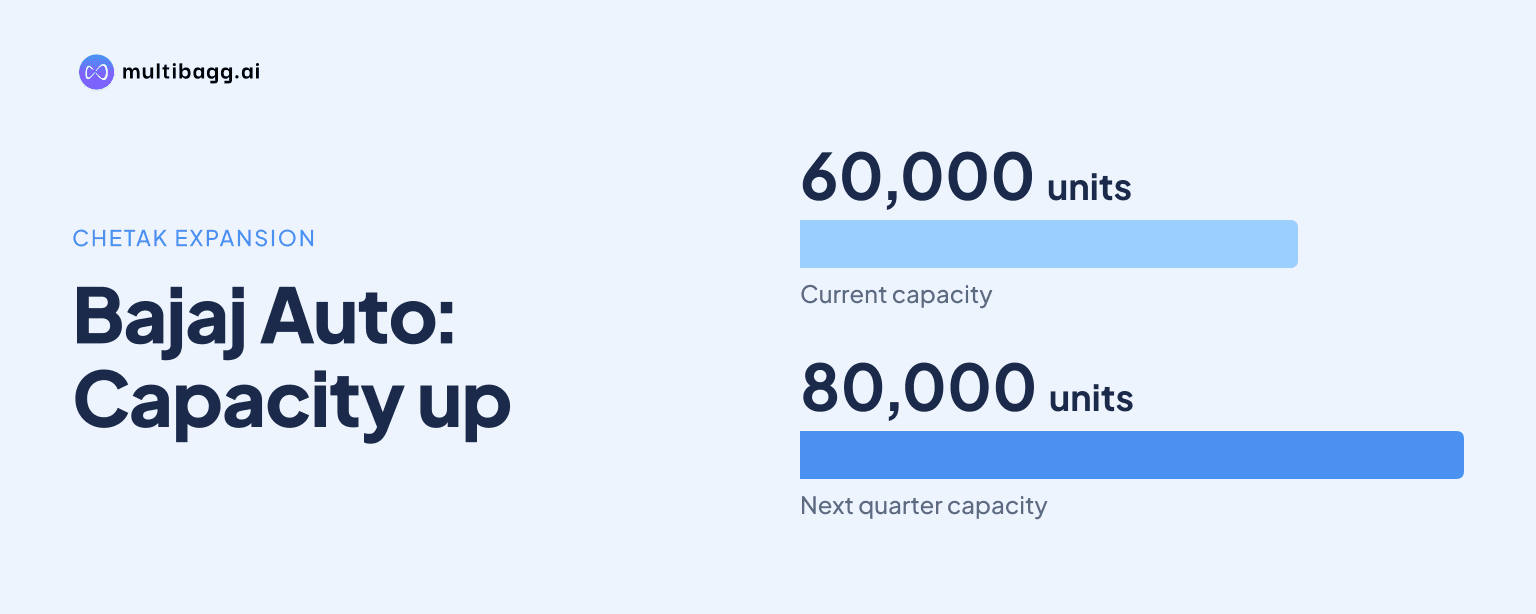
Bajaj Auto Limited plans to raise Chetak manufacturing capacity to 80,000 units a month in the next quarter, from 60,000-64,000 units currently, after supply-chain issues limited shipments to 40,000 units in the previous month. Management said the increase should ease dealer shortages as it pursues the number-one position in electric two-wheelers.
Know Bajaj Auto inside out
Results, valuation, peers and who's buying, in one view.
What is Bajaj Auto’s Chetak capacity plan?
Bajaj Auto plans to lift Chetak capacity to 80,000 units a month in the next quarter. Management put current manufacturing capability at 60,000-64,000 units monthly, and said the immediate increase should mitigate availability constraints reported across the Chetak dealer network.
The 80,000-unit target is the disclosed near-term milestone, while management is also considering a more significant expansion at a new site. Bajaj Auto did not disclose the proposed site’s capacity, investment, location or completion date, so it cannot yet be treated as a committed production addition.
Why did Chetak shipments fall to 40,000 units?
Chetak shipments fell to 40,000 units in the previous month because of supply-chain and arrival-related problems. Rakesh Sharma said Bajaj Auto had capacity of about 60,000 units but called the gap an “unfortunate miss,” rather than describing it as a reduction in the underlying 60,000-64,000-unit manufacturing capability.
Management linked the capacity increase to tight dealer inventory of roughly 9 to 15 days. Sharma said a 15-day stock position can be absorbed by requirements for one unit of each colour and test-drive vehicles, while some dealers reported that vehicles were sold when truckloads arrived and others requested at least one truckload.
The supply issue comes as management estimated electric vehicles account for 25% of India’s scooter market. Bajaj Auto uses scooters rather than all two-wheelers as the comparison base because management said much of the substitution is occurring from scooters, although it also identified first-time buyers and households adding an electric vehicle.
How is Bajaj Auto expanding Chetak’s retail network?
Bajaj Auto had 550 exclusive Chetak stores and said it could have about 1,000 within 12 months. Management was targeting 100 additional openings, but said about 75 might become operational before some of the remainder shifted to January.
About 80% of Chetak stores are being established by Bajaj Auto’s existing dealers, management said. Where a standalone Chetak outlet is not viable, a motorcycle dealer can sell Chetak, with an exclusive store to follow if local demand reaches a sufficient level.
Bajaj Auto said it chose a specialist channel because its electric portfolio could broaden as the category matures. Sharma cited electric three-wheelers progressing through 25,000, 35,000, 75,000 and 125,000 volume points before more distinct customer needs emerged, while not suggesting Chetak would necessarily follow those same levels.
Got a follow-up? Ask IRIS
Can Bajaj Auto become the top electric two-wheeler brand?
Bajaj Auto is seeking the number-one position in electric two-wheelers, but management gave no market-share target or deadline. Sharma said the company’s intent was to be “Number 1” and described Chetak as a core business alongside the 125cc and 150cc Pulsar segments.
Management also cautioned that market positions can change with competitors’ capacity actions. Sharma said a rival’s capacity problem might shift rankings for one quarter before reversing, so Bajaj Auto presented leadership as an objective rather than a forecast for the next quarter or year.
Bajaj Auto sees room for electric-scooter penetration to rise beyond the current 25% level. Management cited Odisha at 40% penetration and Gujarat, described as the third-largest scooter market, at an estimated 10%-12%, arguing that adoption levels between states could converge over time.
Sharma said operating economics became a demand driver after petrol prices crossed Rs 100 a few years earlier. He also linked a later increase in electric-scooter consideration in smaller towns and villages to fuel-availability uncertainty during the Iran war, though Bajaj Auto gave no quantified measure of either effect on Chetak volumes.
What is Bajaj Auto’s electric export strategy?
Bajaj Auto is keeping electric exports limited while it directs constrained capacity toward domestic demand. Management said it has begun sending small numbers of electric vehicles to Nepal, Sri Lanka and other countries, but provided no electric-export volume target for the next two to three years.
Most emerging overseas markets are around three to four years behind India in electric-vehicle adoption, in management’s view, because buyers remain focused on range, safety and resale value. Bajaj Auto identified expanding delivery use cases and higher petrol prices as potential demand drivers, while noting that some market participants resist a move from internal-combustion-engine vehicles to electric scooters.
This domestic-first approach differs from Bajaj Auto’s broader export objective of about 750,000 units a quarter. Management said it was aspiring to roughly 240,000-260,000 units a month for total exports, supported by market-share gains, new segments, possible new countries over two to three years, and potential KTM joint-product volumes.
Conclusion
The disclosed plan combines a move from 60,000-64,000 to 80,000 Chetak units a month with a retail network that stood at 550 exclusive stores. The 40,000-unit shipment outcome shows that component and logistics execution remains important alongside manufacturing capacity, while management’s leadership ambition depends on both its own output and competitors’ actions.
The next disclosed milestones are the 80,000-unit capacity increase in the next quarter, progress toward the 100 targeted additional stores and the prospect of about 1,000 exclusive outlets within 12 months. Investors can also watch whether Bajaj Auto advances the proposed new-site expansion and whether supply conditions improve from the 9-15 days of dealer inventory management described on the call.