










Bajaj Auto accepts 100cc losses to reset Pulsar portfolio
Key highlights
- Bajaj Auto accepted 100cc volume losses after pricing ahead of competitors to protect profitability.
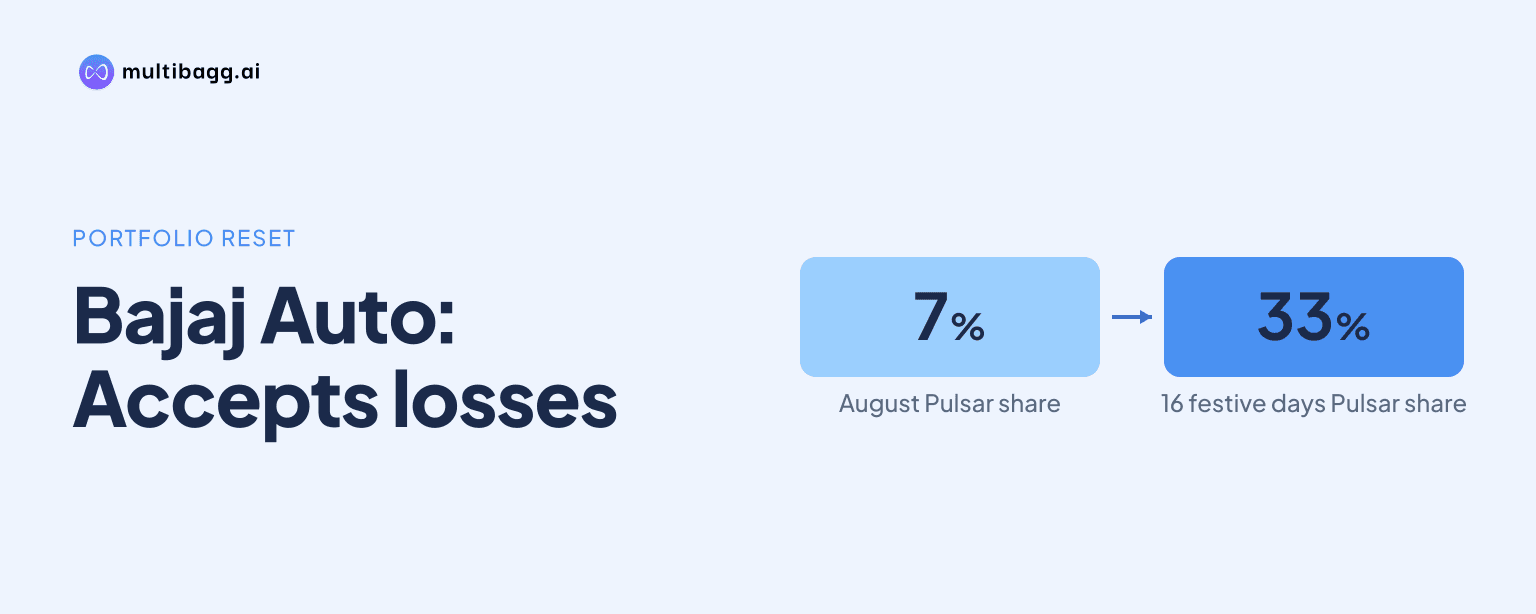
- New Pulsar launches rose from 7% of Bajaj Auto's 125cc-plus portfolio in August to 33% in the first 16 festive days.
- Bajaj Auto expects to enter January with a fully refreshed Pulsar portfolio after legacy channel stock clears.
- Bajaj Auto reported Q2 FY2027 EBITDA of Rs 4,172 crore and a 20.9% EBITDA margin.
powered by IRIS
Bajaj Auto Limited is accepting lower 100cc motorcycle volumes after pricing ahead of competitors to protect profitability, while refreshed Pulsar models reached 33% of its 125cc-plus portfolio in the first 16 festive days. Management aims to enter January with a fully refreshed Pulsar range after clearing legacy dealer inventory.
Know Bajaj Auto inside out
Results, valuation, peers and who's buying, in one view.
Why is Bajaj Auto accepting lower 100cc motorcycle volumes?
Bajaj Auto is accepting 100cc volume losses because management chose to raise prices ahead of competition to protect profitability amid inflation. Management said the decision reduces overall two-wheeler volumes but supports the margin outcome, while Bajaj Auto remains in the 100cc segment on terms it considers profitable.
The decision followed input-cost inflation of about 3% to 3.5% of revenue in Q2 FY2027, after 4% to 4.5% in Q1 FY2027. Across the first half, price actions covered 50% to 60% of inflation, while favourable currency realisation and cost optimisation offset much of the remainder; electrical-component costs rose in the mid-teens during July to September.
Management said the 100cc losses and legacy Pulsar inventory cloud aggregate market-share readings from the VAHAN registration portal and wholesale data. It is instead focusing product interventions on motorcycles of 125cc and above, where the 150cc-plus segment and electric scooters drove much of industry growth in April to August.
How is Bajaj Auto rebuilding Pulsar share above 125cc?
Bajaj Auto is rebuilding Pulsar share through a staged product renewal that started in the 150cc-plus range before reaching 125cc models. Management said it lost share in both the 125cc and 150cc-plus segments last year because the previous portfolio had reached the end of its life cycle and faced product fatigue.
During Q2 FY2027, Bajaj Auto launched new Pulsar 125 and Pulsar 150 Classic models and upgraded the Pulsar 160 range. The updated products include thin-film transistor displays, electronic throttle bodies, ride modes, projector headlamps, Crawl Tech and traction control on applicable models, with retail sales starting in August.
New launches rose from 7% of Bajaj Auto's 125cc-plus portfolio in August to 26% in September and 33% in the first 16 festive days. Over those 16 days, Bajaj Auto registrations grew 32%, compared with management's estimate of 24% growth for 150cc-plus motorcycles and electric scooters and 10% for the total two-wheeler market.
The NS series, including the 200 NS and 160 NS, contributed more than 20% of the 150cc-plus portfolio in H1 FY2027 and grew faster than the market, management said. The N series accounted for 40%, also growing faster than the market, while the remaining Classic range continued to weigh on performance because older dealer stock had not fully cleared.
Got a follow-up? Ask IRIS
When will Bajaj Auto's Pulsar reset become visible in market share?
Bajaj Auto expects the Pulsar reset to become clearer after legacy Classic inventory is sold through during the festive period and the company enters January with a fully refreshed portfolio. Management said old channel stock remains a drag until retail inventory changes over, not merely production and wholesale dispatches.
Further Pulsar and Dominar refreshes across the 160cc to 400cc range are planned over the coming months. Management said it would have preferred to complete the transition a quarter earlier, but cited another significant southern sales season in Q4 FY2027 as an opportunity for the updated range to gain further retail traction.
Bajaj Auto also plans two new brands in FY2027 that will collectively address the 125cc to 250cc space in India and global markets. Management did not disclose the brands, models or launch dates, but said the additions would complement Pulsar, which currently spans 125cc to 400cc.
What supports Bajaj Auto's profitability-led motorcycle strategy?
Bajaj Auto's pricing and portfolio decisions sit within a quarter of higher volumes, richer mix and inflation management. In Q2 FY2027, volume exceeded 15 lakh units, revenue exceeded Rs 20,000 crore, and earnings before interest, tax, depreciation and amortisation, or EBITDA, reached Rs 4,172 crore, up 37% year on year.
EBITDA margin held at 20.9% sequentially and increased 40 basis points year on year despite the second consecutive quarter of elevated input costs. Management attributed the outcome to pricing, favourable currency, operating leverage, cost control and a mix supported by commercial vehicles, premium motorcycles, exports and electric vehicles.
Exports reached 7.8 lakh units in Q2 FY2027, up 41% year on year, while combined domestic electric two-wheeler and three-wheeler volumes approached 2 lakh units and more than doubled. Electric vehicles contributed more than one-third of domestic revenue and more than 20% of enterprise revenue, although management said the electric business remained dilutive to the overall enterprise margin of nearly 21%.
The industry data supports the emphasis on larger motorcycles rather than entry models, according to management. The total two-wheeler market, including electric scooters, grew 18% year on year from April to August, while the 150cc segment and electric scooters grew faster than the market; management expects September to December growth to remain in double digits, albeit below the earlier 18% rate because of the base effect.
Conclusion
Bajaj Auto is deliberately trading some 100cc volume and share for price-led profitability while attempting to restore momentum in the 125cc-plus motorcycle market. The early mix shift from 7% new Pulsar products in August to 33% in the first 16 festive days provides management's main evidence that the refreshed range is gaining adoption, even as legacy Classic stock still affects reported share trends.
The next measure is whether older Classic inventory clears by the end of the festive period, allowing Bajaj Auto to enter January with the new portfolio across dealer channels. Management's planned 160cc-to-400cc refreshes, two new 125cc-to-250cc brands in FY2027, and the unresolved effects of input inflation, pricing capacity and currency movements will shape the outcome.