










Bajaj Auto Limited targets sustained 7.5 lakh quarterly exports
Key highlights
- Bajaj Auto exported a record 7.8 lakh units in Q2 FY27, up 41% year on year.
- Bajaj Auto expects to sustain about 7.5 lakh export units per quarter, versus about 6 lakh units last year.
- Bajaj Auto’s share of India’s two-wheeler exports rose to 48% in H1 FY27 from 44% in FY26.
- Nigeria retail sales averaged 30,000 units a month in Q2 FY27, where Bajaj Auto held almost 60% market share.
powered by IRIS
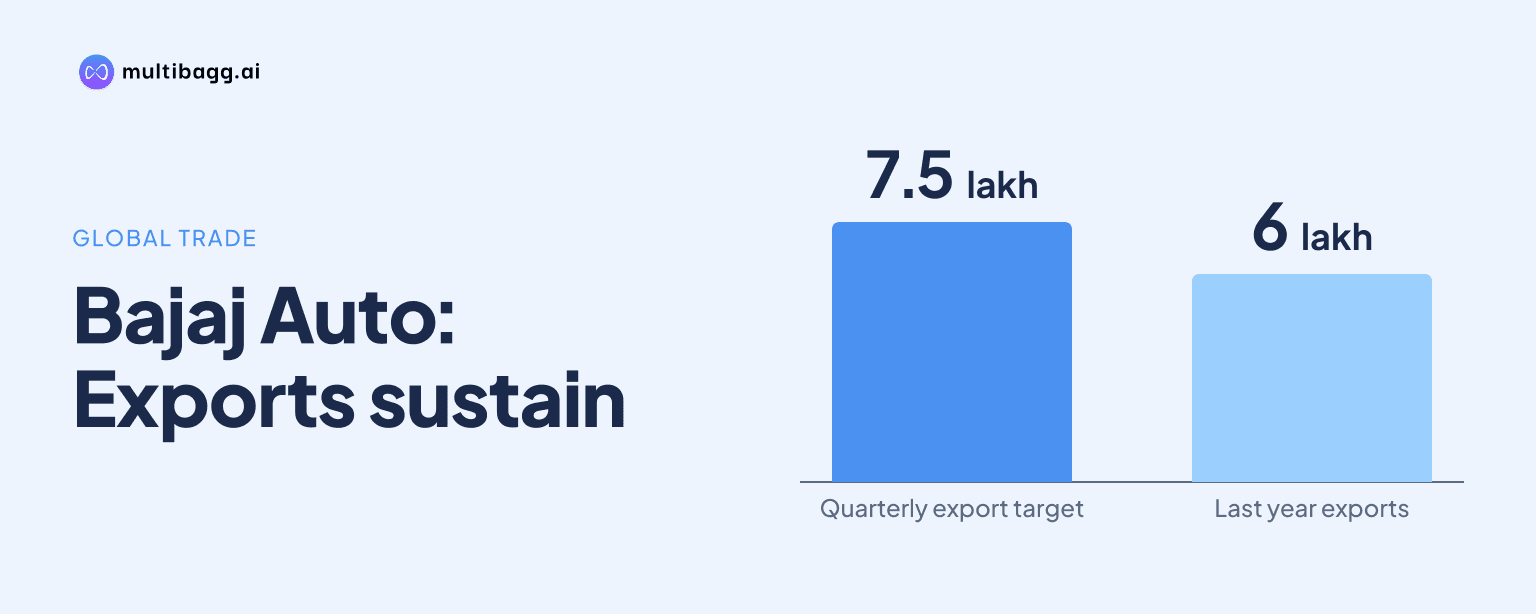
Bajaj Auto Limited expects to sustain quarterly exports of about 7.5 lakh units after its record 7.8 lakh-unit export volume in Q2 FY27, up 41% year on year. Management said the higher run rate reflects share gains across major regions and could be supported by new segments, countries and KTM-linked products.
Know Bajaj Auto inside out
Results, valuation, peers and who's buying, in one view.
Why does Bajaj Auto expect to sustain 7.5 lakh quarterly exports?
Bajaj Auto expects to sustain about 7.5 lakh export units per quarter, compared with about 6 lakh units per quarter last year. Q2 FY27 was its second consecutive quarter above 7 lakh units, despite management citing logistics complexity and capacity constraints in exports, electric vehicles and high-end motorcycles.
Management said it assesses exports mainly through absolute volume rather than a single international growth rate. Elections, financing conditions and economic developments can differ across countries, meaning the 7.5 lakh-unit objective is a run-rate target rather than percentage-growth guidance. The company also changed its export structure, elevating the business head to chief business officer level and appointing four presidents for Africa, Asia, Latin America and advanced markets.
Exports represented around 40% of Bajaj Auto’s revenue in Q2 FY27, while Africa reached new highs and Latin America continued its growth run. Management said the record quarter was broad-based, although it did not provide export revenue in Indian currency or regional unit volumes.
Which markets and products drove Bajaj Auto’s Q2 export record?
Bajaj Auto outgrew the market in Africa, Latin America and Asia in Q2 FY27, while its volume decline in the Middle East and North Africa was smaller than the regional industry decline. Management said these comparisons indicated market-share gains in almost all regions.
Nigeria remained Bajaj Auto’s largest overseas market, with retail sales at an average of 30,000 units a month in Q2 FY27 and a record market share of almost 60%. Management said that retail level was still only 60% of the prior peak. The Boxer 125 heavy-duty upgrade, introduced in Africa in early FY26, recorded export growth of more than 50% and helped the company outpace Africa’s motorcycle market.
In Latin America, Bajaj Auto’s exports in the sports segment of 150cc and above rose 50%. The company said it became number one in the S1 category, covering 150cc to 250cc motorcycles. In Asia, its 5% volume growth contrasted with a 7% industry decline, while its 24% decline in the Middle East and North Africa was narrower than the industry’s 29% fall.
Got a follow-up? Ask IRIS
How has Bajaj Auto’s export share changed in FY27?
Bajaj Auto increased its share of India’s two-wheeler exports to 48% in H1 FY27 from 44% in FY26, while its three-wheeler export share rose to 63% from 60%. Its two-wheeler exports grew 47% in H1, against 32% growth for Indian two-wheeler exports reported by the Society of Indian Automobile Manufacturers, or SIAM.
The comparison means Bajaj Auto’s two-wheeler exports grew at almost 1.5 times the wider Indian export market’s rate in H1 FY27. Management described the resulting share as nearly one in every two two-wheelers and two in every three three-wheelers exported from India carrying a Bajaj badge. These measures concern exports from India, not retail market share in each overseas country.
Three-wheeler exports crossed 1 lakh units in Q2 FY27 and grew 41% in H1. That export performance came alongside domestic three-wheeler sales of 1.62 lakh units in Q2, up 13% year on year. Management said the company is expanding overall capacity from 6.25 lakh units a month to about 7.75 lakh units a month over the next six to nine months because demand exceeds available capacity in selected products.
Bajaj Auto has also started exporting electric vehicles in small numbers to nearby markets including Nepal and Sri Lanka. Management said domestic demand remains the priority while electric-vehicle capacity is constrained, but it intends to consider more markets as capacity becomes available.
What could extend Bajaj Auto’s export growth beyond the current run rate?
Bajaj Auto identified four potential drivers beyond its current run rate: further market-share expansion, a new segment in existing non-African markets, new countries over two to three years, and more jointly developed KTM products made and exported from India. Management did not identify the new segment or countries, and did not disclose their expected volume contribution.
Management said Bajaj Auto’s positions in Africa, Latin America and other regions should support additional share gains. It also plans two new brands in FY27 covering parts of the 125cc to 250cc range in India and internationally. The company said the two brands together will address that range and complement the Pulsar portfolio, rather than necessarily each covering the full range.
KTM could provide an additional export route as its business stabilises, according to management. Bajaj Auto said joint-product work with KTM is expanding, and a more ambitious KTM top line could increase demand for jointly developed products manufactured and exported from India. Management described new countries and a larger KTM contribution as opportunities more likely 12 to 18 months away.
Currency and input costs remain variables for the export business. Bajaj Auto’s realised exchange rate was Rs 95.5 per US dollar in Q2 FY27, compared with Rs 94.4 in Q1 FY27 and Rs 87.1 in Q2 FY26. Management said October realisations had fallen below the Q2 level as the rupee moved near Rs 95 per US dollar, which could become a headwind if those levels persisted.
Conclusion
Bajaj Auto’s record 7.8 lakh export units in Q2 FY27, up 41% year on year, supports management’s assessment that exports have moved to a roughly 7.5 lakh-unit quarterly run rate. The rise in its share of India’s two-wheeler exports to 48% from 44%, and three-wheeler exports to 63% from 60%, provides measurable evidence of that shift even as regional demand trends differed.
The next developments to watch are the planned increase in monthly capacity from 6.25 lakh to about 7.75 lakh units within six to nine months, the FY27 launch of two new brands across the 125cc to 250cc range, and management’s proposed new export segment and countries. KTM-linked products, which management placed on a 12-to-18-month horizon, and currency realisations below Q2 FY27’s Rs 95.5 per US dollar are additional unresolved factors.