










Bajaj Auto Reports H1 FY27 Input Inflation Up to 8% of Revenue
Key highlights
- Bajaj Auto’s Q1 and Q2 FY27 input-cost ranges imply cumulative H1 inflation of 7% to 8% of revenue.
- Bajaj Auto said price increases recovered 50% to 60% of H1 FY27 input-cost inflation.
- Bajaj Auto reported Q2 EBITDA of Rs 4,172 crore and a sequentially unchanged EBITDA margin of 20.9%.
- Bajaj Auto took October price increases covering about 30% of estimated Q3 FY27 inflation.
powered by IRIS
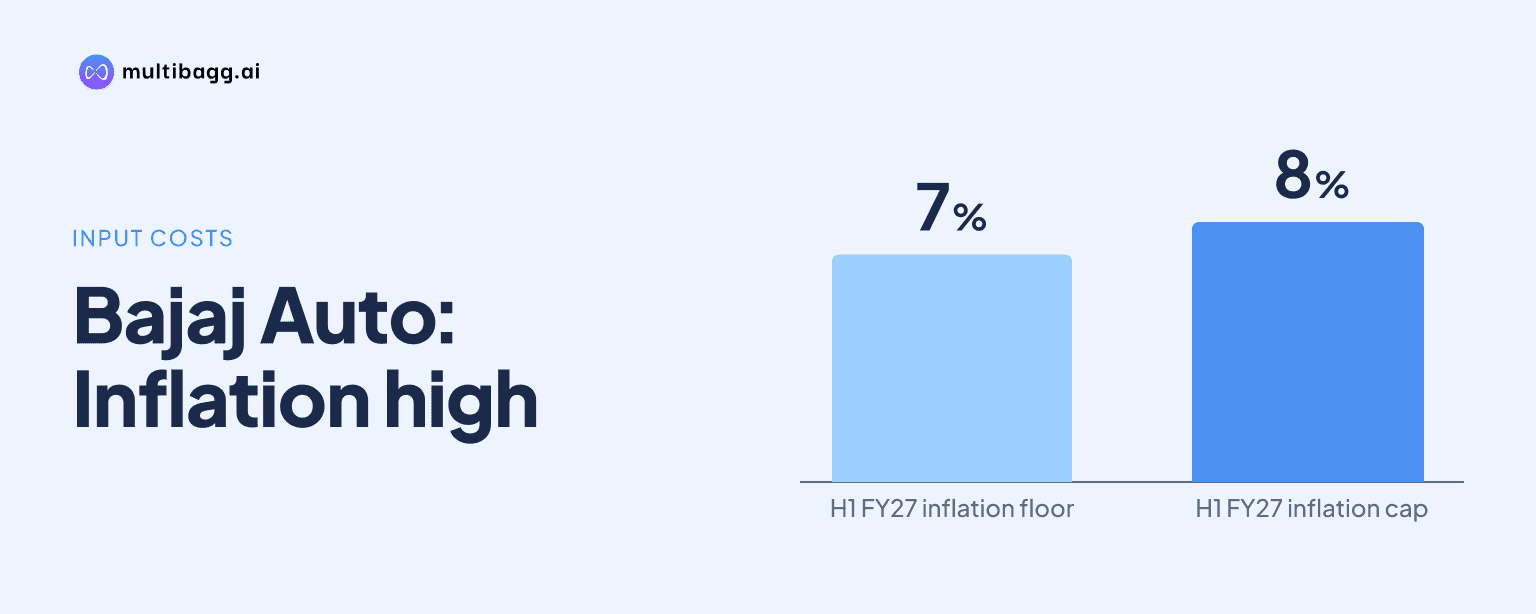
Bajaj Auto’s disclosed Q1 and Q2 ranges imply cumulative H1 FY27 input-cost inflation of 7% to 8% of revenue, while its Q2 EBITDA margin held at 20.9% after pricing covered 50% to 60% of the first-half impact. The pressure spanned metals, electrical components, proprietary parts and conversion charges.
Know Bajaj Auto inside out
Results, valuation, peers and who's buying, in one view.
What caused Bajaj Auto’s input-cost inflation in H1 FY27?
Bajaj Auto’s inflation was broad-based across conventional commodities, electrical components, proprietary parts and supplier conversion charges rather than being confined to one material. In Q2 FY27, electrical-component costs increased in the mid-teens, while proprietary parts and conversion charges rose by double digits. Aluminium, copper, nickel and natural rubber also recorded sequential rises ranging from high single digits to double digits, while steel prices began firming toward the end of Q2.
Bajaj Auto quantified the Q1 FY27 impact at 4% to 4.5% of revenue and the Q2 FY27 impact at a further 3% to 3.5% of revenue. The 7% to 8% H1 range is therefore calculated from the two quarterly ranges rather than disclosed by management as a separate half-year figure. Management described the scale of escalation as inflation that would typically be spread over many years.
The issue included supply availability as well as purchase costs. Bajaj Auto said its electric two-wheeler and three-wheeler businesses delivered only 75% of originally planned output in Q2 because of supply-chain and capacity constraints. Component availability, supplier capacity, shipping and logistics affected output even as quarterly volumes exceeded 15 lakh units.
How much of Bajaj Auto’s inflation did price increases recover?
Bajaj Auto said calibrated price increases covered about 50% to 60% of the H1 FY27 inflationary impact, leaving the balance to be addressed through currency realisation and cost optimisation. In the 100cc motorcycle segment, management said Bajaj Auto raised prices ahead of competitors to protect profitability, accepting the resulting effect on volumes.
Favourable exchange rates provided an important offset in Q2 FY27. Bajaj Auto’s realised exchange rate was Rs 95.5 per US dollar, compared with Rs 94.4 in Q1 FY27 and Rs 87.1 in the same quarter a year earlier. Management said that sequential and year-on-year rupee depreciation supported export realisations, while exports accounted for around 40% of quarterly revenue.
Pricing alone did not neutralise the cost increase. Bajaj Auto said the unpriced balance was largely offset by currency and internal cost actions, including scrutiny of discretionary spending. Currency gains depend on exchange-rate movements, whereas cost optimisation reflects operating actions rather than a permanent increase in vehicle prices.
Got a follow-up? Ask IRIS
How did Bajaj Auto hold its Q2 EBITDA margin at 20.9%?
Bajaj Auto held its Q2 FY27 EBITDA margin at 20.9% despite input inflation equal to 3% to 3.5% of revenue, aided by higher realisations, favourable currency, operating leverage and cost management. EBITDA means earnings before interest, tax, depreciation and amortisation. Q2 EBITDA reached Rs 4,172 crore, increasing 37% year on year against revenue growth of 34%.
The margin was unchanged sequentially and rose 40 basis points year on year, with one basis point equal to one hundredth of a percentage point. Bajaj Auto attributed the year-on-year increase principally to currency realisation and operating leverage. Management also said the growing electric two-wheeler business remained dilutive to overall enterprise margin, although the combined electric business was accretive to the domestic business in Q2.
Revenue scale helped absorb fixed and discretionary costs during the quarter. Revenue from operations surpassed Rs 20,000 crore, while profit after tax rose 35% year on year to Rs 3,354 crore. The revenue mix benefited from commercial vehicles, premium motorcycles, exports and electric vehicles, while domestic electric two-wheeler and three-wheeler revenue was about Rs 5,500 crore in H1 FY27.
What does Bajaj Auto expect for Q3 FY27 costs and pricing?
Bajaj Auto expects inflation to continue into a third consecutive quarter but did not provide a firm Q3 FY27 estimate because steel, copper and proprietary-part prices remain variable. Management said that if steel, copper and certain proprietary parts stayed elevated through the quarter, Q3 inflation could be a couple of percentage points.
Bajaj Auto took one price increase in the first week of October that covered about 30% of estimated Q3 inflation. Management said further pricing would depend on the market’s ability to absorb increases during the festive period and could differ by market, portfolio or model. It also said it would not raise prices solely to offset currency movements it regarded as short-term and potentially reversible.
Currency could be less supportive than it was in Q2 FY27. Management said October realisations were below the Q2 rate of Rs 95.5 per US dollar after Reserve Bank of India measures kept the rupee around Rs 95 per US dollar. If that level persisted, Bajaj Auto said it would create a headwind relative to the prior quarter and add to the variables affecting pricing and cost actions.
Conclusion
Bajaj Auto entered H2 FY27 after absorbing a calculated 7% to 8% revenue-equivalent input-cost shock in H1. It retained a 20.9% Q2 EBITDA margin through partial price recovery, favourable Q2 currency, higher volume and revenue scale, and cost controls rather than through pricing alone.
The next issue to watch is whether Q3 steel, copper and proprietary-part inflation approaches management’s indicated couple-of-percentage-points scenario, and whether the 30% October price cover is followed by further action. Bajaj Auto also plans to expand total monthly capacity from 6.25 lakh units to about 7.75 lakh units over the next six to nine months, targeting constraints in electric vehicles, high-end bikes and some three-wheeler subsegments.