










Bajaj Auto says EV margins lift domestic business profit
Key highlights
- Bajaj Auto said EV margins were accretive to domestic-business margin in Q2 but dilutive to the 20.9% enterprise EBITDA margin.
- Bajaj Auto exited Q2 at an 18% PLI accrual rate and expects that maximum rate to continue through H2.
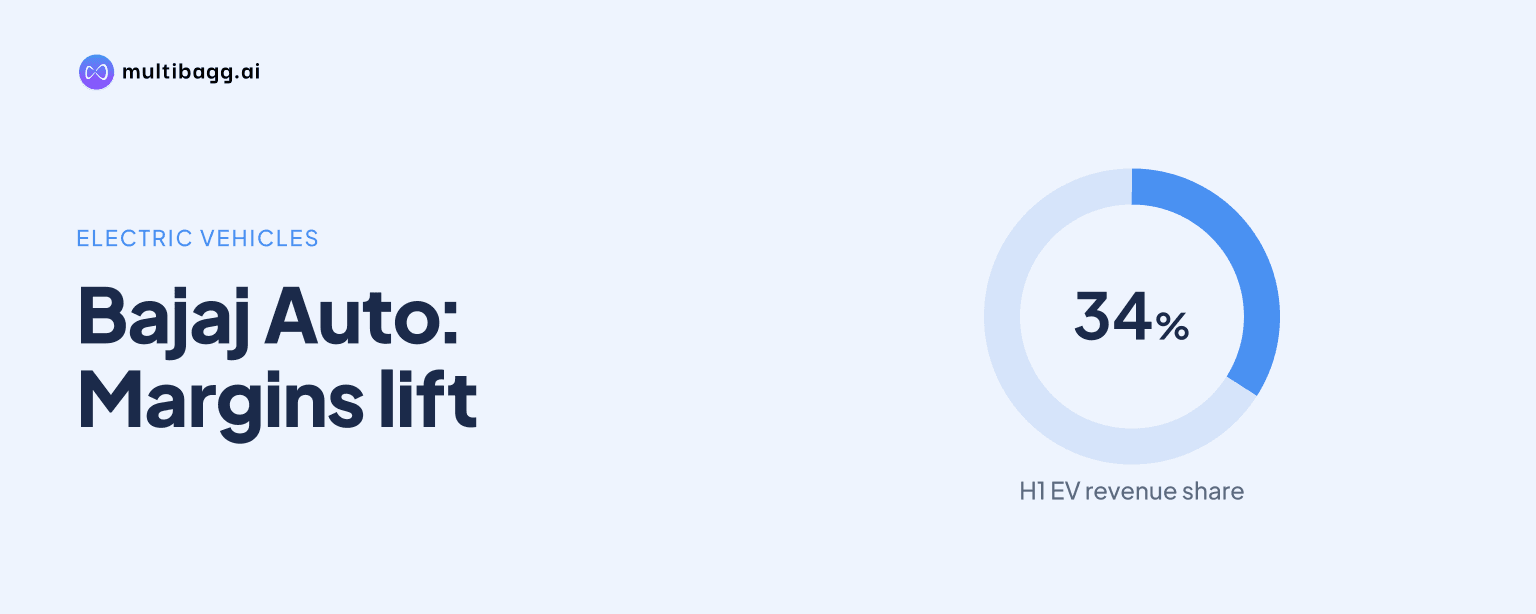
- Bajaj Auto reported H1 EV revenue of about Rs 5,500 crore, equal to roughly 34% of domestic revenue.
- Bajaj Auto said combined EV two-wheeler and three-wheeler volume approached 2 lakh units in Q2.
powered by IRIS
Bajaj Auto said in Q2 that its electric-vehicle business became accretive to domestic-business margin as production-linked incentive, or PLI, accruals reached the scheme’s maximum 18% rate. Bajaj Auto reported EV revenue of about Rs 5,500 crore in H1 and said its combined EV business maintained double-digit EBITDA margins.
Know Bajaj Auto inside out
Results, valuation, peers and who's buying, in one view.
Are Bajaj Auto’s EV margins now accretive?
Yes. Bajaj Auto management said its electric business was accretive to domestic-business margin in Q2, aided by a good EV quarter and PLI accruals at the highest available rate. Management drew a clear comparison boundary: the statement applies to the domestic business and not to the overall enterprise, whose Q2 EBITDA margin was 20.9%.
EVs remained dilutive to the enterprise margin because the group’s Q2 EBITDA margin was nearly 21%, Bajaj Auto said. Management did not disclose a blended EV margin or separate margins for electric two-wheelers and three-wheelers. It said electric three-wheelers generated double-digit EBITDA margins, while better Chetak unit economics helped the overall electric business retain double-digit EBITDA margins.
The scale of the EV portfolio makes that distinction material. Combined electric two-wheeler and three-wheeler volume approached 2 lakh units in Q2, more than doubling year on year. The portfolio contributed more than one-third of domestic revenue and over 20% of enterprise revenue, although Bajaj Auto said the electric two-wheeler mix continued to reduce the enterprise-wide margin.
How much PLI support is Bajaj Auto receiving?
Bajaj Auto exited Q2 with an 18% PLI accrual rate on eligible EV revenue, comprising a 16% base rate and a 2-percentage-point booster. Management said this was the scheme’s maximum applicable rate and expects it to remain in place for the second half. The booster followed the company crossing the scheme’s cumulative revenue threshold of Rs 10,000 crore.
The effective rate increased during the first half rather than beginning at 18%. Bajaj Auto said it started the year at about 15%, made up of a 13% base rate and the 2-percentage-point booster. As eligible revenues accumulated through Q1, the applicable base-rate slab rose, taking the rate to 18% by the end of Q2.
PLI was one of three factors behind higher other operating income in Q2. Bajaj Auto also cited export incentives from stronger export volumes and higher royalty income from Bajaj Genuine Oil. Management said export incentive rates range between 3% and 4% of export revenue, with the Q2 increase driven mainly by export scale rather than a significant rate change.
What does Bajaj Auto’s EV scale mean for earnings?
Bajaj Auto said EV revenue was about Rs 5,500 crore in H1, equal to roughly 34% of domestic revenue. That is a half-year figure, while management’s statement on margin accretion related specifically to Q2. The call did not disclose revenue separately for electric two-wheelers and electric three-wheelers.
The wider Q2 result provides the financial setting for the EV business. Revenue from operations exceeded Rs 20,000 crore, increasing 34% year on year, while EBITDA rose 37% to Rs 4,172 crore. Bajaj Auto said EBITDA grew faster than revenue and margin expanded 40 basis points year on year despite the dilutive mix effect of electric two-wheelers.
EV output did not fully meet Bajaj Auto’s original plans because of supply-chain and capacity limits. The company said electric two-wheeler and three-wheeler plans were delivered at only 75% of the original level. It also said capacity in EVs, premium motorcycles and some three-wheeler subsegments was under pressure.
Got a follow-up? Ask IRIS
Can Bajaj Auto sustain EV profits after PLI expires?
Bajaj Auto said it is working to offset at least a substantial part of PLI support through lower platform costs, but gave no quantified post-PLI margin target. Management said the scheme under its current terms ends on 31 March 2028. Whether it is extended or replaced is an external matter, management said.
The company said its research and development pipeline includes milestones intended to create the next round of electric-product cost savings. Those efforts concern platform costs and are meant to address the known eventual expiry of the incentive. Bajaj Auto did not specify the value or timing of those expected savings.
Pricing could also affect profitability after 31 March 2028, but management did not commit to using it to replace PLI. It said pricing in a post-PLI market would depend on the wider competitive set. Bajaj Auto therefore identified cost reductions as an active internal programme, while treating future market pricing as uncertain.
Why does the 18% PLI rate matter to Bajaj Auto’s domestic margin?
The 18% rate matters because it coincided with the Q2 in which Bajaj Auto said EV margin became accretive to the domestic business. Management described PLI as a contributor to the improvement, rather than its sole cause. EV scale, Chetak’s improving unit economics and double-digit electric three-wheeler margins were the other stated factors.
The incentive benefit arrived during a period of substantial cost inflation. Bajaj Auto said commodity and other input-cost inflation was about 3% to 3.5% of revenue in Q2, following roughly 4% to 4.5% in Q1. Pricing covered 50% to 60% of the cumulative first-half impact, with favourable currency realisation and cost optimisation offsetting much of the remainder.
For Q3, management said it took pricing in early October that covered about 30% of estimated inflation, assuming steel, copper and selected proprietary-part costs persisted through the quarter. It did not provide a full Q3 inflation figure because input costs remained volatile. Currency realisation was also lower in October than the Q2 realised rate of Rs 95.5 per US dollar, according to management.
Conclusion
Bajaj Auto’s Q2 disclosure shows that EV profitability had moved beyond double-digit EBITDA to a level accretive to its domestic business margin. That result combined EV volume nearing 2 lakh units, H1 EV revenue of about Rs 5,500 crore, improving Chetak economics, electric three-wheeler margins and PLI accruals at 18%, while EVs still diluted the 20.9% enterprise EBITDA margin.
The next measures to watch are the expected 18% PLI rate in H2, resolution of EV supply and capacity constraints, and the expansion of overall capacity from 6.25 lakh units to about 7.75 lakh units a month over the next six to nine months. Longer term, Bajaj Auto’s stated platform-cost programme ahead of the current PLI scheme’s 31 March 2028 expiry remains the key disclosed plan for mitigating the incentive’s eventual loss.