










Bajaj Steel Industries Limited exports fell 39% to Rs 158 crore
Key highlights
- Bajaj Steel’s cotton-machinery export revenue fell to Rs 158 crore in FY26 from Rs 260 crore in FY23.
- Cotton Processing Machinery Division revenue declined to Rs 309 crore in FY26 from Rs 385 crore in FY25.
- Bajaj Steel reported a Rs 350 crore cotton-machinery order book as of November 6, 2026.
- Cotton machinery contributed Rs 158 crore of the Rs 215 crore export revenue across four disclosed divisions in FY26.
powered by IRIS
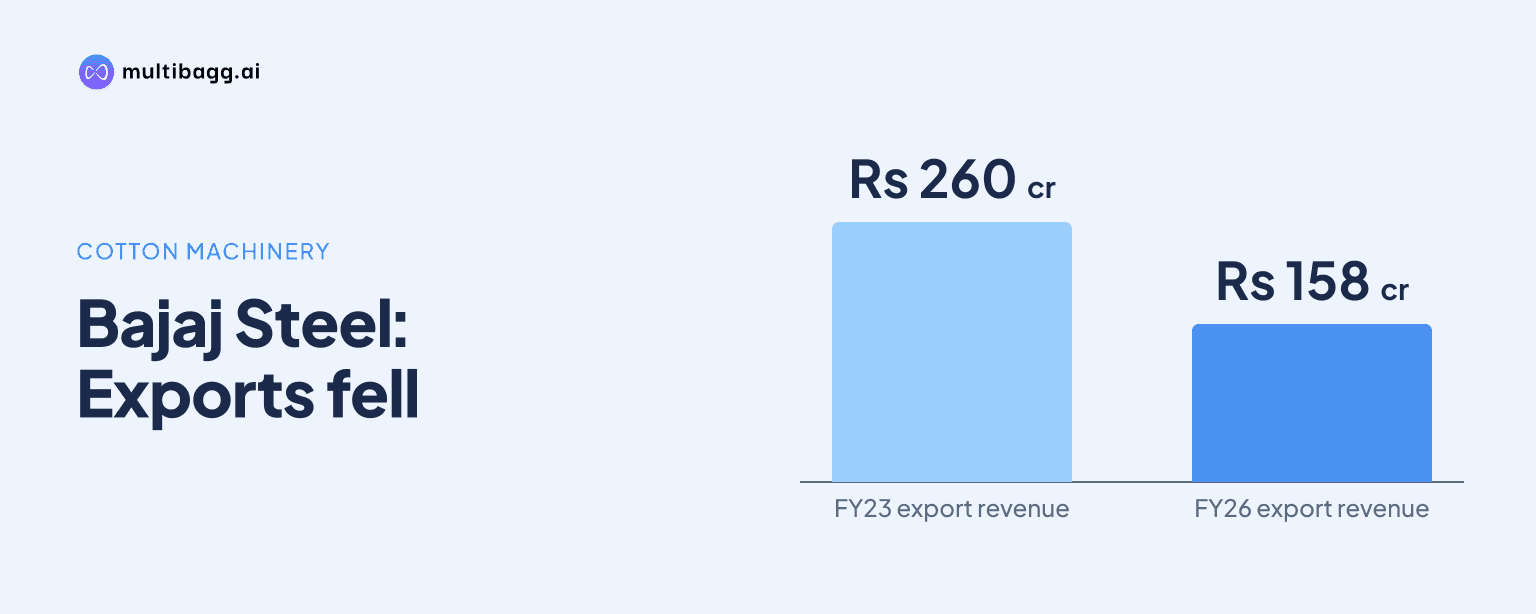
Bajaj Steel reported Rs 158 crore of cotton-processing machinery export revenue in FY26, down 39% from Rs 260 crore in FY23, while the division’s total revenue declined to Rs 309 crore. Bajaj Steel also reported a Rs 350 crore order book for the division as of November 6, 2026.
Know Bajaj Steel Industries inside out
Results, valuation, peers and who's buying, in one view.
Why did Bajaj Steel’s cotton-machinery exports fall in FY26?
The presentation does not state why Bajaj Steel’s cotton-machinery exports fell in FY26. Export revenue was Rs 158 crore, down Rs 99 crore from Rs 257 crore in FY25 and Rs 119 crore from the FY24 high of Rs 277 crore. The FY26 figure was Rs 102 crore below the Rs 260 crore reported in FY23.
Domestic revenue increased to Rs 151 crore in FY26 from Rs 128 crore in FY25, but remained below Rs 164 crore in FY23. Total Cotton Processing Machinery Division revenue therefore declined for a third consecutive year, from Rs 424 crore in FY23 to Rs 393 crore in FY24, Rs 385 crore in FY25 and Rs 309 crore in FY26. The presentation does not identify whether volume, pricing, product mix or project timing caused the change.
Exports accounted for about 51% of the division’s FY26 revenue, compared with about 61% in FY23, based on the disclosed segment rows. The Rs 23 crore domestic revenue increase in FY26 did not offset the Rs 99 crore year-on-year export reduction. Bajaj Steel describes the division as deriving more than 50% of revenue from exports and operating in more than 60 countries.
How does Bajaj Steel’s export trend compare with other divisions?
Bajaj Steel’s Cotton Processing Machinery Division remained its largest disclosed exporter in FY26 at Rs 158 crore, despite the year-on-year fall. Electrical Panel Division export revenue was unchanged at Rs 40 crore in FY25 and FY26, Infrastructure Division exports increased to Rs 11 crore from Rs 10 crore, and Heavy Engineering Division exports declined to Rs 6 crore from Rs 10 crore.
The four disclosed divisions generated Rs 215 crore of export revenue in FY26, with cotton machinery contributing about 73%. Cotton machinery’s Rs 99 crore export decline was substantially larger than the Rs 5 crore combined change across Infrastructure and Heavy Engineering. Electrical Panel Division total revenue rose to Rs 57 crore from Rs 54 crore, while cotton machinery revenue declined by Rs 76 crore.
Infrastructure Division revenue increased to Rs 113 crore in FY26 from Rs 86 crore in FY25, including Rs 102 crore of domestic revenue. Heavy Engineering Division revenue fell to Rs 33 crore from Rs 42 crore. Cotton machinery still generated Rs 309 crore in FY26, more than the other three disclosed divisions, but it recorded the largest absolute revenue decline.
Got a follow-up? Ask IRIS
What cotton-machinery capabilities does Bajaj Steel report?
Bajaj Steel says it has about 35% to 40% global market share and 50% domestic market share in cotton machinery, although the presentation does not provide a market-size calculation or third-party support for those claims. It also says the Ministry of Textiles awarded it the status of India’s largest and most modern cotton ginning machinery maker. These positioning statements do not explain the FY26 export decline.
The division says it offers four ginning technologies: single roller, double roller, saw-ginning and roto-bar ginning. Bajaj Steel acquired Continental Eagle in the United States in 2012, adding saw-ginning and roto-bar technologies. Its custom-built machines can handle up to 200 bales per hour, which the presentation describes as the highest global capacity.
The portfolio includes double-roller ginning machines, saw gins with feeders, IMPCO delinting equipment, and 9300 and 9500 bale presses with capacities ranging from 45 to 90 bales per hour. Bajaj Steel reports four wholly owned subsidiaries: one in the United States, one in Uganda and two in Brazil. The presentation lists customers including SODECOTON, NIBE India and Olam Agri.
What does Bajaj Steel’s Rs 350 crore order book show?
Bajaj Steel reported a Rs 350 crore Cotton Processing Machinery Division order book as of November 6, 2026, exceeding its FY26 divisional revenue of Rs 309 crore by Rs 41 crore. The disclosed backlog provides a measure of orders on hand, but it does not establish the period in which revenue will be recognised.
The presentation does not disclose the order book’s domestic and export split, product mix, customer allocation, cancellation terms or margins. That missing export split is material to the reported trend because cotton-machinery export revenue fell from Rs 257 crore in FY25 to Rs 158 crore in FY26. Bajaj Steel has not stated how much of the Rs 350 crore backlog relates to its more than 60-country international presence.
Cotton machinery had the largest order book among the four divisions disclosed on November 6, 2026. Infrastructure reported Rs 83 crore, Heavy Engineering reported Rs 67 crore and Electrical Panel reported Rs 50 crore. The combined order book was Rs 550 crore, of which the cotton-machinery division represented about 64%.
What financial figures accompanied the export decline?
Bajaj Steel reported net worth of Rs 424 crore in FY26, compared with Rs 387 crore in FY25 and Rs 207 crore in FY22. Cash flow from operations was Rs 78 crore in FY26, up from Rs 52 crore in FY25 and Rs 55 crore in FY24. The presentation does not link these company-level figures specifically to the Cotton Processing Machinery Division.
Net debt to equity was negative 0.1 times in FY26, unchanged from FY25, while total outside liabilities to tangible net worth were 0.7 times, compared with 0.6 times in FY25. Bajaj Steel also reported Rs 194 crore of bank loan facilities rated in March 2025, enhanced from Rs 158 crore, with CRISIL A/Stable long-term and CRISIL A1 short-term ratings.
Conclusion
Bajaj Steel’s FY26 segment data show that a Rs 99 crore year-on-year reduction in cotton-machinery exports outweighed a Rs 23 crore rise in domestic revenue. The division remained the largest disclosed business by revenue and the largest contributor to the four divisions’ Rs 215 crore of FY26 export revenue, but its export mix narrowed from the FY23 level.
The next disclosed marker is the Rs 350 crore cotton-machinery order book as of November 6, 2026. What to watch next is whether Bajaj Steel discloses the execution timing and export share of that backlog, and whether later segment revenue shows conversion after the FY24-to-FY26 export decline.