










Bajaj Steel infrastructure revenue rose to Rs 113 crore in FY26
Key highlights
- Bajaj Steel Infrastructure Division revenue rose from Rs 86 crore in FY25 to Rs 113 crore in FY26.
- Domestic Infrastructure Division revenue increased by Rs 26 crore to Rs 102 crore in FY26.
- Bajaj Steel reported an Infrastructure Division order book of Rs 83 crore as of November 6, 2026.
- The Infrastructure Division has completed more than 600 projects and has annual capacity of 35,000 metric tonnes.
powered by IRIS
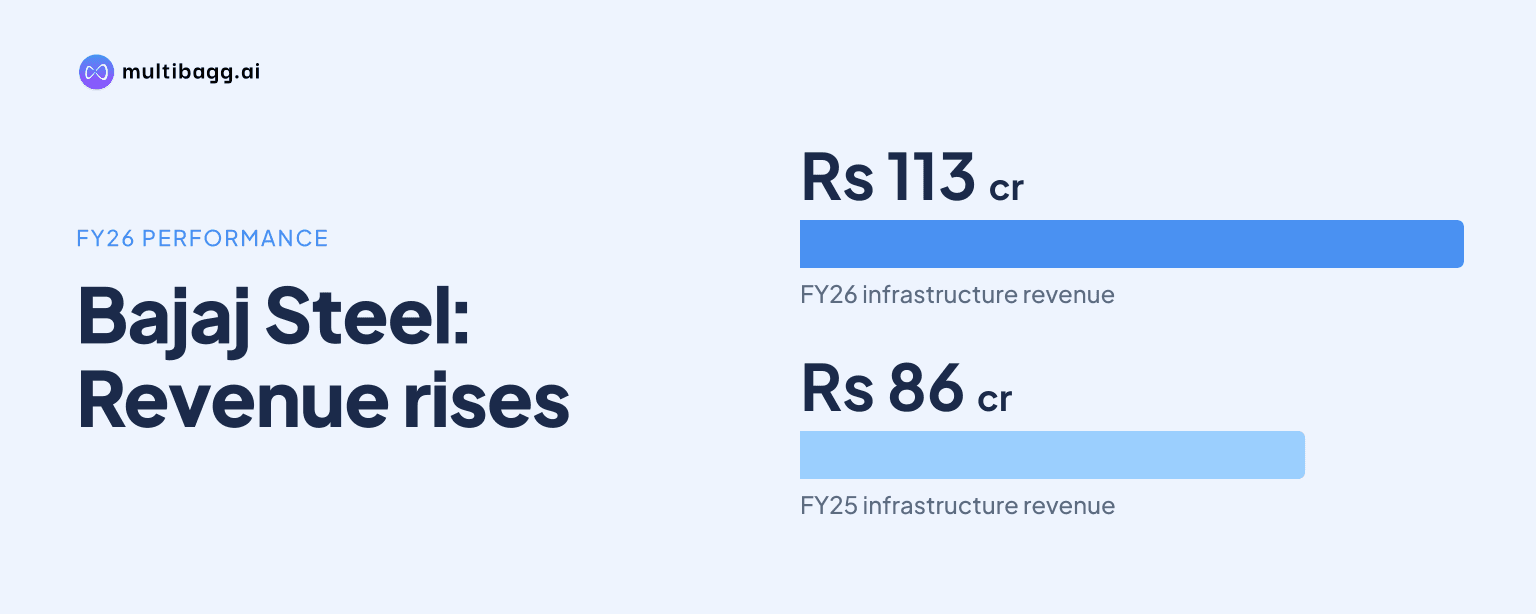
Bajaj Steel Industries Limited (Bajaj Steel) reported Infrastructure Division revenue of Indian rupees (Rs) 113 crore in financial year 2026 (FY26), up Rs 27 crore from FY25, and an Rs 83 crore order book as of November 6, 2026. The division had completed more than 600 projects and has annual capacity of 35,000 metric tonnes.
Know Bajaj Steel Industries inside out
Results, valuation, peers and who's buying, in one view.
What was Bajaj Steel Infrastructure Division’s FY26 revenue?
Bajaj Steel’s Infrastructure Division generated total revenue of Rs 113 crore in FY26, compared with Rs 86 crore in FY25, Rs 89 crore in FY24 and Rs 82 crore in FY23. FY26 was the highest revenue figure in the four financial years disclosed, and was Rs 31 crore above the FY23 level.
Domestic infrastructure revenue rose to Rs 102 crore in FY26 from Rs 76 crore in FY25, contributing Rs 26 crore of the Rs 27 crore increase in total divisional revenue. Export revenue was Rs 11 crore in FY26, compared with Rs 10 crore in FY25; the presentation did not show export revenue for FY23 and listed Rs 7 crore for FY24.
The divisional increase came as Bajaj Steel’s consolidated revenue from operations fell to Rs 524.2 crore in FY26 from Rs 584.8 crore in FY25. The comparison shows that Infrastructure Division revenue moved differently from consolidated revenue during FY26, while the presentation does not disclose divisional profit or margin figures.
What does Bajaj Steel’s Infrastructure Division supply?
Bajaj Steel’s Infrastructure Division designs, fabricates and erects pre-engineered buildings, industrial sheds, warehouses, K-Houses and solar mounting structures. The presentation states that its structures are designed to Indian seismic and wind-load codes and American Institute of Steel Construction (AISC) codes.
The division also executes turnkey engineering, procurement and construction (EPC) projects. Bajaj Steel identifies Indian Oil Corporation Ltd., Maharashtra State Warehousing Corporation, Nuclear Fuel Complex and Maha-Metro among EPC clients, while Apollo International Group is also listed in its client base. The presentation gives no contract values for individual customers or assignments.
The listed project categories include automotive showrooms, industrial sheds, commercial buildings and cotton ginning plants. Bajaj Steel says the division has completed more than 600 projects, which is a cumulative total rather than a measure of FY26 project completions.
Which projects demonstrate Bajaj Steel’s execution record?
Bajaj Steel completed a turnkey Nuclear Fuel Complex project in Hyderabad in 2022 involving a 40-metre clear-span structure, four cranes, a walkway and an extension linked to an existing shed. The work also included civil works, infrastructure, fire-fighting systems and the pre-engineered-building structure.
A logistics warehouse completed at Kalameshwar, Nagpur, in 2023 covered 150,000 square feet and had a 12-metre clear height, continuous ridge ventilation and insulation. An industrial shed completed in Shendra, Aurangabad, in 2022 was nearly 120,000 square feet and included a crane in each bay for electrical-panel manufacturing.
The project list also records an indoor stadium completed at Deoli, Wardha, in 2016, with a 62-metre clear span, civil works and seating for 3,000 people. A 2024 industrial shed in Chhatrapati Sambhajinagar measured 80,000 square feet, while a warehouse project in Belwadi, Kolhapur, is listed with 3,000-metric-tonne capacity but no completion year.
Got a follow-up? Ask IRIS
How does Bajaj Steel infrastructure revenue compare with other divisions?
Bajaj Steel’s Infrastructure Division was the second-largest reported division by FY26 revenue among the business-segment pages, at Rs 113 crore. Cotton Processing Machinery reported Rs 309 crore, followed by Electrical Panels at Rs 57 crore, Heavy Engineering at Rs 33 crore and Other Products at Rs 12 crore.
The FY26 comparison shows varied segment movements from FY25. Cotton Processing Machinery revenue declined from Rs 385 crore to Rs 309 crore, while Infrastructure rose from Rs 86 crore to Rs 113 crore and Electrical Panels increased from Rs 54 crore to Rs 57 crore. Heavy Engineering declined from Rs 42 crore to Rs 33 crore, and Other Products declined from Rs 19 crore to Rs 12 crore.
Bajaj Steel lists six manufacturing facilities across 100,000 square metres. Its 24,000-square-metre G6-G7 facility in Hingna, Nagpur, serves both Cotton Processing Machinery and pre-engineered buildings, while the Infrastructure Division has stated capacity of 35,000 metric tonnes per annum.
What does Bajaj Steel’s Rs 83 crore infrastructure order book show?
Bajaj Steel reported an Infrastructure Division order book of Rs 83 crore as of November 6, 2026. The presentation identifies work on hand at that date, but does not specify the projects in the order book, their expected completion dates, revenue-recognition timing or margins.
Infrastructure’s Rs 83 crore order book was below Cotton Processing Machinery’s Rs 350 crore and above Heavy Engineering’s Rs 67 crore, Electrical Panels’ Rs 50 crore and Other Products’ Rs 10 crore. Each of these divisional order-book figures was reported as of November 6, 2026, allowing a like-for-like comparison by date.
The Infrastructure Division order book was Rs 30 crore below its FY26 revenue, although the two figures measure different periods. Revenue represents a completed financial year, while the order book is a point-in-time measure; Bajaj Steel provides no divisional revenue target, capacity-expansion plan or management forecast in the presentation.
Conclusion
The reported figures show that Infrastructure became a larger contributor to Bajaj Steel’s FY26 segment mix as domestic revenue increased by Rs 26 crore and exports rose by Rs 1 crore. The division’s activities cover fabrication and erection alongside turnkey work, with disclosed examples ranging from a 62-metre-span stadium to a 150,000-square-foot logistics warehouse.
The next disclosed item to watch is execution of the Rs 83 crore order book reported on November 6, 2026, particularly because Bajaj Steel provides no project delivery schedule or division-level profitability data. The presentation also leaves unresolved how much of the division’s 35,000-metric-tonne annual capacity will be used for future work.